

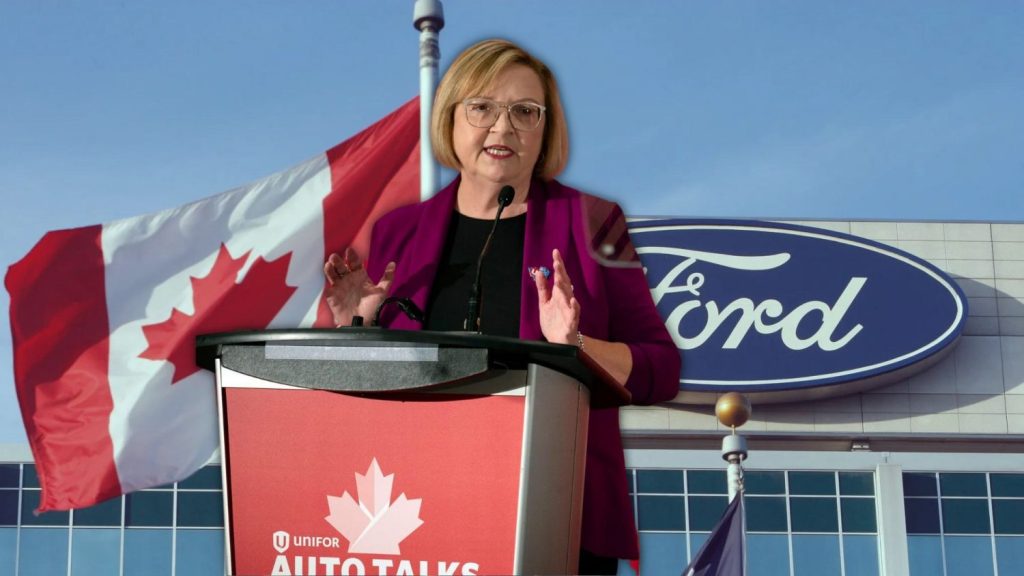
Negotiations between Unifor and Ford Motor Company have officially begun in Toronto, launching what union leaders are calling one of the most important rounds of bargaining in decades as uncertainty surrounding tariffs, investments and jobs casts a shadow over Canada’s auto industry.
The talks, which opened Monday at the Sheraton Centre in Toronto, involve more than 5,100 unionized Ford workers across Canada. The outcome is expected to establish the pattern agreement that will serve as the blueprint for subsequent negotiations with General Motors and Stellantis, the other members of Detroit’s Big Three automakers.
Unifor selected Ford as its first bargaining target, citing the company’s long-standing commitment to Canadian manufacturing and a constructive relationship between the two sides. National President Lana Payne described the negotiations as taking place at a critical moment for workers and the industry, as the effects of U.S. tariffs and trade tensions continue to create uncertainty for manufacturers and employees alike.
The union has set a July 10 deadline to reach a tentative agreement and says its priorities include wage increases, income security, pensions, benefits and improvements to workplace conditions. Union leaders also hope the agreement will provide greater stability for workers facing mounting concerns about the future of automotive production in Canada.
The negotiations come amid growing anxiety over reports that General Motors’ Oshawa Assembly plant could lose production of light-duty Chevrolet Silverado trucks later this year, a move that would have significant implications for employment and investment in Ontario. While GM has denied any plans to reduce production, speculation has heightened concerns throughout the sector.
John D’Agnolo, chair of Unifor’s Ford Master Bargaining Committee, said workers cannot afford to wait and hope that economic conditions improve. Instead, he emphasized the importance of securing a strong agreement that provides certainty for employees and their families during a period of industrial upheaval.
The talks are unfolding against a backdrop of global competition, evolving technologies and changing trade relationships that are reshaping the automotive landscape. Decisions made in the coming weeks are expected to influence investment strategies and production plans for years to come.
With negotiations at Ford now underway and similar discussions with General Motors and Stellantis expected to follow, the next few weeks could prove pivotal not only for thousands of autoworkers but also for the future of Canada’s automotive industry, a sector that remains a cornerstone of the country’s manufacturing economy.