

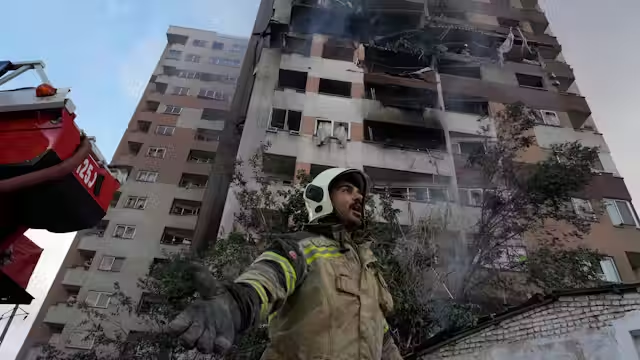
A dramatic escalation in Middle East tensions unfolded early Friday as Israel launched a sweeping wave of airstrikes against Iran, targeting nuclear and missile facilities and killing some of Tehran’s top military commanders. In what is being described as one of the most significant attacks Iran has faced since its war with Iraq in the 1980s, Israel said the operation was a preemptive measure against what it called a clear and present nuclear threat.
Iran responded with a swarm of over 100 drones, some of which flew over Iraqi and Jordanian airspace en route to Israel. Israeli forces claimed most were intercepted before reaching their destination, though the full impact remains unclear. The strikes on Iranian territory reportedly involved about 200 Israeli aircraft and covert drone operations launched from within Iran, according to two unnamed security officials. These included drones positioned near Tehran and precision weapons smuggled into the country and activated remotely.
Among the casualties were three of Iran’s most senior military leaders: Gen. Mohammad Bagheri, who oversaw the armed forces; Gen. Hossein Salami, commander of the Revolutionary Guard; and Gen. Amir Ali Hajizadeh, the head of Iran’s ballistic missile program. Supreme Leader Ayatollah Ali Khamenei confirmed their deaths and vowed “severe punishment” in response, while accusing Israel of striking residential centers and revealing its “malicious nature.”
Israeli Prime Minister Benjamin Netanyahu defended the attack, saying it was necessary to halt Iran’s nuclear ambitions and safeguard Israel’s existence. He argued that Iran’s program was progressing dangerously and emphasized that Israel was prepared to continue operations as long as needed. “This is a clear and present danger to Israel’s very survival,” Netanyahu said. In a separate message directed at the Iranian people, he claimed the fight was not against them, but against what he called the “brutal dictatorship” in Tehran, expressing hope that this would accelerate the regime’s downfall.
The fallout has sent shockwaves across the globe. In Washington, President Donald Trump issued a warning on his Truth Social platform, calling on Iran to negotiate or risk further devastation. He stated bluntly, “No more death, no more destruction, JUST DO IT, BEFORE IT IS TOO LATE.” Though Trump denied any U.S. involvement, his administration had quietly pulled some diplomats from Baghdad earlier in the week and advised caution across U.S. military bases in the region.
U.S. Secretary of State Marco Rubio confirmed that Israel acted unilaterally and emphasized that the White House’s top priority is the protection of American personnel in the region. Meanwhile, embassies and institutions throughout the Middle East have gone on high alert. In Jerusalem, air raid sirens rang out and supermarket shelves were cleared by anxious residents. In Iran, museums were closed and artifacts moved into secure vaults as fears of further strikes mounted.
This latest round of violence follows weeks of increasing tension over Iran’s nuclear enrichment activities. On Thursday, the International Atomic Energy Agency (IAEA) Board of Governors officially censured Iran for its lack of cooperation, prompting Tehran to announce it would begin constructing a third enrichment site using advanced centrifuges. While Iran continues to insist its nuclear program is peaceful, the IAEA confirmed that its Natanz facility—one of the main enrichment sites—was hit in the Israeli attack.
The strike itself pushed Israel’s military resources to their limits, requiring older air-to-air refueling aircraft and possibly launching standoff missiles from outside Iranian airspace. Residents in Iraq reported hearing fighter jets overhead during the operation.
Hezbollah, Iran’s close ally in Lebanon, issued a statement condemning the Israeli strikes and offering condolences, but notably did not threaten retaliation or signal immediate involvement—likely due to the severe losses it suffered in its last conflict with Israel in 2024.
As Israel’s war in Gaza drags into its 21st month, critics suggest the timing of this operation may serve to deflect domestic scrutiny. While there is general public consensus in Israel about the threat posed by Iran, prolonged reprisals or civilian casualties could quickly shift public opinion.
Global leaders have urgently called for restraint. Yet as the dust settles from this dramatic and deadly exchange, the risk of further escalation looms—and the prospect of all-out war between two of the Middle East’s most formidable powers feels closer than ever.