

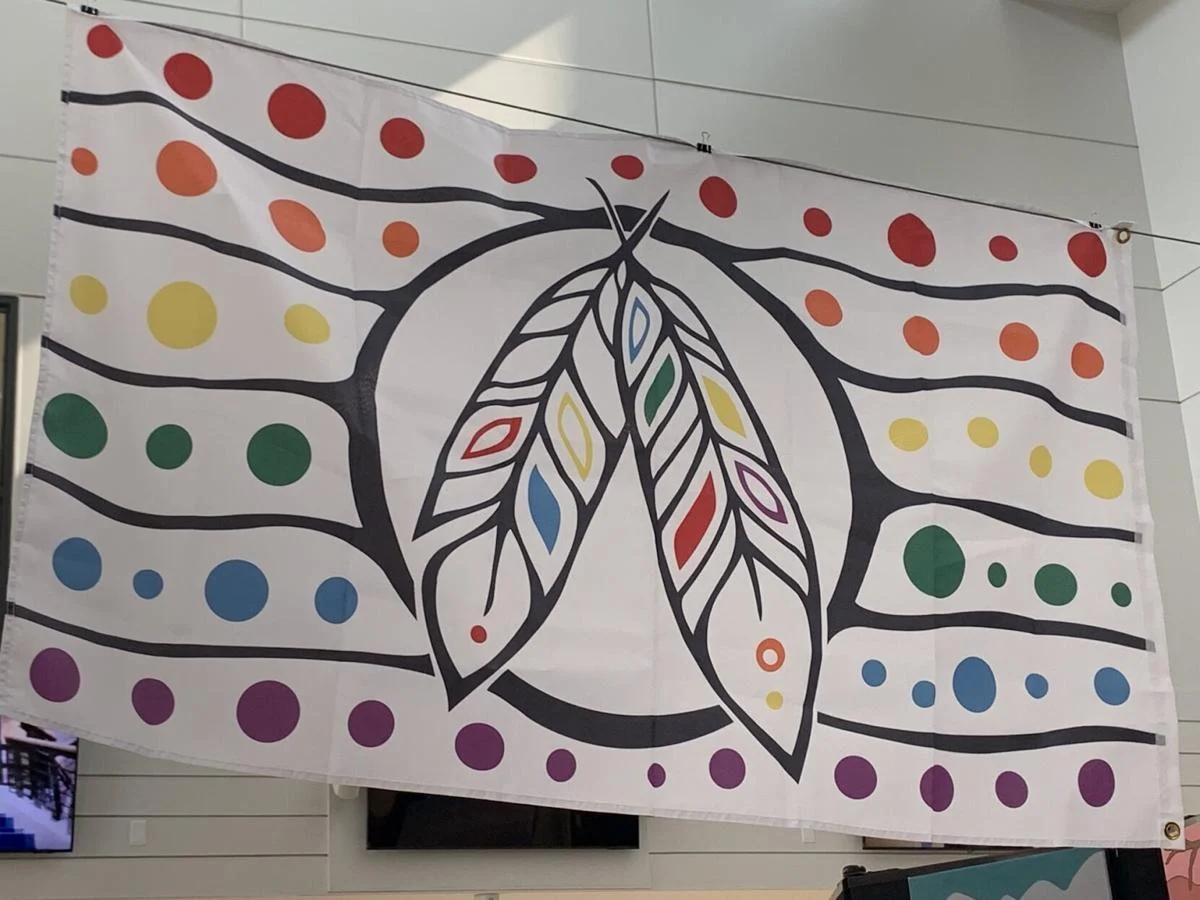
A historic symbol of inclusion and cultural pride is now flying across Ontario. Earlier this year, the first-ever two-spirit Pride flag in Canada was unveiled—designed by Ojibwe artist Patrick Hunter to honour the 35th anniversary of the term “two-spirit,” a word rooted in Indigenous tradition to describe individuals who embody both masculine and feminine traits.
Hunter’s creation is more than just a banner—it’s a deeply meaningful piece of art. Drawing from the traditional Pride rainbow, the flag is “Indigenized” through the inclusion of two feathers placed above a sun, representing the feminine and masculine energies that two-spirit people balance as they walk between both worlds. “Representation really does matter,” said Hunter in a video shared during the unveiling ceremony. “The Pride flag itself is so beautiful, and I knew I wanted to incorporate those colours in an Indigenized view.”
He explained that the two-spirit journey is about harmony and duality—two perspectives coexisting and guiding the spirit. “We walk Turtle Island with these two perspectives at all times,” he said in a press release from Day of Pink. “And if they are in harmony, we can achieve anything.”
The launch of the two-spirit flag marks an important milestone in Canada’s evolving conversation around identity, inclusion, and Indigenous recognition within the broader 2SLGBTQIA+ community. And while many Ontarians are familiar with the traditional rainbow flag, few realize the symbolism behind each vibrant hue: red for life, orange for healing, yellow for sunlight, green for nature, blue for serenity, and purple for the spirit. The rainbow, first designed by Gilbert Baker in 1978, was always meant to represent the vast spectrum of humanity.
Since then, new flags have been introduced to represent diverse identities within the Pride community. In 1999, Monica Helms created the transgender flag, blending white, baby blue, and baby pink. In 2021, Valentino Vecchietti introduced the intersex-inclusive Pride flag, combining traditional and trans colours with black and brown for diversity and a yellow field with a purple circle to include the intersex community. Its chevron shape points rightward to symbolize forward momentum.
As of 2024, this intersex-inclusive flag has been adopted as the official Pride flag of the federal public service in Canada. But the introduction of a dedicated two-spirit flag—created by an Indigenous artist—adds another powerful layer to that expanding visual vocabulary, ensuring Indigenous identities are visibly included in the celebration of Pride.
As Pride Month unfolds across Ontario, the new two-spirit flag is more than a banner—it is a statement of visibility, honour, and healing for a community long overlooked. It’s a reminder that true progress means embracing all identities, especially those rooted in the sacred traditions of the land we share.