

In just over 100 days, the United States will co-host the 2026 FIFA World Cup — a tournament Iran have already qualified for. But following U.S. military action against Iran and escalating conflict in the Middle East, fresh uncertainty now surrounds what was already shaping up to be one of the most politically charged World Cups in recent memory.
Iran are scheduled to face New Zealand and Belgium in Los Angeles before taking on Egypt in Seattle. It would mark their fourth consecutive World Cup appearance. However, after the killing of Iran’s Supreme Leader, Ayatollah Ali Khamenei, and amid major political upheaval at home, questions have emerged over whether the team will ultimately take part.
The head of Iran’s football federation has reportedly cast doubt on participation, suggesting that recent events make it difficult to look ahead to the tournament. At the same time, with the country’s political leadership in flux and uncertainty over who would make such a decision, predicting Iran’s course of action remains difficult.
FIFA, world football’s governing body, has said it is monitoring developments but privately expects Iran to compete. FIFA Secretary General Mattias Grafström stated that the focus remains on delivering a safe tournament with all qualified teams participating. If Iran were to withdraw or be unable to attend, speculation has arisen that another team from the Asian Football Confederation could be invited as a replacement, though no formal discussions have been announced.
Beyond participation, security concerns are growing. U.S. President Donald Trump previously signed an executive order restricting entry to nationals from several countries, including Iran, though exemptions apply to World Cup players and coaching staff. If Iran competes, their matches — particularly in Los Angeles, home to one of the largest Iranian diaspora communities in the world — are likely to draw heightened security scrutiny.
Iran’s games at the 2022 World Cup in Qatar took place amid mass anti-government protests back home, with visible tensions among supporters inside stadiums. With Trump openly supporting regime change in Iran and the conflict intensifying, similar scenes of protest or political demonstration could emerge at this summer’s tournament.
The broader geopolitical environment is also adding complexity. The conflict erupted as U.S. host cities were already warning of funding challenges for tournament security amid a partial government shutdown. Concerns have also been raised over immigration enforcement policies, cartel-related violence in co-host Mexico, and strained trade relations between the United States and co-host Canada.
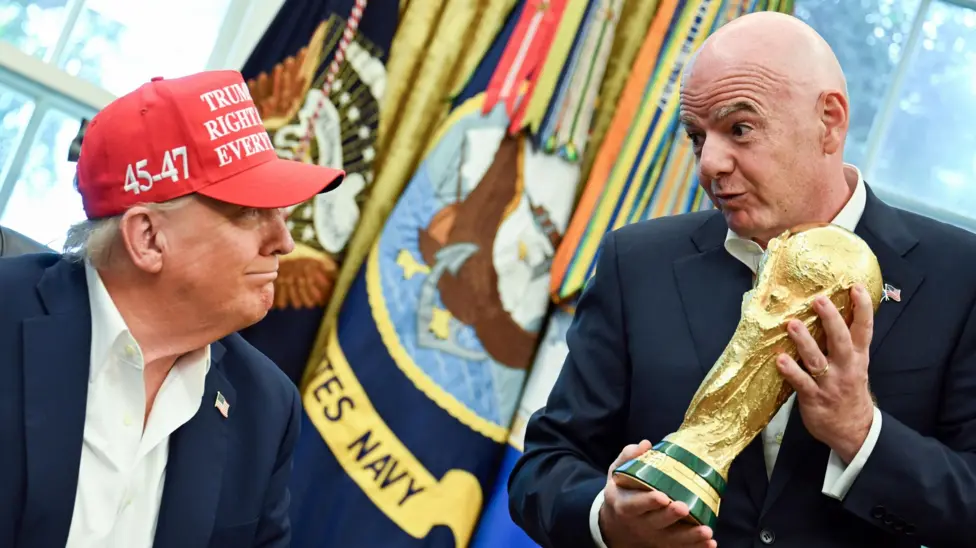
The escalating conflict is also placing renewed attention on FIFA President Gianni Infantino’s relationship with Trump. In December, FIFA awarded Trump its inaugural “Peace Prize,” citing his role in diplomatic efforts in the Middle East. In the months since, the United States has taken military action in several countries, including Iran, prompting criticism of FIFA’s perceived alignment with political leadership.
Some European politicians have previously called on international sporting bodies to consider expelling the United States from major competitions over foreign policy concerns, though such proposals have not gained formal traction. Similarly, there may be calls from Gulf states for consequences against Iran following its retaliatory strikes in the region.
FIFA maintains that it has a statutory obligation to remain politically neutral and cannot resolve geopolitical disputes. The organization faced similar pressure in 2018 when Russia hosted the World Cup after annexing Crimea, and later banned Russia in 2022 following its invasion of Ukraine.
As it stands, there is no indication that FIFA is considering sanctions against the United States, despite controversy surrounding its foreign policy decisions.
What is clear is that the 2026 World Cup — already tied to the 250th anniversary celebrations of the U.S. Declaration of Independence and expected to feature a highly visible presidential presence — now faces an even more complicated political backdrop.
With just over three months until kickoff, uncertainty over Iran’s participation, heightened security concerns, and growing geopolitical tension have transformed what should be a global sporting celebration into an event deeply intertwined with world affairs.