

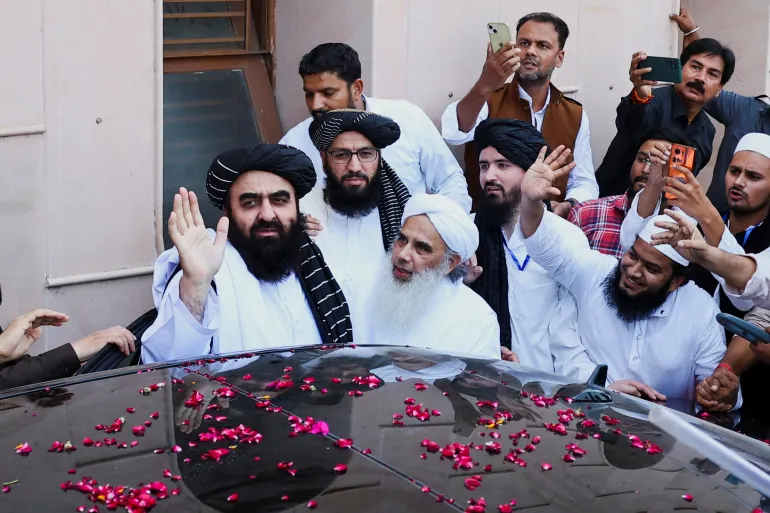
Four years after hurriedly shutting its embassy and evacuating personnel following the Taliban’s return to power, India is rolling out the red carpet for a high-level Taliban delegation — marking a dramatic shift in its Afghanistan policy.
Taliban Foreign Minister Mawlawi Amir Khan Muttaqi, who remains under United Nations sanctions, arrived in New Delhi earlier this week for a weeklong visit after receiving a temporary UN travel exemption. His trip is being billed as groundbreaking — the first official visit by a senior Taliban leader to India since the group’s 2021 takeover of Kabul.
During his meetings with Indian officials, including Foreign Minister Subrahmanyam Jaishankar, Muttaqi discussed trade, economic cooperation, and diplomatic relations. New Delhi announced it will reopen its embassy in Kabul, signaling a reset in ties. “Closer cooperation between us contributes to your national development as well as regional stability and resilience,” Jaishankar said.
The Taliban delegation, which included senior trade and foreign ministry officials, invited Indian companies to invest in Afghanistan’s mining sector — a move they hope will help strengthen bilateral economic ties. India, for its part, pledged to continue humanitarian assistance and development projects in Afghanistan, one of the world’s poorest nations.
Muttaqi also visited Darul Uloom Deoband in Uttar Pradesh, one of South Asia’s most influential Islamic seminaries and historically linked to many Taliban leaders through shared religious education networks. On Monday, he announced that direct flights would soon begin between Kabul and Indian cities, including Amritsar.
India’s engagement with the Taliban marks a notable departure from its historical stance. For decades, New Delhi saw the Taliban as a proxy for Pakistan’s powerful intelligence services, which nurtured the group during the 1980s mujahideen movement against Soviet forces. India shuttered its Kabul embassy in 1996 after the Taliban’s first rise to power, backing the anti-Taliban Northern Alliance alongside Iran and Russia.
When the Taliban were ousted in 2001, India reopened its embassy but maintained a cautious distance, viewing the group as complicit in attacks on its diplomatic missions. Meanwhile, Pakistan was accused by U.S. officials of sheltering Taliban leaders as they launched a prolonged insurgency against NATO forces.
Analysts say New Delhi’s new approach reflects pragmatic geopolitical realignment rather than ideological alignment. With Pakistan–Taliban relations strained by cross-border attacks, India sees an opening to expand its influence in Afghanistan and counter Pakistan’s strategic depth. By engaging directly with the Taliban, India aims to protect its regional interests, limit security threats, and position itself as a relevant player in Afghanistan’s future.
Critics argue that hosting Taliban leaders grants them de facto legitimacy at a time when their administration remains diplomatically isolated. Supporters, however, contend that engagement is a realistic response to shifting power dynamics in the region.