

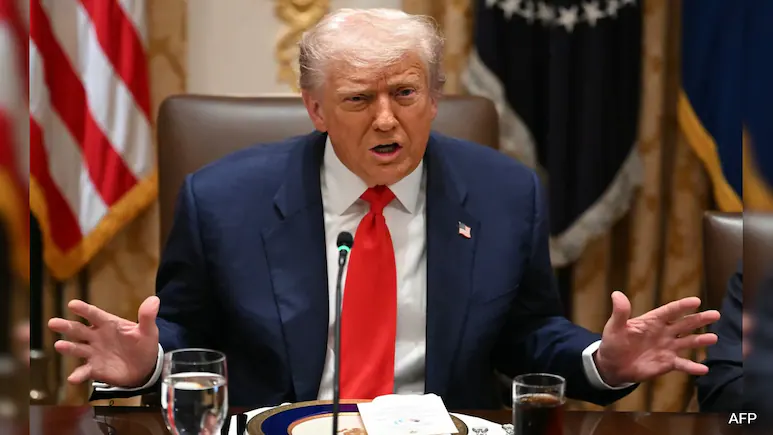
U.S. President Donald Trump has defended his aggressive tariff strategy against BRICS member states, portraying the bloc’s efforts to create alternative trade mechanisms as a direct threat to American financial power. Speaking at the White House alongside Argentine Prime Minister Javier Milei, Trump claimed that his tariff threats led nations to abandon the group.
“I told anybody who wants to be in BRICS, that’s fine, but we’re going to put tariffs on your nation. Everybody dropped out. They’re all dropping out of BRICS,” Trump said. “I’m very strong on the dollar, and anybody that wants to deal in dollars, they have an advantage over people that aren’t. BRICS was an attack on the dollar, and I said, you want to play that game, I’m going to put tariffs on all of your products coming into the U.S. They said, like I said, we’re dropping out of BRICS. They don’t even talk about it anymore.”
Trump’s remarks come amid renewed global debate over BRICS’ push to reduce reliance on the U.S. dollar through alternative trade and financial arrangements—a move seen as a challenge to U.S. economic dominance. The BRICS bloc, originally comprising Brazil, Russia, India, China, and South Africa, has expanded in recent years to include Egypt, Ethiopia, Indonesia, Iran, and the United Arab Emirates, reflecting its growing appeal among emerging economies.
Throughout his presidency, Trump has wielded tariffs as a foreign policy weapon, often threatening punitive levies to extract concessions or deter rival economic initiatives. In the past, he proposed an additional 10 per cent levy on any country seeking to join BRICS. Member nations such as India, Brazil, China, and Russia have been among the hardest hit by his tariff measures.
India, however, has distanced itself from any notion of challenging the dollar’s role. In March, Foreign Minister S. Jaishankar clarified India’s stance following trade tensions with Washington. “Regarding the role of the dollar, we are realistic. We have no issue with the dollar… We have no interest in undermining the dollar,” he said.
Trump’s comments underscore how geopolitical and economic rivalry is increasingly intertwined with currency politics. BRICS’ ambitions to offer alternative financial systems have prompted U.S. pushback, with Trump’s tariff threats representing one of the clearest examples of Washington leveraging economic power to defend the dollar’s dominance on the global stage.