

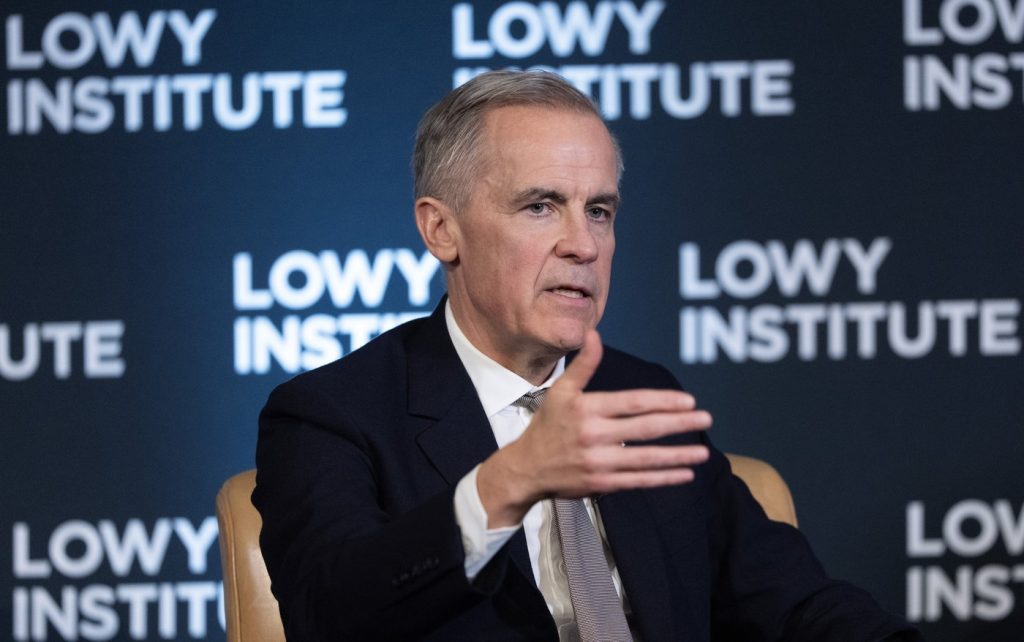
Prime Minister Mark Carney continued to promote his vision of stronger cooperation among so-called middle powers during a visit to Australia, arguing that countries like Canada and Australia can help shape global rules and build effective international coalitions.
Speaking at the Lowy Institute in Sydney, Carney said nations that are not global superpowers still possess significant influence if they work together strategically.
“Australia and Canada can’t compel like the great powers; but we can convene, we can set the agenda, shape the rules, and organize and build capacity through coalitions that deliver results at speed and global scale,” Carney said in his speech.
The prime minister repeated several themes from his widely discussed address earlier this year at the World Economic Forum Annual Meeting in Davos, where he argued that middle powers have greater global influence than is often recognized.
Carney pointed to countries such as Europe, Australia, Canada, Japan and South Korea, noting that together their economies exceed that of the United States and their combined trade is roughly three times larger than China’s.
His stop in Australia follows a visit to India and precedes a final leg of his 10-day diplomatic tour in Japan.
During his remarks, Carney emphasized the potential for deeper collaboration between Canada and Australia, particularly in the development of critical minerals. He said both countries are working together to help establish what he described as the “largest mineral reserve held by trusted democratic nations.”
He also suggested expanding joint defence projects, particularly in emerging technologies such as artificial intelligence and aerospace.
Carney noted that a large share of defence spending in allied countries currently flows to the United States.
“Right now, when we spend capital on defence, 70 cents of those dollars goes to the United States,” he said.
Canada and Australia have already strengthened defence cooperation. Last year Ottawa signed an agreement to purchase an over-the-horizon radar system from Australia for use in monitoring Canada’s Arctic region.
Carney also highlighted efforts to connect the Comprehensive and Progressive Agreement for Trans-Pacific Partnership with the European Union, a move he said could eventually create a major trading network representing roughly 1.5 billion people.
Canada is a member of the CPTPP and already maintains a separate trade agreement with the European Union.
Before delivering his speech, Carney met with several Australian business and investment leaders, including executives from global mining company Rio Tinto and major investment funds.
Following his time in Sydney, Carney is scheduled to travel to Canberra where he will meet Australian Prime Minister Anthony Albanese and address the Australian Parliament as part of his broader diplomatic tour aimed at strengthening Canada’s partnerships across the Indo-Pacific region.