

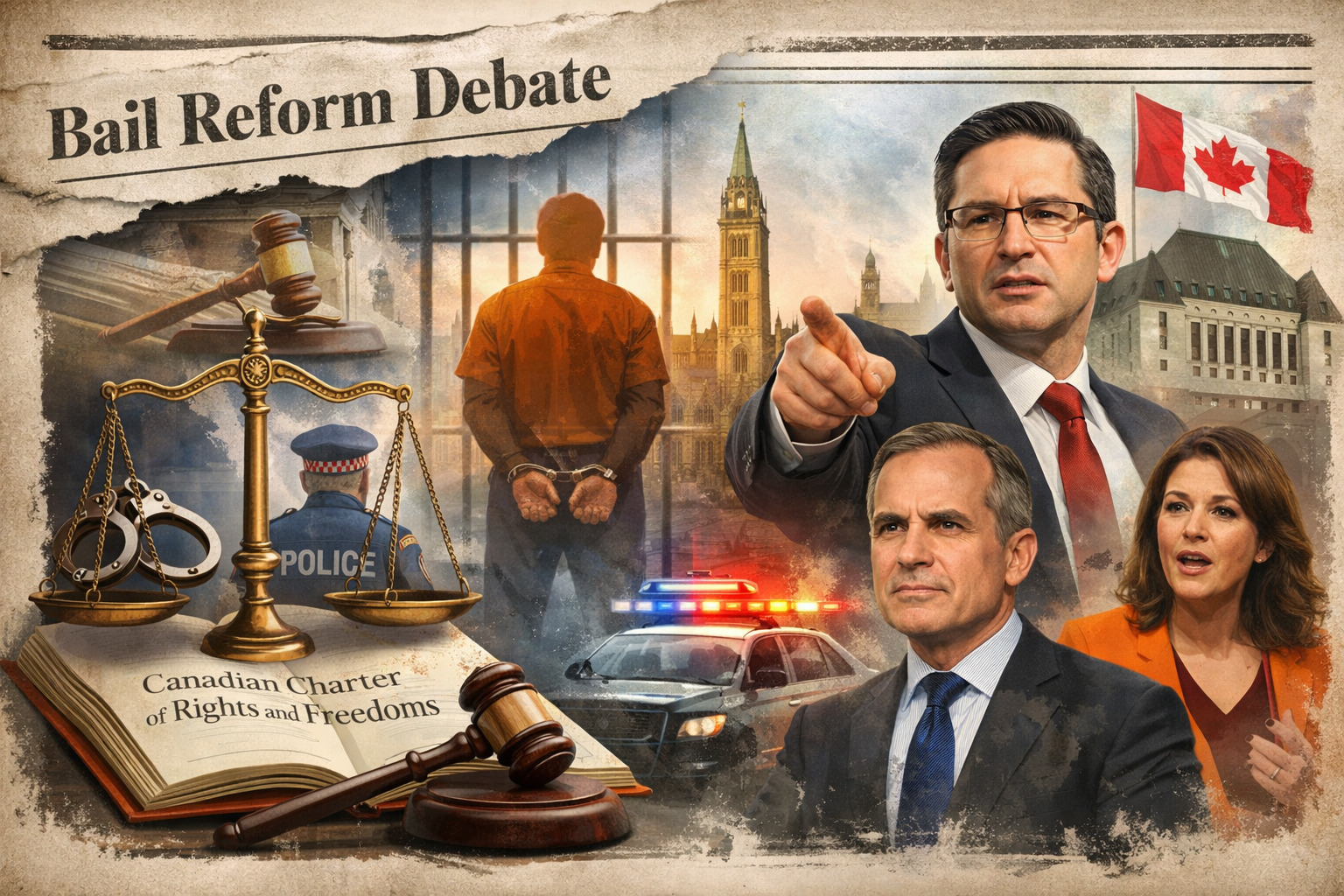
Why promises of sweeping reform may be harder to deliver than campaign slogans suggest
So far, Conservative leaders have strongly advocated tougher bail laws but have not proposed amending the Charter or invoking the notwithstanding clause.
Canada’s debate over crime and bail reform has moved to the forefront of national politics. Police leaders, provincial governments, and many Canadians have raised concerns that repeat offenders are being released too quickly, while legal experts warn that Canada’s justice system is grounded in strong constitutional protections that cannot easily be altered.
The issue has become a key political battleground between the Liberal government under Prime Minister Mark Carney, the Conservative opposition led by Pierre Poilievre, and the New Democratic Party (NDP). Each party has proposed different solutions, but all must operate within the same constitutional framework that governs Canada’s justice system.
A Bail System Rooted in the Charter
Canada’s bail laws are shaped primarily by the Canadian Charter of Rights and Freedoms and the Criminal Code of Canada.
Section 11(e) of the Charter guarantees that anyone charged with an offence has the right “not to be denied reasonable bail without just cause.”
Source: Government of Canada – Department of Justice
Under the Criminal Code, release before trial is generally the starting point unless the prosecution can demonstrate a clear reason for detention.
Source: Criminal Code Section 515 – Government of Canada
This principle was reinforced by the Supreme Court of Canada in the landmark decision R v Antic (2017).
In that ruling, the Court emphasized the “ladder principle,” meaning judges must begin with the least restrictive form of release and impose stricter conditions only when necessary.
As a result, Canada is widely considered to have one of the most rights-protective bail systems among democratic countries.
Sources
- Supreme Court of Canada decision: R v Antic (2017)
- Department of Justice Canada – Charter rights and bail provisions
The Liberal Government’s Balancing Act
The Liberal government has attempted to respond to rising public concern about violent crime while preserving Charter protections.
Under pressure from provinces and police organizations, Ottawa passed Bill C-48, which strengthened bail provisions for certain serious offences.
Key elements include:
- reverse-onus bail for repeat violent offenders involving weapons
- expanded reverse-onus provisions for firearm offences
- additional consideration of past violent convictions during bail hearings
- stronger protections for victims of intimate partner violence
Source: Government of Canada – Justice Department news release on Bill C-48 (2023)
More recently, the federal government introduced additional proposed reforms aimed at tackling organized auto theft and violent crime.
Strengths of the Liberal Approach
- Attempts to balance public safety with constitutional protections
- Introduces targeted reforms less likely to be struck down by courts
- Responds to pressure from police and provincial governments
Criticism
- Critics say reforms remain too cautious
- Some police leaders argue repeat offenders continue to be released too easily
Conservatives Push Tougher Crime Policies
Opposition Conservatives under Pierre Poilievre have made crime and bail reform a central political issue.
The party argues that Canada’s justice system allows repeat offenders to move through a “revolving door,” being arrested and released repeatedly.
Conservative proposals typically include:
- stricter bail rules for repeat violent offenders
- broader use of reverse-onus bail provisions
- tougher sentencing for serious crimes
The party frequently refers to the current situation as a “catch-and-release” justice system.
Strengths of the Conservative Approach
- Addresses widespread public concern about safety
- Provides a clear and direct message on crime policy
- Could lead to tougher bail conditions for high-risk offenders
The Legal Reality
Legal experts warn that sweeping restrictions on bail could face serious constitutional challenges.
Because the Charter guarantees reasonable bail and the Supreme Court has emphasized release as the default position, overly strict legislation could be struck down.
Source: Supreme Court of Canada – R v Antic decision
Critics also note that political messaging about stricter bail laws can resonate strongly with voters frustrated by crime, even though implementing such policies may prove difficult within the existing legal framework.
The NDP’s Focus on Systemic Reform
The New Democratic Party has taken a different approach, focusing less on stricter bail rules and more on addressing systemic issues within the justice system.
NDP leaders argue that repeat offending is often linked to deeper problems such as:
- court backlogs
- underfunded justice systems
- mental health and addiction challenges
- lack of rehabilitation and social supports
Strengths of the NDP Approach
- Targets root causes of crime
- Emphasizes prevention and rehabilitation
- Seeks to reduce incarceration of legally innocent individuals
Criticism
- Opponents argue these solutions may take years to show results
- Some voters believe the approach does not adequately address immediate public safety concerns
Why Bail Reform Is Harder Than It Appears
Even if a future government attempted sweeping bail reform, several factors would limit how far changes could go.
First, the Charter guarantees reasonable bail, meaning overly strict detention policies could be ruled unconstitutional.
Second, Supreme Court decisions such as R v Antic strongly reinforce the principle that release should normally be the starting point.
Third, Canada’s justice system is divided between federal and provincial governments. While Ottawa writes criminal law, provinces operate the courts and prosecute cases.
This means bail reform alone cannot solve problems such as court delays, police resources, or prison capacity.
What This Means for Canadians
For Canadians concerned about crime, the bail debate presents both potential benefits and risks.
Potential Benefits of Stricter Bail Policies
- increased public confidence in the justice system
- tougher treatment of repeat violent offenders
- stronger response to organized crime and firearm offences
Potential Risks
- more legally innocent individuals held in jail before trial
- increased costs for provincial prison systems
- longer court delays if the justice system becomes overloaded
The Conservative Question: Can Poilievre Deliver What He Promises?
Among Canada’s political parties, the strongest rhetoric on crime and bail reform has come from the Conservative Party of Canada, led by Pierre Poilievre.
Poilievre has repeatedly criticized what he calls Canada’s “catch-and-release” justice system and has promised tougher bail laws aimed at repeat violent offenders. His message has resonated with many Canadians frustrated by news reports of suspects being arrested multiple times while on bail.
The Conservative approach is built around a simple political argument: public safety must take priority, and the justice system should be tougher on repeat offenders.
However, translating that message into actual legislation may prove more difficult than campaign speeches suggest.
Canada’s bail system is constrained by the Canadian Charter of Rights and Freedoms, which guarantees the right not to be denied reasonable bail without just cause. Courts, including the Supreme Court of Canada, have repeatedly reinforced the principle that detention before trial should be the exception rather than the rule.
Because of these constitutional limits, legal experts widely agree that sweeping bail restrictions could face serious court challenges.
This leads to an even bigger question hovering over Canada’s bail debate: would any government be willing to confront the deeper legal barrier—the Charter itself?
Many legal scholars argue that the Charter—particularly the right to reasonable bail under Section 11(e)—places significant limits on how far governments can go in tightening bail rules.
That raises an increasingly discussed political question: would a future Conservative government led by Pierre Poilievre be willing to challenge or amend the Charter in order to achieve the tougher bail policies it advocates?
Changing the Charter is extremely difficult. Under the constitutional amending formula contained in the Constitution Act, 1982, amendments generally require approval from Parliament and at least seven provinces representing 50 percent of Canada’s population.
Another theoretical option would be invoking the notwithstanding clause (Section 33), which allows governments to temporarily override certain Charter rights. However, using this clause in criminal justice matters would likely be highly controversial and could provoke significant legal and political backlash.
So far, Conservative leaders have strongly advocated tougher bail laws but have not proposed amending the Charter or invoking the notwithstanding clause.
This leaves a fundamental question unanswered: can the sweeping bail reforms being promised actually be implemented within the existing constitutional framework?
Critics argue that promising dramatic changes without directly addressing constitutional limits risks raising expectations that may be difficult for any government to meet.
Supporters of the Conservative position, however, counter that stronger political will and carefully drafted legislation could still tighten the system without crossing constitutional lines.
Ultimately, if Pierre Poilievre hopes to turn his tough-on-crime platform into reality, the real test will not be campaign speeches or political messaging—but whether those policies can survive the constitutional scrutiny of Canada’s courts.
That challenge may become one of the defining issues in Canada’s ongoing debate over crime, justice, and the limits of political power.
The Road Ahead
Canada’s bail debate reflects a broader tension between protecting civil liberties and ensuring public safety.
The Liberals are pursuing targeted reforms designed to remain Charter-compliant. Conservatives are advocating tougher measures to address repeat offending, while the NDP focuses on prevention and systemic reform.
However, regardless of which party forms the next government, any significant overhaul of Canada’s bail system will face constitutional scrutiny and the realities of a justice system built on strong legal protections.
In Canada, crime policy may be shaped by politics—but it is ultimately constrained by the Constitution.