

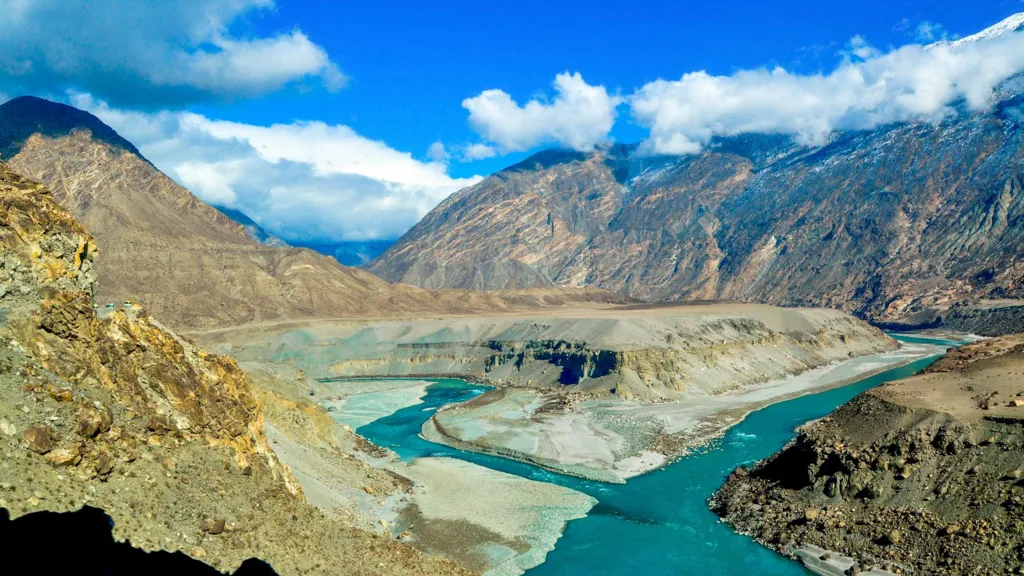
Amid rising tensions following a deadly militant attack in Indian-administered Kashmir, India has suspended the long-standing Indus Waters Treaty (IWT), sparking debate over whether it can realistically block river waters from flowing into Pakistan.
The treaty, signed in 1960 and brokered by the World Bank, has survived two wars between the nuclear-armed neighbors. It divides the water of six rivers in the Indus basin, allocating the three eastern rivers—Ravi, Beas, and Sutlej—to India, and 80% of the three western rivers—Indus, Jhelum, and Chenab—to Pakistan. The waters of these western rivers are vital to Pakistan, supporting over 80% of its agriculture and a significant portion of its hydropower capacity.
India’s decision to suspend the treaty is seen as part of a broader retaliation against Islamabad, which Delhi accuses of backing cross-border terrorism—charges Pakistan strongly denies. In response, Pakistan has warned that stopping the water flow would be considered an “Act of War.”
While the treaty has previously been challenged through legal channels by both countries, this is the first time either has suspended it. India, being upstream, holds a geographical advantage, but experts argue that the actual capacity to block or divert large volumes of water is limited.
Most of India’s infrastructure in the Indus basin consists of run-of-the-river hydropower plants, which do not store large quantities of water but instead rely on natural river flow to generate electricity. According to water resource expert Himanshu Thakkar, India currently lacks the massive storage and canal systems required to significantly hold back water from the western rivers, especially during high-flow monsoon periods.
Although India has not fully utilized its permitted 20% share of the western rivers under the treaty, it now has the ability to construct new storage infrastructure without having to notify or share documentation with Pakistan. This could change the dynamic during dry seasons when water scarcity makes Pakistan more vulnerable.
Infrastructure progress, however, has been slow. Despite pledges made in 2016 after a similar militant attack to speed up dam construction, difficult terrain and local opposition have delayed projects. Nevertheless, if India does build new water-holding infrastructure, the impact could be substantial during dry months when timing and flow volumes become critical.
Another consequence of the suspension is India’s right to stop sharing hydrological data with Pakistan—a requirement of the treaty. While such data is essential for flood forecasting and water management downstream, Pakistani officials claim that India had already been sharing only limited information.
There’s also growing concern about the possibility of “weaponizing” water, a scenario in which India could temporarily withhold river flow and then release it suddenly, potentially causing downstream flooding. Experts caution, however, that India’s own dams are far from the Pakistan border, and such a strategy could result in flooding on Indian territory as well. A more feasible but still harmful option could be sudden flushing of silt from reservoirs, which could cause ecological and infrastructural damage downstream.
The geopolitical implications stretch beyond India and Pakistan. China, which controls the headwaters of the Indus in Tibet and is a close ally of Pakistan, has also shown how upper riparian countries can exert control over downstream neighbors. In 2016, Beijing blocked a tributary of the Brahmaputra River around the same time India made threatening statements about the Indus treaty. Although China claimed it was for a hydropower project, the timing raised eyebrows.
China has since approved the construction of what is expected to be the world’s largest dam on the lower Yarlung Tsangpo (which becomes the Brahmaputra in India), sparking fears in Delhi about potential future leverage over water resources.
While India’s treaty suspension signals a hardening stance, its limited infrastructure makes an immediate large-scale diversion of water unlikely. The true consequences may only become evident over time, especially if dry seasons and new construction shift the balance of water flow—and regional power.