

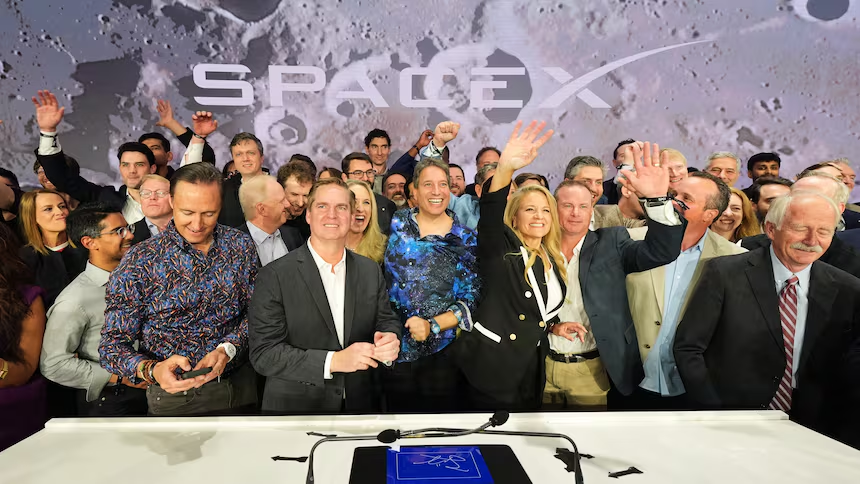
In one of the most remarkable moments in financial market history, SpaceX made a stunning debut on the Nasdaq stock exchange, sending its market value above $2 trillion and cementing founder Elon Musk as the world’s first trillionaire.
Investors rushed to buy shares of the aerospace and technology giant following what has become the largest initial public offering (IPO) ever recorded. The stock surged during its first day of trading, finishing nearly 20 per cent higher than its offering price and instantly placing SpaceX among the largest publicly traded companies in the United States.
The blockbuster debut generated extraordinary investor interest, with hundreds of millions of shares changing hands during the opening trading session. The enthusiasm reflected growing confidence in SpaceX’s position as a leader in commercial space exploration, satellite communications, launch services, and emerging artificial intelligence-related technologies.
The IPO raised approximately $75 billion, surpassing previous records and highlighting investor appetite for companies operating at the intersection of advanced technology, artificial intelligence, and future-oriented industries. Market analysts described the debut as a watershed moment that could influence investment trends for years to come.
Founded in 2002 by Musk, SpaceX has transformed the global aerospace industry by dramatically reducing launch costs, developing reusable rocket technology, and becoming a key provider of space transportation services. The company now conducts the majority of launches for government agencies, commercial customers, and international partners.
A major contributor to the company’s growth has been its satellite internet division, Starlink, which provides broadband connectivity to millions of users worldwide. Combined with its ambitious plans for deep-space exploration, lunar missions, and future Mars colonization efforts, investors view SpaceX as a company positioned to benefit from multiple long-term growth opportunities.
The company’s public debut also reflects growing optimism about the role of artificial intelligence and advanced technologies in future economic expansion. Many investors see SpaceX as more than a space company, viewing it as a technology platform with potential applications across communications, transportation, data infrastructure, and AI-driven systems.
The successful listing has generated expectations that other high-profile technology firms may soon pursue public offerings as market conditions remain favourable. Analysts suggest the IPO could open the door for a new wave of large-scale listings from artificial intelligence and advanced technology companies.
However, despite the excitement surrounding the company’s market debut, questions remain regarding its valuation. With annual revenue estimated at approximately $18.7 billion, some analysts argue that the company’s market capitalization reflects extremely high expectations about future growth rather than current financial performance.
Supporters counter that traditional valuation metrics may not fully capture SpaceX’s long-term potential. They point to the company’s dominant position in space launches, expanding satellite network, technological advantages, and opportunities in emerging industries as reasons for continued investor confidence.
The company is also expected to be added to the Nasdaq-100 in the coming weeks, a move that could generate additional demand from exchange-traded funds and institutional investors that track the index.
Meanwhile, the IPO’s success has had ripple effects across the broader market. Shares of several competing aerospace and satellite companies declined as investors shifted capital toward SpaceX, reinforcing its status as the dominant player in the rapidly evolving space economy.
For Elon Musk, the IPO represents another milestone in a career marked by ambitious projects and disruptive innovation. Already known for leading companies in electric vehicles, artificial intelligence, space exploration, and advanced technology, Musk now finds himself at the centre of one of the largest wealth-creation events in modern corporate history.
Whether SpaceX ultimately justifies its extraordinary valuation remains a subject of debate among analysts and investors. What is certain, however, is that the company’s historic market debut has reshaped Wall Street, elevated the commercial space sector to new heights, and further strengthened its position as one of the most closely watched companies in the world.