

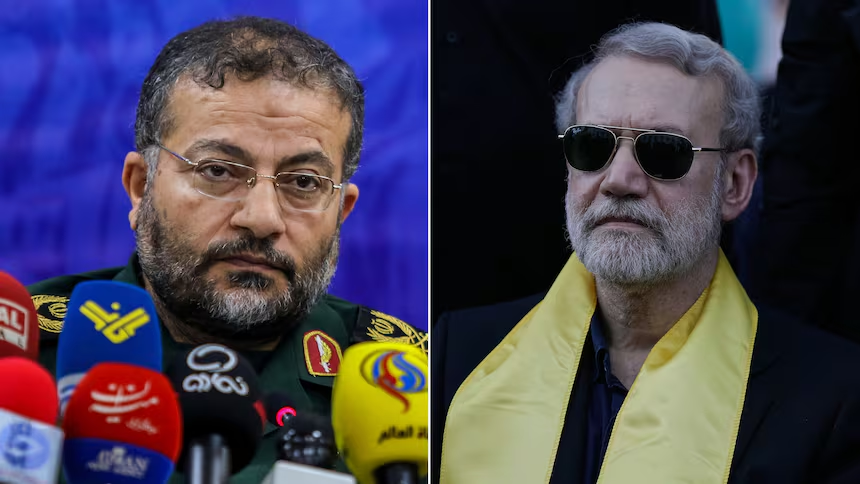
Israel says it has killed two senior Iranian officials during a series of overnight airstrikes targeting Tehran, as the conflict between Israel and Iran continues to escalate across the Middle East.
Israel’s defence minister, Israel Katz, said the strikes killed Ali Larijani and Gholam Reza Soleimani.
Katz said the Israeli military carried out a wide wave of attacks across Tehran overnight and described the operation as part of ongoing efforts against Iran’s leadership and military structure.
Iran has not immediately confirmed the deaths of the two officials. Iranian state media released a handwritten message attributed to Larijani commemorating sailors killed in a recent U.S. attack, but did not address the Israeli claim.
If confirmed, Larijani would be the most senior Iranian official killed since Ali Khamenei was reportedly killed during the opening day of joint Israeli-U.S. strikes on Iran on Feb. 28.
Larijani came from one of Iran’s most prominent political families. He previously served as speaker of parliament and later became secretary of Iran’s Supreme National Security Council. He also acted as an adviser on nuclear negotiations with the United States.
Soleimani led the Basij militia, a volunteer force linked to Iran’s Revolutionary Guard that has been used for internal security operations and to suppress protests.
Israel said Soleimani was killed in a command tent along with other Basij commanders who were reportedly using the location as a temporary headquarters due to fears their main bases could be targeted.
The latest strikes came as Iran continued missile and drone attacks across the region. Israel reported incoming missiles toward Tel Aviv early Tuesday, while Hezbollah fighters launched attacks in northern Israel.
Iran also carried out strikes against several Persian Gulf countries. In the United Arab Emirates, airspace over Dubai was briefly closed as authorities responded to missile and drone threats.
Explosions were also reported in Abu Dhabi, where a man was killed by debris from an intercepted missile. Iranian drones also struck an oil facility in Fujairah, though officials said no injuries were reported.
The conflict has increased pressure on global energy markets. Iran has targeted several ships and energy facilities in the region, including tankers near the Strait of Hormuz, a key shipping route that carries about one-fifth of the world’s oil supply.
Oil prices have surged since the war began, with global benchmark crude remaining above $100 per barrel.
U.S. President Donald Trump said he has asked several countries to send naval forces to help secure the Strait of Hormuz, but many allies have not yet committed to joining the effort.
Iranian-linked groups have also continued attacks in Iraq. Drones targeting the U.S. Embassy in Baghdad were intercepted by air defences, according to Iraqi officials.
Since the war began in late February, more than 1,300 people have been reported killed in Iran, according to figures from the Iranian Red Crescent.