

“No Grand Declarations Expected as Canada Hosts Fractured G7 Summit”
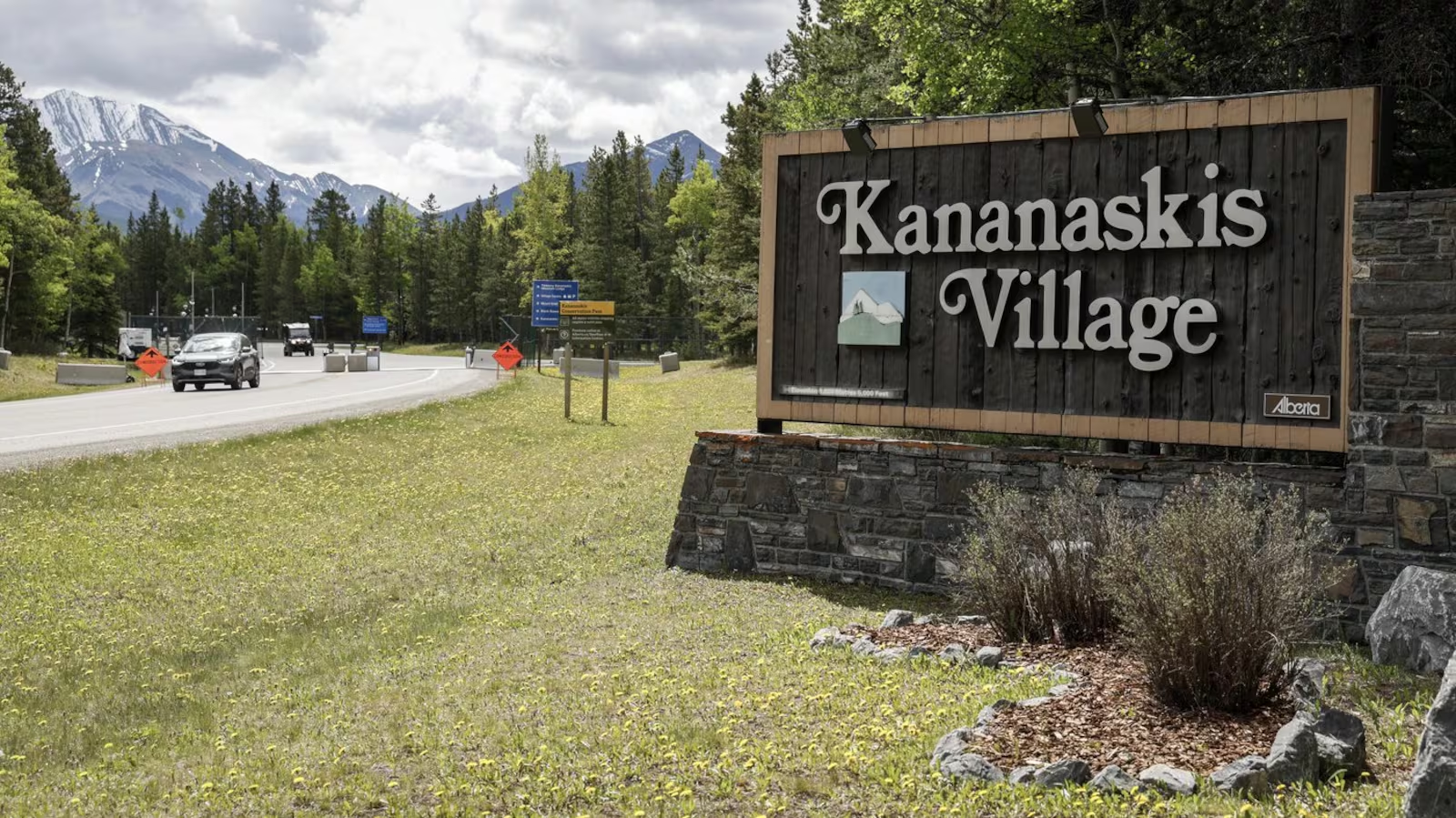
As Canada prepares to host the G7 summit in Kananaskis, Alberta, Prime Minister Mark Carney faces what may be his most delicate international balancing act yet: keeping the G7 intact amid deep divisions and growing global instability.
Analysts say simply preventing a collapse of unity among the group’s leaders — especially without a final joint communiqué — would count as a win. The Group of Seven, composed of Canada, the U.S., U.K., France, Germany, Japan, Italy, and the EU, has long served as a forum for coordinating responses to global challenges. But in 2025, consensus is harder to reach.
“This year, the measure of success may be keeping the group together,” said Sen. Peter Boehm, a veteran G7 negotiator. “Even if it means not issuing a joint statement.”
The backdrop to the summit is unusually tense. Ongoing hostilities between Israel and Iran, renewed doubts over U.S. commitment to multilateralism under President Donald Trump, and rising economic and climate crises have all contributed to skepticism about the summit’s outcomes.
Planning for the meeting was also compressed due to Canada’s spring election and the transition from former Prime Minister Justin Trudeau to Carney. That shortened timeline has limited Canada’s usual outreach and preparation efforts. Instead of a full joint communiqué, federal officials hint that a shorter chair’s statement and several targeted issue documents may be the more realistic result.
Former Canadian ambassador Kerry Buck warned that it could be “impossible” to achieve unified language on key issues like Russia’s war in Ukraine, climate policy, or free trade — especially with Trump pushing for Russia’s readmission to the G7. She said Canada should focus on “quiet diplomacy” and avoid public disputes.
“There’s no benefit to exposing rifts at the table,” she said. “Preserving the G7 as a functional platform is in everyone’s interest.”
The summit will begin with economic discussions led by President Trump, followed by sessions on energy security, artificial intelligence, and critical minerals. Security topics, including foreign interference and climate emergencies like wildfires, will also be addressed. The final day is expected to spotlight foreign policy, with invited leaders from non-G7 nations joining the dialogue. Ukrainian President Volodymyr Zelenskyy is likely to be a prominent voice, though the Iran-Israel conflict may dominate.
One-on-one meetings between leaders are expected to take up much of the agenda. Carney and newly installed German Chancellor Friedrich Merz will be introducing themselves to counterparts, while Trump reportedly favors direct bilateral chats over multilateral settings.
Experts say Canada might still announce a modest “signature initiative” tied to global development or countering authoritarian repression — a hallmark of past G7 hosts. But budget constraints and time pressures may limit the scale.
Meanwhile, civil society groups and advocates will hold side events and protests in designated zones. The RCMP has prepared to broadcast those demonstrations to the summit venue via video, keeping leaders physically distant but aware.
Despite the challenges, observers like John Kirton of the G7 Research Group remain cautiously optimistic.
“Even without a joint communiqué, there’s potential for meaningful agreements,” he said, noting that earlier Canadian-led G7 meetings this year produced progress on AI and maritime security. “A focused, compact outcome might be exactly what this moment calls for.”