

CALGARY — A weeks-long protest by international graduates over denied post-graduation work permits has taken a serious turn after the Canada Border Services Agency identified 12 participants as potentially inadmissible to Canada following immigration status checks requested by Calgary police.
CBSA officers attended the protest site in northeast Calgary on Wednesday and verified the immigration status of 20 people. According to the federal agency, 12 were subsequently identified as “possibly inadmissible” under Canada’s Immigration and Refugee Protection Act.
Those individuals were instructed to report to a CBSA office later the same day for follow-up interviews.
The agency has not disclosed the results of those interviews, citing privacy legislation, and being identified as possibly inadmissible does not by itself establish that an individual will be removed from Canada.
CBSA emphasized that people facing immigration enforcement proceedings, including those who may ultimately receive removal orders, have access to due process under Canadian law.

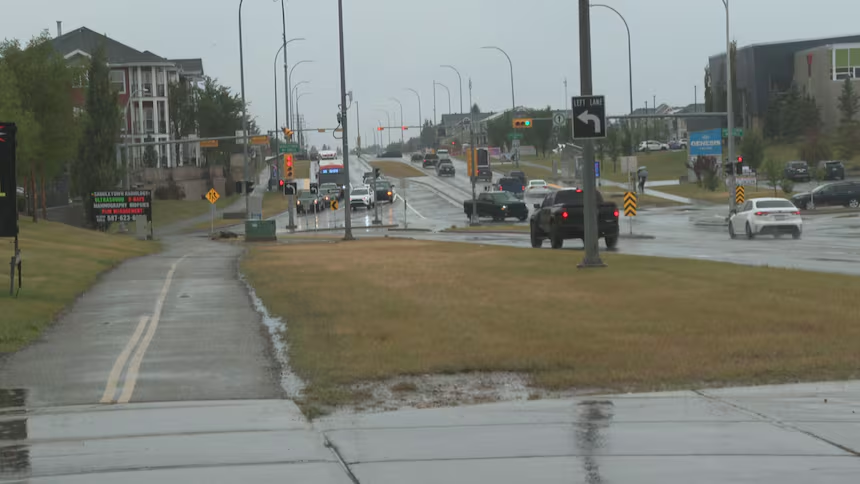
The development follows weeks of demonstrations at Saddletowne Circle in northeast Calgary, where international graduates and supporters had been protesting the rejection of post-graduation work permit applications.
Similar demonstrations have also taken place in Edmonton, with some international graduates reportedly participating in hunger strikes in an effort to draw attention to their cases.
At the centre of the dispute are graduates, including some who attended Portage College, who say they enrolled in their programs believing they would qualify for Post-Graduation Work Permits after completing their studies.
Some subsequently had their applications rejected.
Portage College says its understanding was that international students enrolled in certain non-credit public-private partnership programs before May 15, 2024, would remain eligible to apply for post-graduation work permits under the rules and information available at the time.
The college has said it is seeking clarification from Immigration, Refugees and Citizenship Canada regarding the issue.
The involvement of immigration enforcement authorities began after Calgary police contacted CBSA.
Calgary Police Service said the protest began July 24 and had been “largely peaceful in nature.” Police, however, said they had received complaints involving excessive noise, disturbances, obstruction of businesses and public intoxication.
On Wednesday, officers responded to another complaint alleging that parts of the sidewalk were being blocked and pedestrians were being impeded.
Police said officers requested identification from people who had erected tents or other structures on city property without permits. Concerns about some of the identification provided prompted police to contact CBSA to verify the individuals’ immigration status.
According to CBSA, its officers were initially asked to check four individuals. After determining that two were not in compliance with their immigration status, officers expanded the verification process to other people at the protest.
The resulting checks involved 20 people, with 12 eventually referred for further examination over possible inadmissibility.
Calgary immigration lawyer Jatin Shory, who represents approximately a dozen students challenging their work permit refusals in Federal Court, said he had advised his clients against participating in public demonstrations.
Shory said the circumstances were unusual because people who may no longer have valid immigration status could potentially draw the attention of enforcement authorities by publicly identifying themselves through a protest.
He compared the situation to “sheep waiting for the fox to come into the den.”
According to Shory, CBSA is entitled to investigate information it receives concerning possible violations of Canada’s immigration laws.
The case comes amid significant changes to Canada’s immigration system and growing uncertainty among international students and graduates affected by changing eligibility requirements.
Shory said one possible next step for a person determined to be without valid immigration status could be the issuance of an exclusion order.
According to CBSA guidance, an exclusion order generally requires an individual to leave Canada and confirm their departure with the agency. In many circumstances, the individual cannot return to Canada for one year without the appropriate authorization.
However, such an outcome is not automatic simply because someone has been referred for an interview. Individual circumstances, immigration history and available legal remedies can affect what happens next.
For the international graduates involved, the controversy has now expanded far beyond their original dispute over work permits.
What began as a public demonstration demanding reconsideration of post-graduation work permit decisions has become an immigration enforcement matter for some participants, potentially carrying significant consequences for their ability to remain in Canada.
The broader dispute over the graduates’ work permit eligibility also remains unresolved, with affected students pursuing legal challenges and Portage College seeking clarification from federal immigration authorities.
For now, CBSA has not publicly disclosed whether any of the 12 individuals referred for follow-up interviews have received removal or exclusion orders.
The episode highlights the increasingly complicated environment facing international students caught between changing immigration policies, disputed work permit eligibility and the requirement to maintain valid legal status while seeking remedies through Canada’s immigration and court systems.