

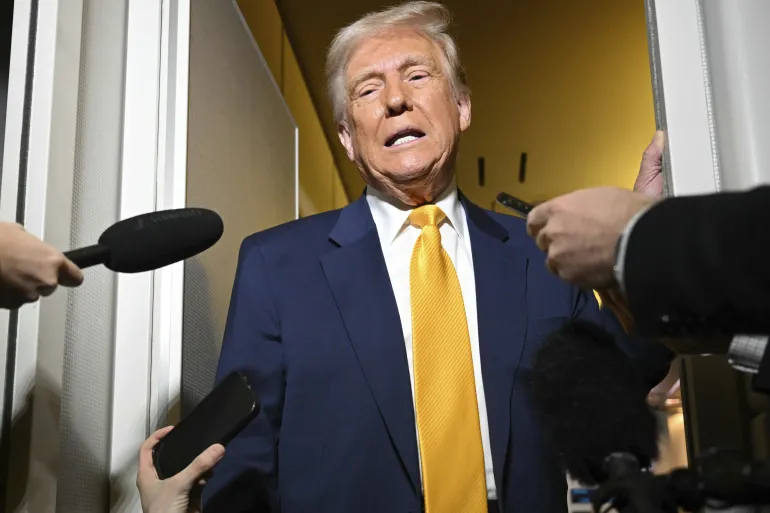
U.S. President Donald Trump reaffirmed his hardline stance on trade Sunday, declaring that no country — especially China — would be spared from his administration’s reciprocal tariff regime, despite apparent signals of flexibility toward certain high-tech sectors.
Speaking aboard Air Force One, Trump emphasized that smartphones, laptops, and other electronics remain subject to the existing 20% import duties, and would simply be moved to a different tariff “bucket” rather than being exempted altogether, refuting reports that the administration was easing pressure on China.
“We will not be held hostage by other countries, especially hostile trading nations like China,” Trump posted on Truth Social, rejecting any narrative of retreat in the ongoing trade standoff.
According to Al Jazeera, the comments follow the U.S. Commerce Department’s notice suggesting temporary exemptions on certain tech products, including those assembled in China. However, Trump and U.S. Secretary of Commerce Howard Lutnick clarified that these exemptions are only short-term and will be replaced with targeted tariffs on semiconductors, expected to be announced within weeks.
“So what [Trump is] doing is he’s saying they’re exempt from the reciprocal tariffs, but they’re included in the semiconductor tariffs, which are coming in probably a month or two,” Lutnick told local media.
The announcement signals a new phase of U.S. trade enforcement focused on critical technologies, particularly semiconductors, which are increasingly viewed as both economic assets and national security priorities. Trump indicated that the new semiconductor tariff policy will be revealed in detail within the coming week.
Meanwhile, China responded swiftly, with its Ministry of Commerce issuing a statement demanding the complete cancellation of U.S. tariffs, which it described as a “wrong practice.” A ministry spokesperson urged the United States to return to the “path of mutual respect,” warning that escalating tariff actions could further destabilize global trade relations.
The Chinese statement followed Trump’s recent decision to grant a 90-day delay on reciprocal tariffs for most nations, with China explicitly excluded from this temporary reprieve — a move that has exacerbated tensions between the two largest economies.
According to France 24, Beijing interpreted the exclusion as a targeted escalation, increasing concerns over deteriorating trade diplomacy. “We urge the U.S. to take a big step to correct its mistakes, completely cancel the wrong practice of ‘reciprocal tariffs,’” the spokesperson said.
Despite the global reaction, Trump remains adamant that tariffs are an essential tool to correct what he describes as decades of unfair trade practices and economic manipulation, particularly by China.
As global markets brace for potential impacts of the looming semiconductor tariffs, business leaders and international observers are watching closely to see whether negotiations will resume — or whether both nations are on course for a deepening economic standoff.