

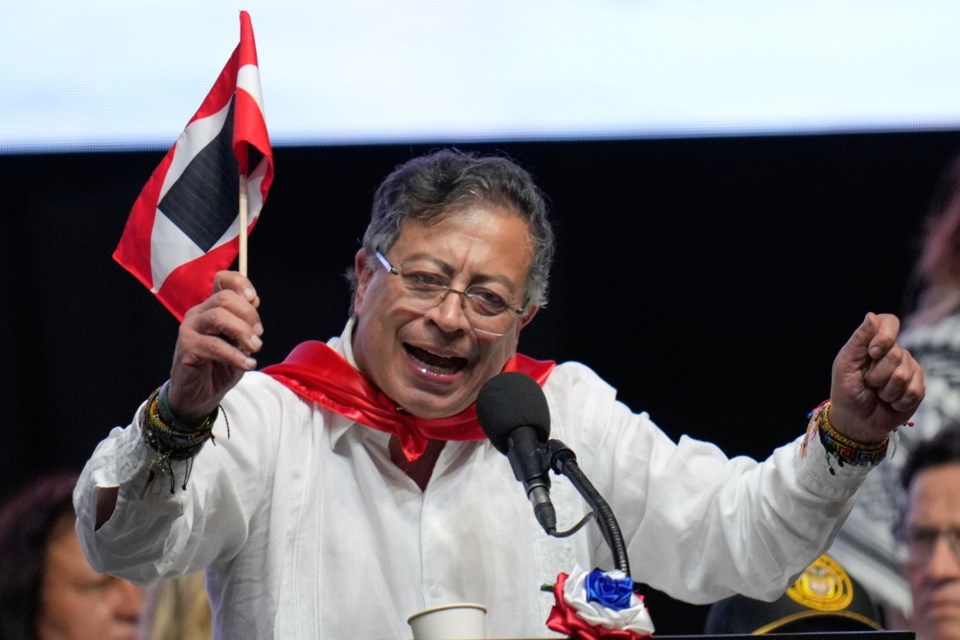
WASHINGTON — The Trump administration has imposed sweeping sanctions on Colombian President Gustavo Petro, his family, and a senior member of his government, accusing them of involvement in the global drug trade — a dramatic escalation in tensions between Washington and one of its oldest regional allies.
The U.S. Treasury Department announced the measures Friday, targeting Petro, his wife Veronica Alcocer, his son Nicolas Petro Burgos, and Interior Minister Armando Benedetti.
In a statement, Treasury Secretary Scott Bessent said Petro “has allowed drug cartels to flourish and refused to stop this activity.” He added, “President Trump is taking strong action to protect our nation and make clear that we will not tolerate the trafficking of drugs into our country.”
The sanctions freeze any assets held by the named individuals under U.S. jurisdiction and bar American citizens or entities from engaging in transactions with them.
The move marks a sharp deterioration in U.S.–Colombia relations, which have already been strained over American military strikes on suspected drug-smuggling boats off South America that have killed more than 40 people.
Petro, Colombia’s first leftist president, denounced the sanctions in a defiant post on X (formerly Twitter), writing: “Combating drug trafficking effectively for decades brings me this measure from the government of the society we helped so much to stop its use of cocaine. Quite a paradox — but not one step back, and never on our knees.” He also appointed an attorney to represent him in U.S. courts.
The sanctions follow weeks of escalating rhetoric from Trump, who has accused Petro of corruption and complicity with drug traffickers. “He’s a guy that is making a lot of drugs,” Trump said earlier this week from the Oval Office. “He better watch it, or we’ll take very serious action against him and his country.”
The administration also announced the deployment of a U.S. aircraft carrier to the eastern Pacific Ocean, expanding its anti-narcotics operations near Colombia and other major drug-producing countries.
In recent months, the Trump administration placed Colombia on its list of countries failing to cooperate in the drug war for the first time in nearly three decades.
Petro has defended his government’s approach, which emphasizes negotiation with coca farmers to transition to alternative crops, while focusing enforcement efforts on money laundering and cartel leaders. He claims Colombia has achieved record cocaine seizures, despite U.N. data showing that coca cultivation reached an all-time high of 253,000 hectares (625,000 acres) in 2023 — nearly triple the area from a decade ago.
Petro has also clashed with Washington over U.S. immigration policy and military actions in Latin America. Earlier this year, the U.S. revoked Petro’s visa before the U.N. General Assembly after he urged American soldiers to disobey Trump’s orders regarding regional operations.
Despite being one of the top recipients of U.S. aid in the hemisphere, Colombia’s relationship with Washington has become increasingly fragile under Petro’s leadership. The sanctions, combined with expanding U.S. military pressure, now mark the lowest point in bilateral relations in decades — and signal that the White House’s “zero tolerance” doctrine on narcotics has entered a new and volatile phase.