

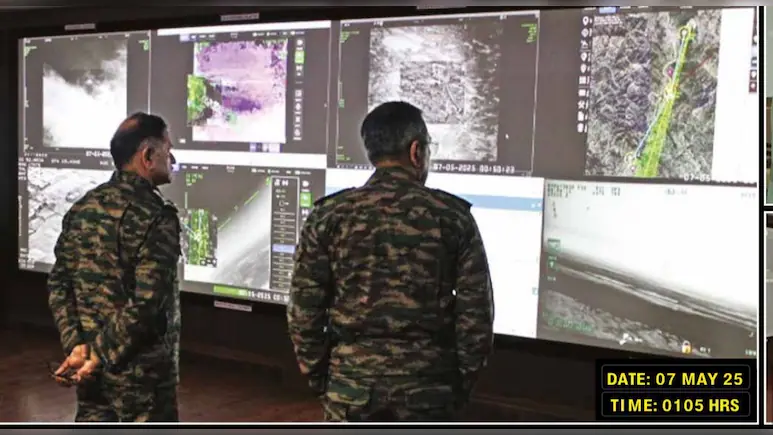
In a rare and candid admission, Pakistan’s Deputy Prime Minister Ishaq Dar has acknowledged that Islamabad was forced to request a ceasefire from India following precision missile strikes on two of its critical air bases during Operation Sindoor, launched by India in early May. The revelation, made during a televised interview now widely shared across social media, has sparked debate over Pakistan’s military preparedness and the rapid escalation of hostilities between the nuclear-armed neighbours.
Dar confirmed that India struck the Nur Khan Air Base in Rawalpindi and the Shorkot Air Base—also known as PAF Base Rafiqui—in Punjab province in the early hours of May 8. The strikes, part of India’s retaliatory operation in response to the April 22 terror attack in Jammu and Kashmir’s Pahalgam that claimed the lives of 26 tourists, marked a significant escalation in bilateral tensions.
“Unfortunately, India once again launched missile strikes at 2:30 a.m. They attacked the Nur Khan air base and Shorkot air base,” Dar told viewers. He said Saudi Foreign Minister Prince Faisal bin Farhan called him just 45 minutes after the attack, after learning of Dar’s earlier conversation with U.S. Secretary of State Marco Rubio. “He asked if he was authorised to talk to S. Jaishankar [India’s External Affairs Minister] and convey that we are ready if they [India] stop. I said yes, brother, you can,” Dar recounted.
India’s Operation Sindoor reportedly targeted infrastructure in nine terror bases across Pakistan and Pakistan-Occupied Kashmir (PoK), prompting counterstrikes from Pakistan’s military. However, according to sources in New Delhi, India’s superior intelligence and aerial precision resulted in heavy damage to key Pakistani facilities, including command-and-control centres and aircraft.
U.S. officials, anticipating escalation, were already in discreet contact with both sides. Washington reportedly pressured Islamabad to activate the military hotline with India to de-escalate immediately. The U.S. is believed to have delivered a clear message to the Pakistani leadership: avoid further delay and use established military channels to defuse the situation.
The de-escalation process culminated on May 10, when Major General Kashif Abdullah, Pakistan’s Director General of Military Operations (DGMO), contacted his Indian counterpart, Lt Gen Rajiv Ghai, via the official military hotline at 3:35 p.m. IST. Hours later, India’s Foreign Secretary Vikram Misri confirmed the ceasefire agreement in a press briefing. Both sides agreed to halt all military activity across land, air, and sea effective 5:00 p.m. IST the same day. However, reports emerged of Pakistan violating the ceasefire just hours after it took effect.
The Nur Khan Air Base, situated between Rawalpindi and Islamabad—Pakistan’s military and political power centres—is among the country’s most sensitive military compounds. It serves as a hub for VIP transport and key air force operations. Satellite imagery reviewed by NDTV showed the extent of the damage: images from May 10 revealed that two trailer trucks, believed to be mobile command posts, were destroyed by precision strikes. Subsequent imagery from May 17 showed Pakistan’s cleanup efforts underway.
The second targeted base, PAF Base Rafiqui, is a major operational centre for Pakistan’s fighter aircraft, including Chinese-made JF-17s, French Mirage 5s, and Alouette III helicopters.
In a related disclosure, retired Air Marshal Masood Akhtar admitted that Pakistan lost an Airborne Warning and Control System (AWACS) aircraft during Operation Sindoor. The critical surveillance platform was reportedly destroyed in a missile strike at the Bholari air base near Islamabad. The AWACS, essential for radar surveillance and airspace control, represents a major strategic loss.
While the strikes have since ceased, the geopolitical shockwaves continue to reverberate. Operation Sindoor has reasserted India’s willingness to carry out cross-border precision strikes in response to terror attacks, while also exposing Pakistan’s vulnerabilities—both in military infrastructure and diplomatic positioning. The public nature of Dar’s admission, especially regarding international mediation via the U.S. and Saudi Arabia, further underscores Islamabad’s behind-the-scenes efforts to avoid full-scale conflict.
As both sides return to an uneasy calm, the conflict has reignited calls in New Delhi for enhanced defence preparedness, particularly in anticipation of potential multi-front threats involving both Pakistan and China.