

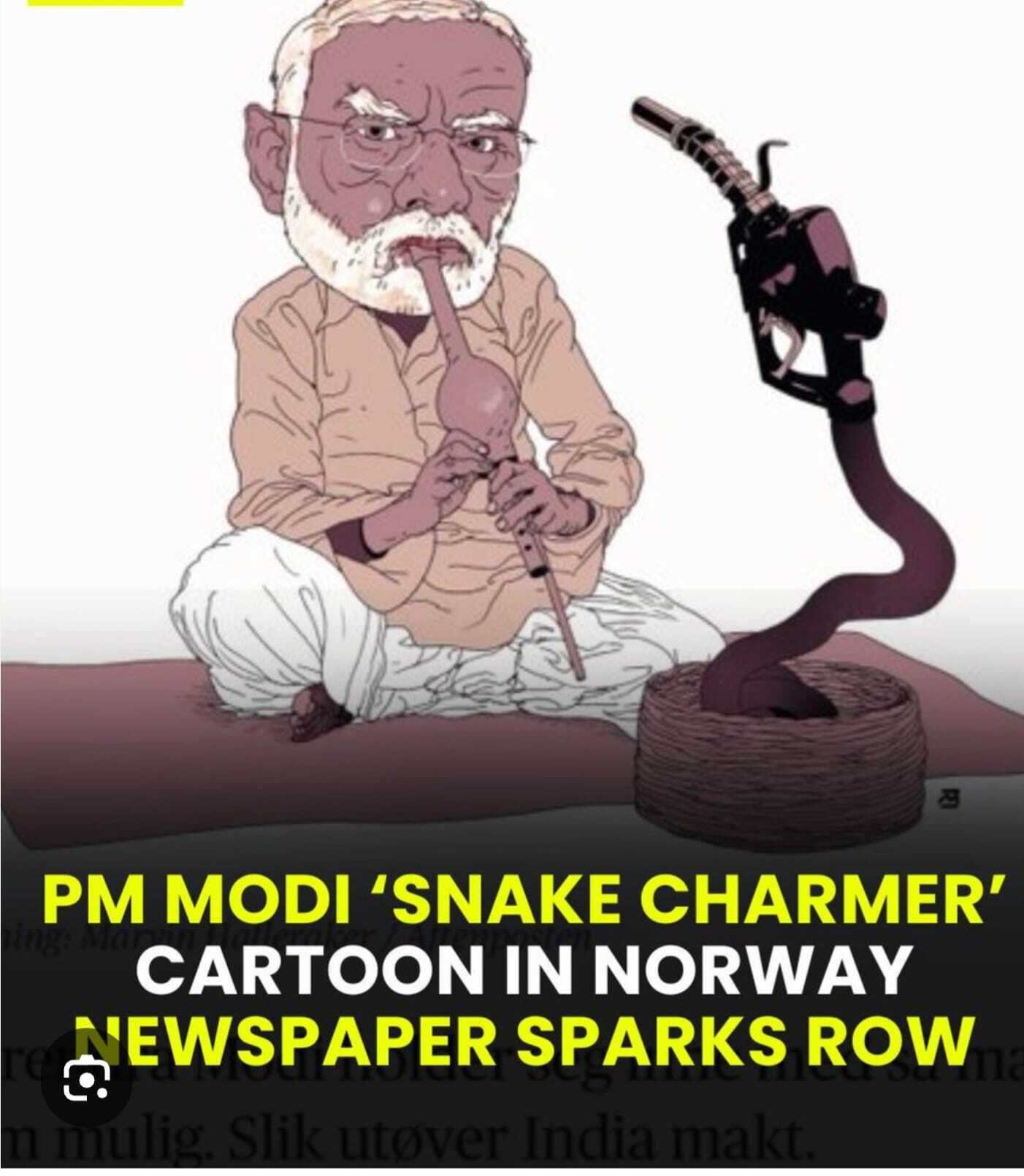
A political cartoon published by a Norwegian newspaper has ignited a sharp international debate, drawing criticism from many Indians who called the illustration insulting, culturally insensitive and disrespectful towards Prime Minister Narendra Modi. The controversy has also reopened discussions around media freedom, satire and how world leaders are portrayed in international publications.
The cartoon, published in a Norwegian daily newspaper, depicted Prime Minister Modi as a traditional snake charmer playing a pungi while attempting to “control” a snake designed in the shape of a fuel pump nozzle. The illustration appeared alongside an opinion article whose title was translated from Norwegian as “A clever and slightly annoying man.” The cartoon was widely interpreted as a reference to the recent rise in petrol and diesel prices in India.
Soon after the image surfaced online, strong reactions poured in across social media platform X, where many users accused the publication of promoting outdated stereotypes associated with India. Critics described the depiction as xenophobic and offensive, arguing that portraying India’s elected Prime Minister as a snake charmer reinforced colonial-era imagery that Indians have long fought to move beyond.
Several users questioned whether similar depictions of Western leaders would be tolerated in global media without widespread condemnation. Others said the cartoon crossed the line between political satire and cultural mockery, especially at a time when India is increasingly asserting itself on the world stage economically and diplomatically.
At the same time, another section of commentators defended the newspaper’s right to satire and criticised what they described as selective outrage. Some social media users argued that journalism must remain fearless and that political cartoons have historically been used worldwide to criticise those in power. One widely shared post stated that Indian media should focus more on asking tough questions to governments instead of reacting emotionally to criticism from foreign publications.
The controversy comes close on the heels of another diplomatic media-related episode involving Norwegian journalist Helle Lyng, who recently questioned why Prime Minister Modi did not take questions during a joint media appearance with Norway’s Prime Minister Jonas Gahr Store. That exchange had already generated significant discussion online regarding press access and media freedom.
So far, neither the Prime Minister’s Office nor the Government of India has issued any official response regarding the cartoon controversy. However, the incident has once again highlighted how international portrayals of political leaders can quickly escalate into broader debates involving nationalism, racism, satire and freedom of expression in today’s highly connected digital world.
Cartoon Photo Courtsey Norwegian daily