

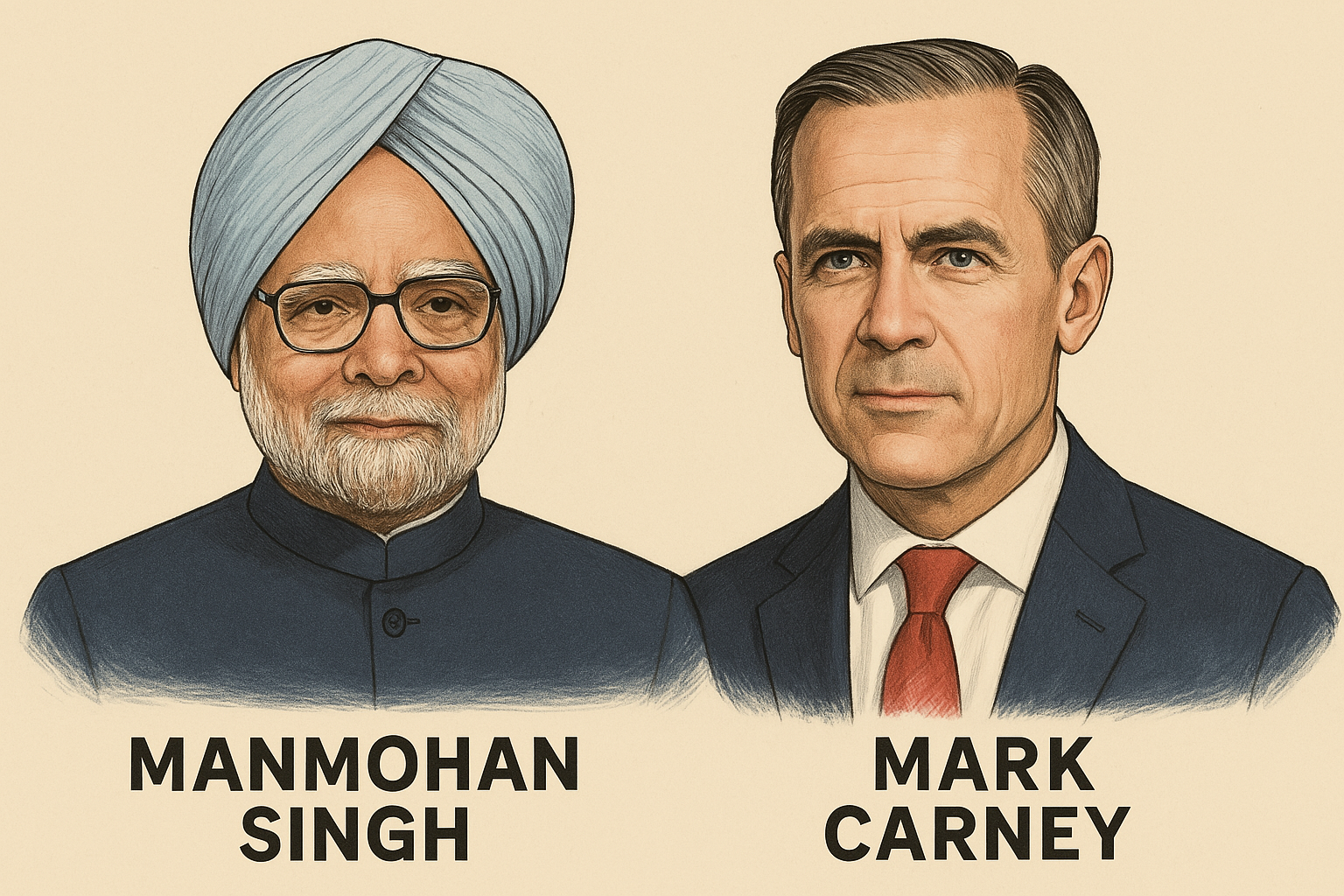
Dr. Manmohan Singh, India’s former Prime Minister and the mastermind behind its economic liberalization, has left a void in the global economic community and stirred profound emotions, especially among the Indian diaspora. Nowhere is this felt more deeply than in Canada’s Peel Region, home to a vibrant Punjabi community that reveres Singh as a native son of Punjab and a symbol of integrity. His death has reignited discussions about his transformative legacy, drawing striking comparisons to Mark Carney, the former Governor of the Bank of Canada and Bank of England, who, as of March 2025, has recently ascended to the leadership of Canada’s Liberal Party.
On March 23, 2025, Mark Carney officially called the federal election, now scheduled for April 28, 2025. Since the writ was dropped, Carney has laid out a bold and progressive economic platform. As of April 9, his major policy announcements include:
- Launching a $12 billion green infrastructure fund to transition Canada toward clean energy and create over 200,000 jobs.
- Creating a National Housing Affordability Task Force with a commitment to build 1.5 million homes by 2030.
- Introducing a “First-Homebuyers Credit” to help young Canadians enter the housing market.
- Expanding support for Canadian manufacturing and clean-tech businesses through tax credits and subsidies.
- Establishing a federal “Canadian Innovation Bank” to support high-growth sectors and advanced research.
- Implementing stricter climate regulations and carbon pricing mechanisms to align Canada with 2050 net-zero goals.
In contrast, Conservative Party leader Pierre Poilievre has promised a leaner, smaller government focused on fiscal restraint and deregulation. Up to April 9, his key proposals include:
- Eliminating the carbon tax and reducing income tax rates.
- Scrapping federal red tape to fast-track housing development on federally owned lands.
- Halting all new spending programs introduced under Trudeau, including those related to green energy subsidies.
- Reforming the Bank of Canada’s mandate to focus solely on price stability.
- Promoting Canadian energy exports and eliminating federal regulations hindering oil and gas development.
Adding to the geopolitical landscape is the expected return of Donald Trump to the U.S. presidency following the 2024 election. Trump’s “America First” policies, including threats to impose auto tariffs and demands for stricter trade terms, pose a direct challenge to Canadian economic interests.
In this context, Carney’s global economic leadership becomes a critical advantage. Having led the Bank of England and served with the G20 and the Financial Stability Board, Carney possesses the diplomatic gravitas and financial expertise to protect Canada’s sovereignty in trade negotiations. His track record mirrors that of Manmohan Singh—respected, principled, and effective in navigating international pressures.
Unlike Poilievre, who has no experience in global economic diplomacy, Carney is uniquely positioned to negotiate assertively with a Trump administration. His deep knowledge of global finance and ability to anticipate market reactions can help shield Canada from protectionist shocks, preserve key industries, and promote balanced trade. Just as Singh safeguarded India’s economic rise through careful liberalization and diplomacy, Carney offers a path forward to strengthen Canada’s economic independence.
Carney’s emergence as a principled, competent leader echoes Singh’s own journey, raising the question: Can Carney replicate Singh’s nation-shaping impact?
Both men, celebrated economists with impeccable records of honesty, have navigated their countries through economic storms with a blend of academic rigor and ethical steadfastness. Their parallels extend beyond their professional expertise to their shared commitment to policy-driven governance and national progress. For Canada’s South Asian community—particularly in Liberal strongholds like Brampton and Mississauga—Singh’s legacy of integrity and economic vision may amplify support for Carney, a leader seen as carrying a similar torch.
Honesty and Integrity: A Common Thread
In an age where political scandals often overshadow governance, the unblemished reputations of Singh and Carney stand out as rare and remarkable.
Dr. Manmohan Singh: The Incorruptible Reformer
Dr. Singh’s career was a testament to ethical leadership. Born into modest circumstances in Punjab (now in Pakistan) in 1932, he rose to become one of India’s most respected figures. As Finance Minister in 1991 and later Prime Minister from 2004 to 2014, he faced intense political scrutiny, yet emerged unscathed by personal scandal. Critics might have questioned his political assertiveness, but none doubted his integrity. Singh’s focus remained on policy over populism, earning him admiration as a humble, principled leader. His famous quip, “History will be kinder to me than the media,” reflects his belief in the enduring value of his contributions over fleeting political noise.
Mark Carney: Canada’s Clean and Trustworthy Leader
Mark Carney, dubbed the “Rockstar Central Banker” during his tenures at the Bank of Canada and Bank of England, mirrors Singh’s spotless record. Born in 1965 in Fort Smith, Northwest Territories, Carney built a career grounded in pragmatism and trust. From his early days at Goldman Sachs to his leadership of two major central banks, he has avoided the controversies that often ensnare public figures. His decisions—whether stabilizing Canada’s economy during the 2008 financial crisis or introducing innovative policies in the UK—were guided by economic logic, not political expediency. Globally, leaders leaned on Carney’s steady hand, a testament to his reputation for reliability and honesty.
Educational and Professional Backgrounds: Academic Excellence & Experience
Pierre Poilievre: Conservative Leader with a Political Communications Background
Pierre Poilievre was born in 1979 in Calgary, Alberta, and raised in Ottawa. He holds a Bachelor of Arts degree in International Relations and Commerce from the University of Calgary. Unlike Mark Carney and Dr. Singh, whose careers are rooted in economics and finance, Poilievre’s background is firmly planted in politics and communications. He began his political career as a Member of Parliament in 2004 at the age of 25 and has since served in multiple roles including Minister for Democratic Reform and Minister of Employment and Social Development. While Poilievre has positioned himself as a champion of fiscal restraint, he has no formal education in economics or experience in global finance, raising questions about his ability to handle complex international economic negotiations.
Global News Investigation: BJP-Linked Support for Poilievre’s Leadership Bid
In a detailed report published by Global News in April 2025, investigative journalists revealed that several individuals with close ties to the Bharatiya Janata Party (BJP) in India played a behind-the-scenes role in supporting Poilievre’s 2022 Conservative leadership campaign. According to the article, prominent pro-BJP organizations and diaspora influencers helped mobilize fundraising efforts, public endorsements, and digital outreach within Indian-Canadian communities. While Poilievre’s campaign has denied any formal connection with foreign political groups, concerns have been raised about transparency and influence, particularly in contrast to Carney’s globally respected independence and non-partisan record. These revelations have sparked significant debate within multicultural ridings and among political analysts watching how foreign political alignments may affect domestic leadership narratives.
Both Singh and Carney emerged from academia, wielding their intellectual credentials to tackle real-world challenges.
Dr. Manmohan Singh: The Scholar Who Transformed India
Singh’s journey began with a BA and MA in Economics from Panjab University, followed by advanced studies at Cambridge and a D.Phil. from Oxford. His academic pedigree laid the foundation for a career that spanned roles as Chief Economic Adviser, Governor of the Reserve Bank of India, Finance Minister, and Prime Minister. His crowning achievement came in 1991, when he dismantled India’s stifling License Raj and opened its economy to the world, setting the stage for decades of growth.
Mark Carney: The Global Financial Steward
Carney’s path mirrors Singh’s in its academic rigor. After earning a BA in Economics from Harvard, he pursued a Master’s and Doctorate at Oxford. His professional journey took him from Goldman Sachs to the Bank of Canada, where he served as Deputy Governor and then Governor from 2008 to 2013, before making history as the first non-British Governor of the Bank of England from 2013 to 2020. His leadership during the 2008 crisis and his advocacy for sustainable finance have cemented his status as a global economic thinker.
Economic Reforms and Impact: Transforming Nations
Singh and Carney’s legacies are defined by their ability to turn economic crises into opportunities for progress.
Dr. Manmohan Singh’s Economic Reforms
In 1991, India faced a dire balance-of-payments crisis. As Finance Minister under Prime Minister P.V. Narasimha Rao, Singh introduced sweeping reforms: slashing import tariffs, dismantling the License Raj, and welcoming foreign direct investment (FDI). These measures unshackled India’s economy, propelling it from near-bankruptcy to a trajectory of robust growth. During his premiership, India’s GDP growth peaked, lifting millions out of poverty and establishing the nation as an economic powerhouse.
Mark Carney’s Economic Leadership
Carney’s tenure at the Bank of Canada coincided with the 2008 global financial crisis. He acted decisively, cutting interest rates and injecting liquidity to shield Canada from the worst of the downturn, earning praise for keeping the country’s banking system intact. At the Bank of England, he pioneered “forward guidance”—a policy signaling future interest rate moves to boost confidence among businesses and investors. Beyond crisis management, Carney championed climate-conscious policies, urging the financial sector to align with sustainability goals, a vision that resonates with Canada’s current priorities.
Political Implications: A Canadian Echo of Singh’s Legacy
Longtime Brampton resident Satpal Singh voiced his concerns regarding the political handling of Bill C-48: “Everyone agrees violent offenders should be kept off the streets, but the law has already been passed. What we need now is proper provincial enforcement, not federal blame games. The Conservatives are using fear to mislead people instead of talking about real solutions like affordable housing or healthcare.”
Devinder Chokkar, a respected community leader, drew a powerful comparison between Carney and Singh: “Mark Carney’s vision for Canada reminds me of Manmohan Singh’s economic revolution in India—grounded, intelligent, and focused on long-term prosperity. Canadians need a leader who can handle both global pressure and domestic growth, and I see that in Carney.”
Mayank Patel, a small business owner from Halton Hills, echoed similar sentiments: “Poilievre talks about freedom, but offers no clear roadmap. Mark Carney has the global credentials, and like Manmohan Singh, he combines humility with economic insight. If we want Canada to grow with dignity and strength, we need steady hands—not slogans.”
Charnjit Gill, a retired teacher and lifelong admirer of Dr. Singh, shared: “Manmohan Singh showed the world that intellect and integrity can lead a nation. His loss is personal for many of us. Seeing someone like Carney rise with similar values gives us hope for Canada’s future.”
As the election campaign intensifies, the Conservative Party has been actively steering public discourse in Brampton and other suburban areas toward crime and bail reform, frequently invoking Bill C-48. This bill, which aims to toughen bail conditions for repeat violent offenders, has already gained broad bipartisan support—including from the Liberal Party. However, critics and community advocates argue that the Conservatives’ heightened focus on crime, particularly in ridings like Brampton, serves more as a political distraction than a solution. They contend that this narrative is diverting residents’ attention from more urgent and complex challenges such as housing affordability, job creation, healthcare access, and inflation. Many view this as a deliberate tactic to stoke fear rather than offer substantive solutions, especially considering that Bill C-48 has already been addressed legislatively. Implementation of Bill C-48, however, falls under the jurisdiction of provincial governments—including Ontario—not the federal government. While the federal government has passed the legislation, it is up to each province to implement it effectively. Critics argue that the Conservative Party is spreading misinformation by blaming the federal Liberals for issues that are now the responsibility of Premier Doug Ford’s provincial administration. This misrepresentation, they say, is misleading Brampton residents and obscuring the real accountability chain. A Conservative supporter, who asked not to be named, defended the party’s approach: “The crime issue is very real in our communities. It’s not about distraction—it’s about safety. We need to send a message that repeat offenders won’t be let out so easily. The Liberals may have passed Bill C-48, but we still see people out on bail who shouldn’t be. That’s why it’s a central concern for us. Gurpreet Kainth, a longtime Liberal supporter from Brampton, responded directly to this narrative: “The fear-based messaging coming from the Conservatives does nothing to fix the real problems facing our families. Mark Carney is not just promising safer streets—he’s offering youth programs, housing reform, and economic support that get to the root causes of crime. That’s the kind of leadership Manmohan Singh was known for, and it’s exactly what Carney brings to the table today.””
As the election campaign intensifies, the Conservative Party has been actively steering public discourse in Brampton and other suburban areas toward crime and bail reform, often citing Bill C-48. While safety is a critical issue, critics argue that this focus may be diverting residents from more pressing economic and affordability concerns, particularly around housing, inflation, and job creation. Bill C-48, introduced to tighten bail provisions for repeat violent offenders, is already widely supported across party lines—including by the Liberals—raising questions about the Conservatives’ emphasis on it.
Meanwhile, Mark Carney’s campaign continues to address core economic issues with detailed policy proposals that aim to make life more affordable and secure for Canadians. In addition to the previously announced Liberal policies, the platform includes:
- A National Pharmacare Strategy to ensure access to essential medicines.
- Doubling the Canada Child Benefit for families with children under six in low-income households.
- Funding community policing and youth intervention programs to address crime at its roots.
From the Conservative Party, newly released campaign commitments include:
- Repealing the federal carbon tax and introducing a “Homegrown Energy Act” to support fossil fuel investment.
- Introducing a “Free the Builders Act” to force cities to approve housing faster.
- A “Crime Crackdown Strategy” promising stricter sentencing, more jail space, and federal-provincial funding for policing.
While both parties present starkly different visions, the question remains: which leader is better equipped to lead Canada into a secure and economically sovereign future?
As Canada gears up for its 2025 election, Carney’s rise comes at a pivotal moment. The Liberal Party, seeking to recover from recent challenges under Justin Trudeau, has turned to Carney as a fresh, credible face. His economic expertise and clean image could prove decisive in Liberal strongholds, particularly in the Greater Toronto Area, where the South Asian community—numbering over a million—holds significant sway. In ridings like Brampton East, Brampton Centre, Brampton West, Brampton South, Brampton Chinguacousy Park, Brampton—Caledon North, and Mississauga—Malton, where Punjabi Canadians form a voting bloc, Singh’s revered status as an honest economist could bolster Carney’s appeal. Posts on X and community sentiment suggest that many see Carney as a Singh-like figure: a technocrat capable of steering Canada through economic uncertainty with integrity.
Conclusion: The Enduring Legacy of Economic Leadership
Dr. Manmohan Singh’s passing marks the end of an era, but his legacy endures as a benchmark for honest, impactful leadership. Mark Carney, now at the helm of Canada’s Liberal Party, stands poised to carry forward a similar mantle. Their shared commitment to integrity, economic reform, and national progress offers a powerful lesson in the value of expert-driven governance. As Canada faces trade tensions, climate challenges, and economic recovery—especially with a protectionist U.S. under Donald Trump—Carney’s Singh-esque qualities may resonate deeply, especially with communities that hold Singh’s memory dear. His international stature and negotiation skills position him as Canada’s best hope for safeguarding its economic sovereignty, revitalizing its industries, and building a prosperous, sustainable future. Whether Carney can transform Canada as Singh did India remains to be seen, but the parallels between these two economists suggest a promising path ahead.