

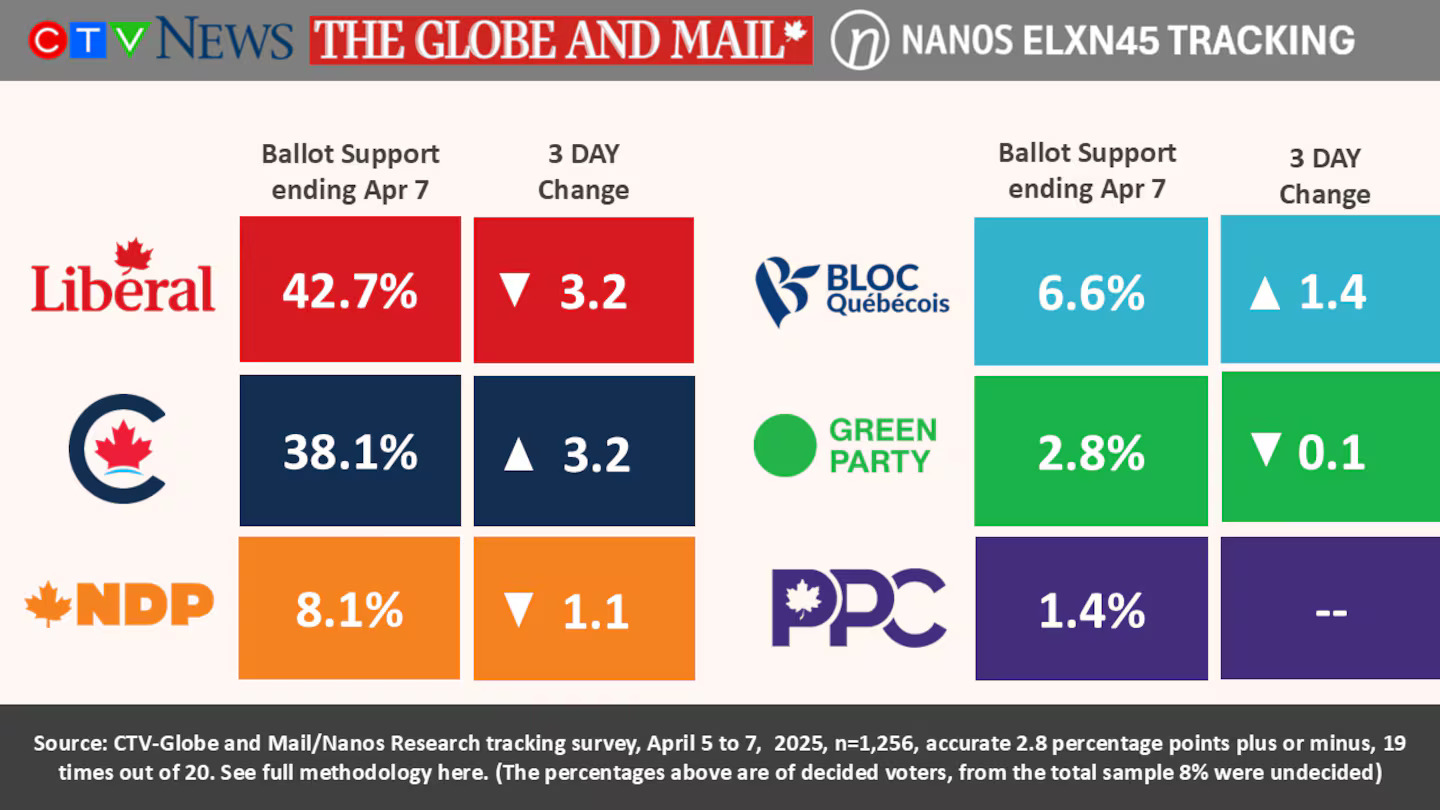
As the federal election campaign enters its third week, a new Nanos Research tracking poll shows the Liberal Party holding a 5-point lead over the Conservatives nationally, though the regional gap is narrowing—particularly in vote-rich Ontario.
According to a three-day rolling sample ending April 7, conducted for CTV News and The Globe and Mail, 43% of decided voters say they support the Liberals, compared to 38% for the Conservatives. The NDP remains at 8%, matching its lowest level of national support in 25 years, while the Bloc Québécois sits at 7%, the Green Party at 3%, and the People’s Party at 1%.
“The Liberals continue to lead in four out of five regions, but the margin is tightening,” said Nik Nanos, Chief Data Scientist at Nanos Research. “Compared to three days ago, the Liberals are down three points, while the Conservatives are up three.”
In Ontario, the Conservatives have made notable gains, now polling at 41%, while the Liberals lead with 48%, down several points from earlier this week. The Conservatives dominate in the Prairies, leading with 59%, compared to 31% for the Liberals.
In Quebec, the Liberals lead with 42%, while the Bloc is gaining ground at 29%, and the Conservatives trail at 19%. In British Columbia, the Liberals continue to perform strongly with 42%, followed by the Conservatives at 32% and the NDP at 18%, their strongest regional showing.
The poll also shows Mark Carney maintaining a strong lead as Canadians’ preferred choice for prime minister. 49% of respondents said they support Carney in the role, compared to 32% for Conservative Leader Pierre Poilievre.
Gender-based tracking reveals a stronger Liberal performance among women, with 46% of women backing the party compared to 30% supporting the Conservatives. Among men, support for the Conservatives remains strong at 46%, while Liberal support has risen slightly to 39%.
With the election campaign evolving, Nanos says the focus is beginning to shift away from U.S. President Donald Trump and toward domestic concerns.
“We’re likely entering a more ‘normal’ campaign period,” Nanos noted, “with voters increasingly focused on jobs, the cost of living, housing, and taxes.”
The 2025 federal election is scheduled for April 28, and with less than three weeks remaining, parties are intensifying their campaigns as the race continues to tighten in key regions.