

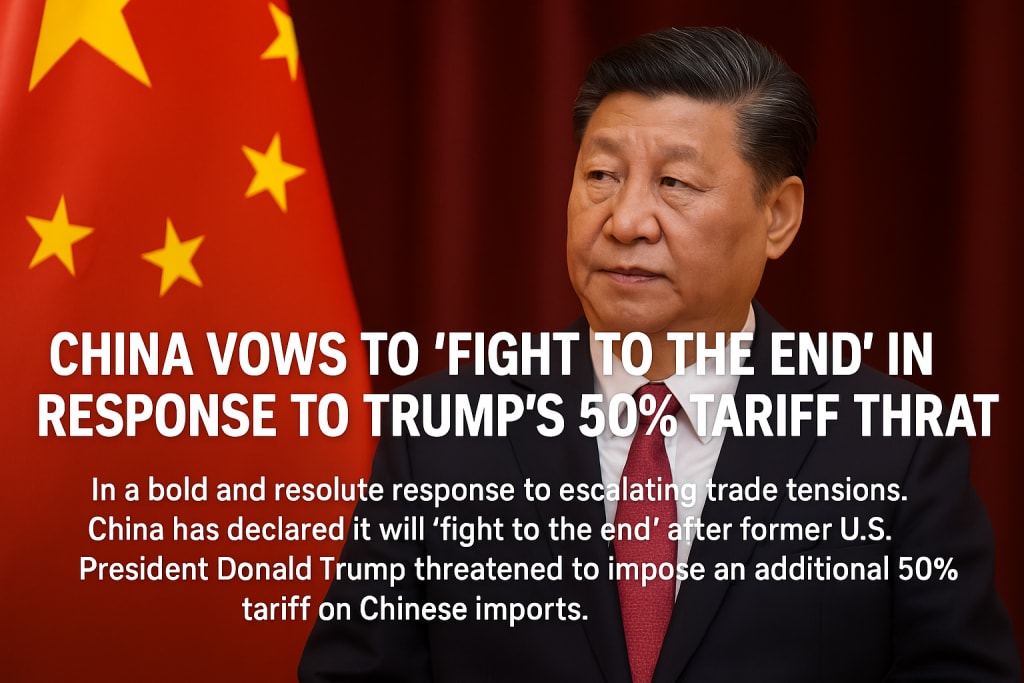
In a bold and defiant response to U.S. President Donald Trump’s latest tariff threats, China’s Ministry of Commerce declared Tuesday that it will “fight to the end” to defend its economic sovereignty and national interests, signaling a further escalation in the intensifying U.S.-China trade conflict.
The warning follows Trump’s announcement on Monday that the U.S. would impose an additional 50% tariff on Chinese imports if Beijing fails to roll back a 34% retaliatory tariff by April 8. The new measures, set to take effect April 9, would bring total U.S. tariffs on Chinese goods to 104%, marking one of the most aggressive trade standoffs between the two nations in modern history.
“The U.S. threat to escalate tariffs on China is a mistake on top of a mistake,” said a statement from China’s Commerce Ministry. “Once again, this exposes the blackmailing nature of the U.S. China will never accept this.”
“If the U.S. insists on its own way, China will fight to the end.”
Calling the U.S. actions “groundless” and “typical unilateral bullying,” Chinese officials emphasized that all countermeasures taken thus far are legitimate efforts to protect the nation’s sovereignty, security, and development interests, as well as the broader international trade order.
Analysts warn the fallout could ripple far beyond the U.S. and China, threatening to destabilize global markets and upend fragile supply chains still recovering from the pandemic and inflationary shocks.
Stock exchanges in Asia, Europe, and North America have already shown increased volatility as traders brace for further disruptions.
In Beijing, citizens expressed a mix of concern and national confidence.
“Trump says one thing today and another tomorrow,” said Wu Qi, a 37-year-old construction worker. “Anyway, he just wants benefits, so he can say whatever he wants.”
Others, especially those in trade-dependent sectors, were less optimistic.
“The European market is more important now,” said Paul Wang, a jewelry exporter. “We’ll need to see how much competition increases there.”
“If the tariffs hit chemicals, we might have to shut down,” said Jessi Huang, a chemical importer. “It would be very hard to recover.”
While specific retaliatory actions were not detailed, Beijing has a range of levers at its disposal. Experts note China could:
- Suspend cooperation on fentanyl enforcement;
- Raise quotas on U.S. agricultural imports;
- Target U.S. service-sector firms in China, such as finance and legal firms.
Total U.S.-China goods trade reached $582 billion in 2024, with a U.S. trade deficit estimated between $263 billion and $295 billion, underscoring the depth of the economic relationship now under strain.
At a media briefing, Foreign Ministry Spokesperson Lin Jian dismissed the Trump administration’s openness to talks.
“I don’t think what the U.S. has done reflects a willingness for sincere dialogue,” Lin said. “If the U.S. really wants to engage, it should adopt an attitude of equality, mutual respect, and mutual benefit.”
In Hong Kong, Chief Executive John Lee condemned the tariffs as “bullying” and pledged to strengthen economic integration with mainland China, increase free trade partnerships, and attract more foreign investment to buffer local industries from tariff shocks.
“This ruthless behavior has brought great risks and uncertainties to the world,” Lee said.
As the global economic fallout mounts, and diplomacy between the two superpowers appears stalled, many fear the world is edging toward a full-scale trade war—with consequences that could affect everything from consumer prices to job security around the globe.