

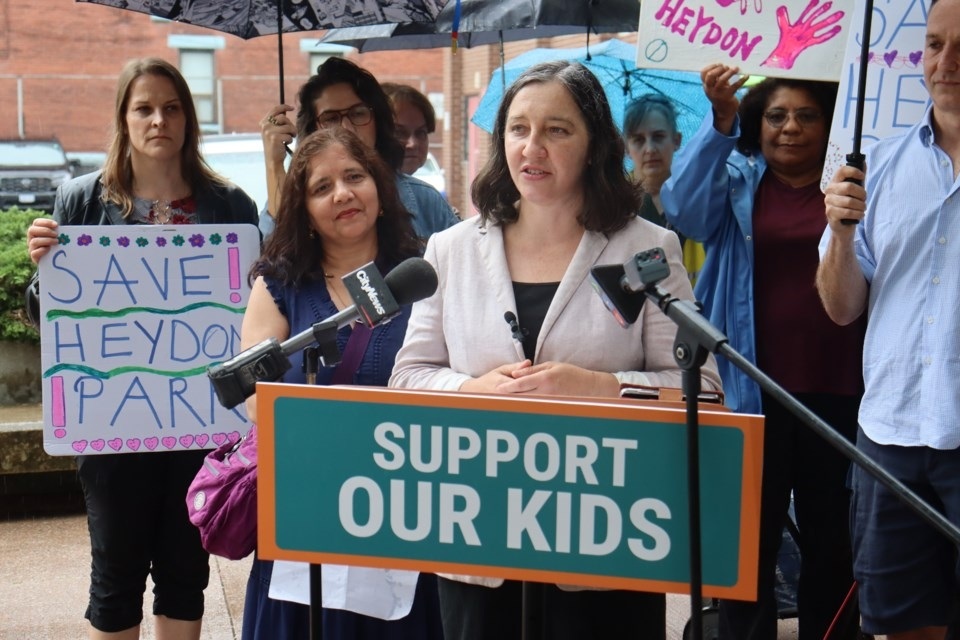
After securing re-election in February, NDP MPP Jessica Bell says 2025 has been a year defined by mounting economic pressure on residents, contentious provincial policies, and what she views as a growing need for public engagement to protect democratic institutions.
Bell, who represents University—Rosedale, spent much of the year advocating for increased special education funding and assisting tenants facing alleged illegal evictions in Kensington Market. In a year-end interview, she reflected on the issues dominating conversations with constituents and offered a pointed critique of the Progressive Conservative government, while also expressing cautious optimism about Toronto’s direction under Mayor Olivia Chow.
According to Bell, affordability remained the most persistent concern raised by residents. Housing and food costs, she said, are pushing many renters—students, seniors and full-time workers alike—into precarious financial situations. She also pointed to rising unemployment as a growing worry, noting that Ontario now has roughly 700,000 people seeking work, the highest level in decades.
Bell said she is increasingly meeting young people who are struggling to find employment or are working reduced hours for wages that no longer cover basic living costs. She described the challenge as widespread, affecting people across educational backgrounds, from recent high school graduates to those with advanced degrees.
Several provincial policy decisions, Bell argued, have compounded these pressures. On the closure of safe consumption sites, she said Toronto continues to face intertwined crises of homelessness, mental health and addiction that require coordinated, evidence-based responses from all levels of government. She criticized the province for shutting down existing sites while promoting HART hubs, which she said are not yet fully operational, leaving communities to deal with increased public drug use and fewer supports for people struggling with addiction.
Bell also raised concerns about changes to tenant protections under Bill 60. While the government backed away from an earlier proposal to remove rent control following public backlash, she said the legislation still makes it easier for landlords to evict tenants who fall behind on rent and limits tenants’ ability to appeal alleged illegal evictions. She described the public response to the initial proposal as a sign of growing renter activism in Ontario.
Education policy was another flashpoint. Bell said parents in her riding are frustrated by what they see as declining quality in public education, driven by funding shortfalls. She criticized the province’s decision to replace elected school board trustees with appointed supervisors, arguing that it sidelines local voices without addressing underlying resource issues.
On transportation, Bell accused the government of misdirecting public frustration by blaming bike lanes for traffic congestion. She said congestion in the Greater Toronto and Hamilton Area can only be addressed through sustained investment in public transit, denser development near transit corridors, and safe walking and cycling infrastructure. Targeting bike lanes, she argued, has deepened tensions between road users without improving traffic flow.
Looking ahead to Toronto’s next municipal election, Bell said she believes the city has made measurable progress under Mayor Olivia Chow. She contrasted Chow’s approach with that of former mayor John Tory, whom she said failed to deliver on promises related to transit and affordable housing. Bell pointed to frozen TTC fares, restored transit service and new dedicated bus lanes as positive steps, while acknowledging that significant challenges remain.
Despite serving her entire tenure as an MPP under a Ford majority government, Bell said she believes opposition members can still drive change. She emphasized the role of public pressure, citing the government’s reversal on Greenbelt development plans as evidence that organized citizen action can influence policy. Much of her work outside Queen’s Park, she said, involves helping tenants form associations and challenge landlords who are allegedly breaking the law—efforts she finds personally rewarding.
Bell also addressed Premier Doug Ford’s past comments about potentially using the notwithstanding clause to remove bike lanes. She said she does not believe the government will pursue that option, describing the threat as a bluff. More broadly, she expressed concern about what she sees as a pattern of democratic erosion, including the frequent passage of legislation without committee review, the expansion of strong mayor powers, the removal of school board trustees and increased provincial involvement in judicial appointments.
While stressing that Ontario remains a democracy, Bell warned that repeated departures from established norms make it harder for the public to influence decisions that affect their lives. She said defending democratic processes can be challenging at a time when many residents are focused on immediate economic survival, but argued that Ontarians still value democratic rights, particularly amid global examples of democratic decline.
Bell said she believes the path forward lies in broad coalitions—bringing together parents, educators, municipal leaders, legal professionals and community members—to collectively push back against policies that weaken public oversight and accountability. In her view, sustained civic engagement remains the most effective tool for shaping Ontario’s future.