

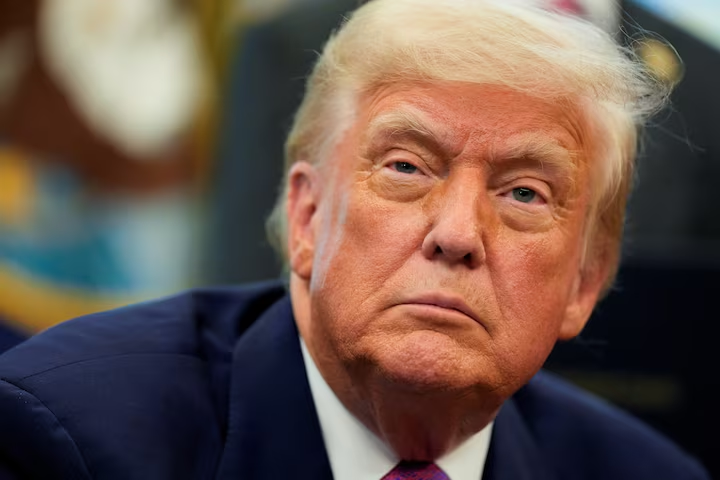
U.S. President Donald Trump sparked fresh controversy on Monday by claiming that the United States not only brokered the ceasefire between India and Pakistan but also prevented a full-scale “nuclear conflict” between the two South Asian rivals. Speaking from the Roosevelt Room of the White House, Trump said he had threatened to halt trade with both nations unless they agreed to end hostilities.
“I said, let’s stop it. If you stop it, we’re doing trade. If you don’t stop it, we’re not going to do any trade,” Trump told reporters, asserting that trade pressure was the key motivator behind the ceasefire deal. He also revealed, for the first time, that the U.S. was preparing to begin trade talks with Pakistan alongside ongoing discussions with India.
However, government sources in New Delhi swiftly rejected these claims, insisting that no mention of trade was made in any of the communications between Indian and U.S. officials during last week’s crisis. According to Indian sources, Vice President J.D. Vance spoke with Prime Minister Narendra Modi on May 9, while Secretary of State and National Security Advisor Marco Rubio had conversations with External Affairs Minister S. Jaishankar on May 8 and NSA Ajit Doval on May 10—just as the ceasefire was being finalized. All discussions, they said, focused solely on de-escalation and security coordination, with no reference to trade negotiations.
Trump also asserted that U.S. diplomacy “stopped the nuclear conflict” between the two countries. “I think it could have been a bad nuclear war. Millions of people could have been killed, so I’m very proud of that,” he said, claiming personal credit for avoiding a potential catastrophe.
His comments are likely to become a focal point of political debate in India, especially in the upcoming meeting of the parliamentary standing committee on external affairs scheduled for Monday, May 19. Foreign Secretary Vikram Misri is expected to brief MPs on the recent military and diplomatic developments, including Operation Sindoor and the ceasefire.
Trump’s reference to a possible nuclear standoff has reignited speculation about Indian airstrikes on May 10, particularly concerning a reported hit on Pakistani military facilities near a suspected nuclear site in the Kirana Hills region near the Mushaf Air Base in Sargodha. While some unconfirmed reports suggested the area may house sensitive nuclear infrastructure, Indian Air Marshal A.K. Bharti denied any such targeting. “We did not hit Kirana Hills—whatever is there,” he stated, without elaborating further.
So far, the Indian government has not issued any official clarification on Trump’s sweeping claims about nuclear tensions or trade threats. However, the silence has drawn criticism from opposition leaders and former diplomats alike, many of whom argue that Trump’s assertions challenge India’s long-standing policy of refusing third-party mediation in its bilateral affairs with Pakistan.
“The Prime Minister’s silence is unacceptable,” said CPM leader Dipankar Bhattacharya. “By not responding, he has failed to reassure the country that India does not accept American or any third-party involvement in matters that are strictly bilateral.” Bhattacharya also demanded an urgent session of Parliament to address the issue and clarify the government’s stance.
As the fallout from Operation Sindoor continues to unfold, Trump’s remarks have not only added diplomatic pressure but also stirred renewed political debate in both Washington and New Delhi over who is really in charge of peace—and who is rewriting the narrative.