

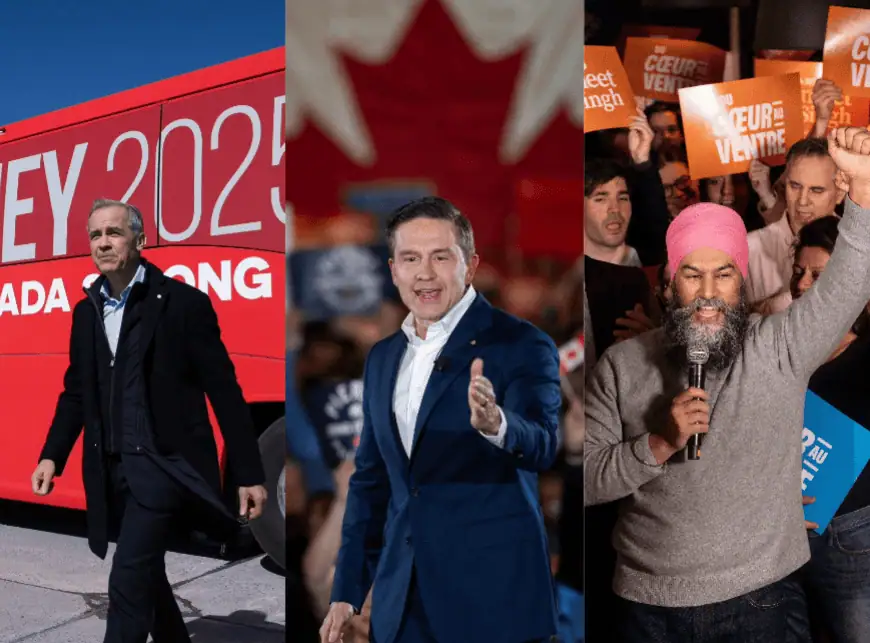
As the final week of Canada’s federal election campaign unfolds, party leaders are making their closing pitches on the issues they believe will move voters—housing, health care, and economic leadership—while federal security officials sounded a fresh alarm over foreign interference.
On Monday, the government’s election interference task force, known as SITE, confirmed it was tracking a transnational repression campaign targeting Joe Tay, the Conservative candidate in Don Valley North. The campaign included the circulation of fake “wanted” posters and disparaging content aimed at discrediting Tay on Chinese-language platforms such as WeChat, Douyin, and RedNote. Officials said the digital assault was originating from accounts associated with Chinese interests—a troubling echo of previous interference efforts earlier in the campaign that targeted Liberal Leader Mark Carney.
Meanwhile, Conservative Leader Pierre Poilievre visited Scarborough and promised bold action on the housing crisis, pledging to release his costed platform on Tuesday—one day after the end of advance polling. Speaking to supporters, Poilievre promised to deliver 2.3 million new homes in five years and made clear that future federal infrastructure funding for cities would depend on their pace of home approvals. Cities accelerating housing construction by at least 15 per cent annually would receive full funding, while those falling short could see their funding reduced. His plan also includes unlocking federal land for development, scrapping the GST on new homes priced under $1.3 million, and encouraging municipalities to cut development charges.
Across the country in Charlottetown, Liberal Leader Mark Carney focused on Canada’s strained health-care system. Addressing the shortage of primary care providers, Carney called on Canadian health-care professionals working abroad—particularly in the United States—to come home. “If you’ve been thinking about returning to Canada, there’s never been a better time,” he urged. A Liberal government, he said, would invest $4 billion to help provinces build more hospitals and clinics, train more doctors and nurse practitioners, and accelerate the recognition of foreign health credentials so internationally trained professionals can practise in Canada more easily.
NDP Leader Jagmeet Singh, campaigning in Nanaimo, British Columbia, outlined his party’s plans to expand pharmacare by year’s end, starting with full coverage of essential medications. Singh criticized both Poilievre and Carney for what he described as weak commitments to the public health-care system. He accused Poilievre of voting against key pharmacare and dental care bills in Parliament, and called Carney’s stance “incomplete,” saying the Liberal leader had not pledged to move beyond early-stage coverage of diabetes medications and birth control.
Singh warned against creeping privatization in provincial health systems and framed his campaign as a fight to protect universal health care. “We will defend public health care for all,” he said, appealing to voters concerned about rising costs and accessibility.
As campaigning continued, all three leaders paused to reflect on the death of Pope Francis, who passed away on Sunday. Carney spoke about the Pope’s lasting moral influence, saying his message reminded the world that “markets don’t have values, people do.” He described Francis’ 2022 visit to Canada as a powerful gesture in the Catholic Church’s path toward reconciliation, especially in the context of the residential school apology. When asked if the apology was sufficient, Carney responded that it was a step, but that the journey toward reconciliation is ongoing.
Singh, who was present at the Pope’s apology in Alberta, echoed that sentiment, calling it a meaningful moment but not enough for many survivors. Poilievre opened his remarks in Scarborough by honoring Francis, praising his inspiration to “millions of Catholics and non-Catholics” alike and offering prayers for the global Catholic community as it mourns.
With just days remaining before election day on April 28, Monday marked the final day of advance polls. Canadians have until 6 p.m. local time Tuesday to vote in person at Elections Canada offices or apply to vote by mail.
As the nation nears the finish line of what has been an intense and high-stakes campaign, voters are being asked to choose between competing visions—one centered on economic and housing reform, another focused on investing in health care, and a third vowing to protect universal services for all.