

The world prepares to bid farewell to Pope Francis, the first Latin American pontiff, whose funeral will take place this Saturday in St. Peter’s Square. As public viewing begins Wednesday inside the basilica, hundreds of thousands are expected to line up to pay tribute to a spiritual leader remembered for his humility, compassion, and reformist zeal.
Cardinals convened on Tuesday in the Vatican’s synod hall to begin laying the groundwork for the upcoming conclave to elect his successor, which, according to protocol, must begin between May 5 and May 10. The funeral Mass, set for 10 a.m., will be led by Cardinal Giovanni Battista Re, the dean of the College of Cardinals. Notable dignitaries including U.S. President Donald Trump and Argentine President Javier Milei are expected to attend.
Pope Francis passed away on Monday at the age of 88 following complications from a stroke. His final public appearance was a poignant one—delivering an Easter blessing from the popemobile, circling the very square where he first appeared to the world in 2013. That moment, twelve years ago, marked the beginning of a papacy committed to revitalizing the Church’s mission to serve the poor and marginalized.
In the hours following his death, tributes poured in from every corner of the globe. Bells tolled in cities large and small, from Rome to New Delhi, while flags were lowered in mourning across continents. Soccer matches in Italy and Argentina were suspended in homage to a pope who never hid his devotion to San Lorenzo, his beloved hometown club.
At the Vatican, those closest to Francis were among the first to bid him farewell. Sister Nathalie Becquart, one of the Vatican’s highest-ranking women, reflected on his unwavering commitment to the people. “He truly gave everything he had, up to the end,” she said, noting his symbolic final blessing on Easter. Cardinal Gianfranco Ravasi highlighted Francis’ legacy of championing women in the Church, pointing to his unusual decision to be buried in the Basilica of St. Mary Major near his favorite icon of the Virgin Mary rather than in the papal crypt beneath St. Peter’s. “He wanted to rest in the shadow of a woman — Maria,” Ravasi noted, underlining the pope’s lifelong efforts to amplify women’s roles in Catholicism.
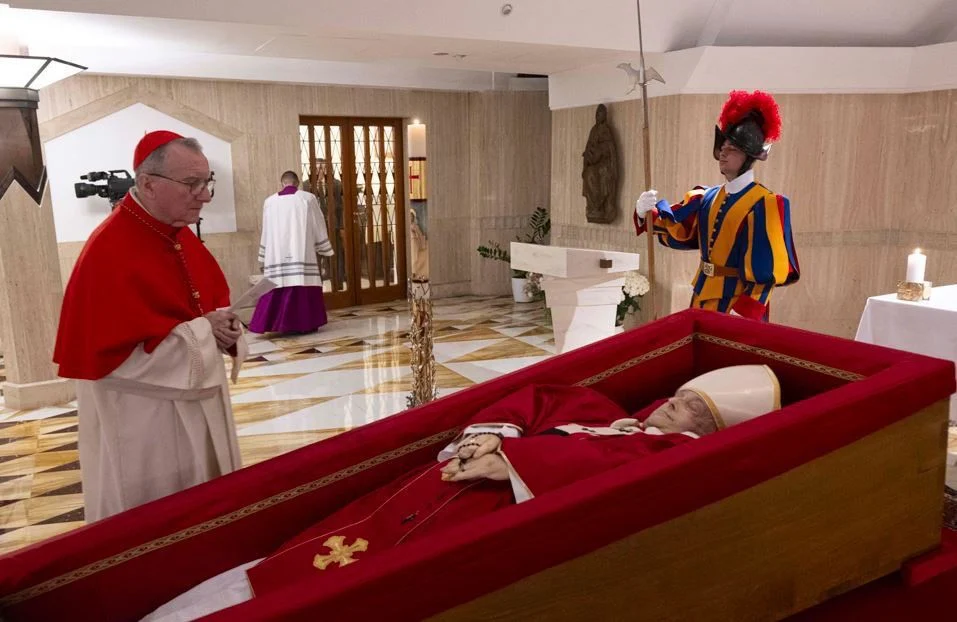
Photographs released Tuesday showed Francis’ body dressed in red papal vestments, resting in a plain wooden casket, with a bishop’s mitre atop his head. The setting was the chapel of Domus Santa Marta, where he lived a modest life in a two-room suite rather than the opulent Apostolic Palace, a choice that embodied his commitment to simplicity.
His final will requested burial at St. Mary Major, home to the Salus Populi Romani icon, before which Francis regularly prayed before and after papal trips. He made his last visit there on April 12, a quiet moment of devotion that now takes on deeper meaning.
Global leaders continued to reflect on the legacy he leaves behind. In East Timor, where over half the population attended his final outdoor Mass last year, President Jose Ramos-Horta praised Francis for speaking truth to power. Nigerian President Bola Tinubu called him a prophetic voice for peace, inclusion, and environmental justice — sentiments echoed by both Catholics and non-Catholics worldwide.
As is tradition, the pope’s formal apartments and his suite in Santa Marta were sealed following his death. Cardinal Kevin Farrell, the camerlengo, led the ritual confirmations. Departing from centuries-old custom, Francis opted not to be entombed in the traditional three coffins. Instead, his body will rest in a simpler wooden casket with a zinc lining, placed humbly facing the pews in St. Peter’s, beside the Paschal candle — a final testament to his devotion to a Church of the people.
Cardinal Baldassarre Reina, vicar for Rome, summed up the essence of Francis’ life during a Mass in his honor: “For him, poor people and migrants were the sacrament of Jesus.”
After the funeral, the Church will enter a nine-day mourning period known as the “novendiali.” During this time, cardinals from around the world will arrive in Rome, meeting privately to prepare for the conclave. Once convened, they will cast secret ballots in the Sistine Chapel. Black smoke signals a failed vote. White smoke announces a new pope.
When the time comes, the world will once again look to the loggia of St. Peter’s Basilica for the historic declaration: “Habemus Papam” — We have a pope.