

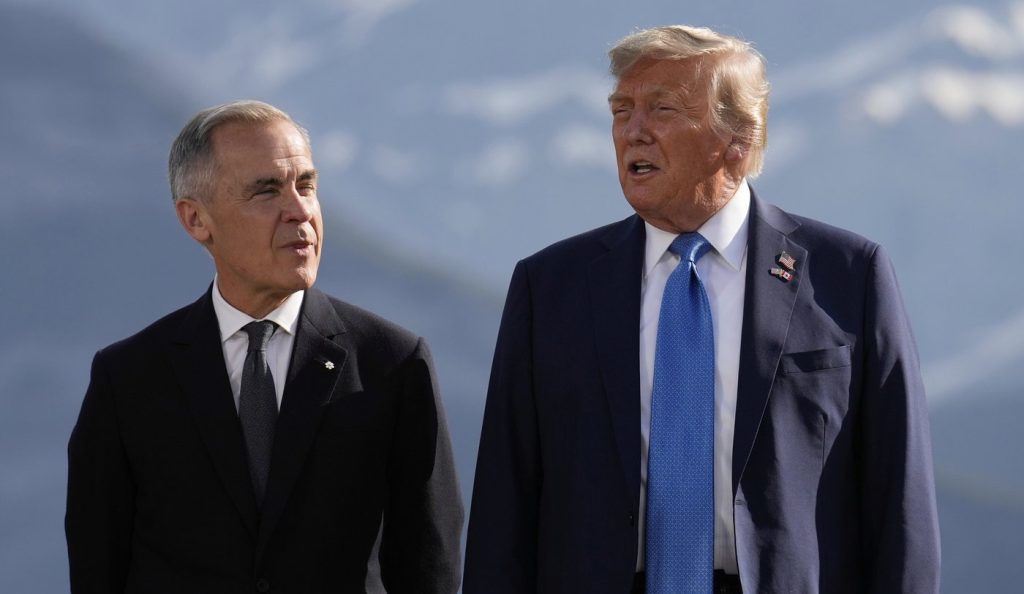
A mandatory review of the Canada–U.S.–Mexico Agreement on trade is set to intensify in 2026, as U.S. President Donald Trump continues his effort to realign global trade and draw key industries back to the United States.
Negotiations over the pact — known as CUSMA — were a major test for Ottawa during Trump’s first term. While the talks were often tense, the agreement that replaced the North American Free Trade Agreement was ultimately hailed as a success by all three countries.
Now, with Trump back in the White House, confidence in the deal’s long-term future has weakened.
During a recent meeting with Prime Minister Mark Carney, Trump described CUSMA as “transitional” and suggested it may have outlived its purpose.
Trade with Canada may not be Trump’s top priority, said Fen Osler Hampson, a professor of international affairs at Carleton University and co-chair of the Expert Group on Canada–U.S. Relations. Instead, he likened it to a hidden but vital force.
“It’s more like the proverbial iceberg,” Hampson said. “It’s what you don’t see that matters — the hidden economic wiring of a very deep and highly interdependent relationship.”
The review process began in the United States in September with public consultations. The Trump administration is expected to send a report to Congress early in the new year outlining the changes it wants.
The formal trilateral review starts in July, though Carney said last week that Canada–U.S. Trade Minister Dominic LeBlanc will travel to Washington in January to begin discussions with U.S. officials.
Under CUSMA, the three countries face a choice: renew the agreement for another 16 years, withdraw from it, or agree to neither renew nor withdraw — a decision that would trigger annual reviews and ongoing negotiations.
Trump’s comments suggest his administration is preparing for longer-term talks, though he has also said the United States could allow the pact to “expire.”
Ryan Majerus, a Washington-based partner at King & Spalding and a former assistant general counsel at the Office of the U.S. Trade Representative during Trump’s first term, said he expects the process to resemble the original negotiations.
“The U.S. has concerns about how it’s operated in the past five years, as do our trading partners, and they’ll just hash it out in negotiating rooms,” Majerus said.
Trump has repeatedly criticized long-standing irritants in the U.S.–Canada trade relationship, including Canada’s supply management system for dairy, alleged subsidies to the softwood lumber sector and other non-tariff barriers. Observers expect those issues to return to the negotiating table.
U.S. Trade Representative Jamieson Greer told a congressional committee last week that Washington is also concerned about the impact of Canada’s Online Streaming Act and Online News Act on American digital services companies.
Successive U.S. administrations have opposed Canada’s digital services tax, which Carney paused earlier this year in hopes of easing tariff tensions.
Greer also said the U.S. is frustrated by provincial bans on American alcohol sales, imposed in response to tariffs placed on Canada after Trump’s re-election.
Automobiles are expected to be another flashpoint. While CUSMA introduced stricter regional content and labour rules, the highly integrated North American auto industry has been disrupted by Trump’s Section 232 tariffs.
“It’s pretty obvious the U.S. will push for greater regional content in the U.S.,” Majerus said.
For Canada, energy and critical minerals are likely to be key bargaining chips. The Trump administration’s push to expand artificial intelligence data centres is driving demand for energy — a need Canada could help meet.
Washington is also seeking to loosen China’s grip on the global critical minerals supply chain. Majerus said the U.S. could offer trade concessions in exchange for a more reliable Canadian supply.
By the time talks begin in earnest, the U.S. Supreme Court is expected to rule on Trump’s use of the International Emergency Economic Powers Act to impose sweeping tariffs on trading partners. If the court curtails that authority, it could significantly alter the negotiating landscape.
The talks will also unfold against the backdrop of a contentious U.S. midterm election campaign, as Democrats seek to regain control of Congress. Even if control shifts, it remains unclear what role lawmakers would play in any changes to CUSMA.
“That may be an interesting point of contention,” said Greta Peisch, former general counsel at the Office of the U.S. Trade Representative and now a partner at Wiley Rein in Washington. “How extensive are the changes? Do they require review by Congress? And those answers aren’t always crystal clear.”
Peisch noted that if Trump chooses to withdraw from the agreement altogether, he may be able to do so without congressional approval.
Trump has frequently claimed he holds the upper hand in trade disputes, and his aggressive tariff strategy has unsettled long-standing assumptions about global commerce. Under Carney, Canada has moved to reduce internal trade barriers and diversify its trading partners to lessen dependence on the U.S. market, though those efforts remain in early stages.
Peisch said it is still too soon to judge which country will have greater leverage in the talks.
“I think it depends on what your objectives are in the near, medium and long term,” she said, “and how you’re positioning yourself for future eventualities.”