

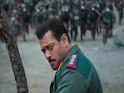
China’s state-run media has reacted sharply to the teaser of Battle of Galwan, a forthcoming Hindi-language war drama starring Salman Khan, accusing the film of misrepresenting the 2020 India-China military clash in eastern Ladakh and inflaming nationalist sentiment.
The film, directed by Apoorva Lakhia, is based on the deadly hand-to-hand fighting between Indian and Chinese troops in the Galwan Valley in June 2020. Khan portrays Colonel Bikkumalla Santosh Babu, the commanding officer of the 16 Bihar Regiment who was killed during the confrontation with troops from China’s People’s Liberation Army (PLA).
China’s criticism
In an article published by Global Times, Chinese commentators claimed the film “does not align with the facts” of the Galwan clash and dismissed it as an exaggerated, emotionally driven portrayal.
“The Bollywood films at most provide an entertainment-driven, emotionally charged portrayal, but no amount of cinematic exaggeration can rewrite history or shake the PLA’s determination to defend China’s sovereign territory,” the article said.
The report described Colonel Santosh Babu’s actions as a “so-called pivotal role” and alleged that India bears responsibility for the clash, claiming Indian troops crossed the Line of Actual Control (LAC) and provoked the fighting. It also asserted—contrary to India’s position—that the Galwan Valley lies on the Chinese side of the LAC.
India has officially acknowledged the loss of 20 soldiers in the brutal, weaponless combat. China initially denied suffering casualties, later stating that four of its troops were killed—a figure widely disputed in India.
The Global Times further accused India of exaggerating casualty numbers and using films, particularly Bollywood productions, to stir nationalist sentiment.
Indian reactions
Indian filmmakers have pushed back strongly against the Chinese media’s claims. Speaking to NDTV, filmmaker Ashoke Pandit said the reaction from Beijing was unsurprising.
“When an Indian filmmaker makes a film, he ensures that the activities of our adversary are exposed,” Pandit said, calling the criticism a reflection of insecurity rather than fact-based disagreement.
Actor-producer Rahul Mitra also dismissed the allegations, noting that Global Times is widely seen as a government mouthpiece.
“Films are made with extensive research, and with people like Apoorva Lakhia and Salman Khan involved, I don’t think they would distort facts just to make a movie,” Mitra said, adding that labelling the film a “nationalist melodrama” ignored the rigour involved in serious filmmaking.
Government response
Indian government sources told NDTV that the state has no involvement in the production of Battle of Galwan. Emphasizing India’s commitment to freedom of expression, the sources said filmmakers are free to create works based on their artistic vision.
“India is a country with freedom of expression, and cinematic expression is an integral part of it,” the sources said, adding that those with concerns about the film may approach the Ministry of Defence for clarification.
The controversy highlights how the legacy of the 2020 Galwan Valley clash—one of the most serious India-China confrontations in decades—continues to shape diplomatic tensions, even through popular culture.