

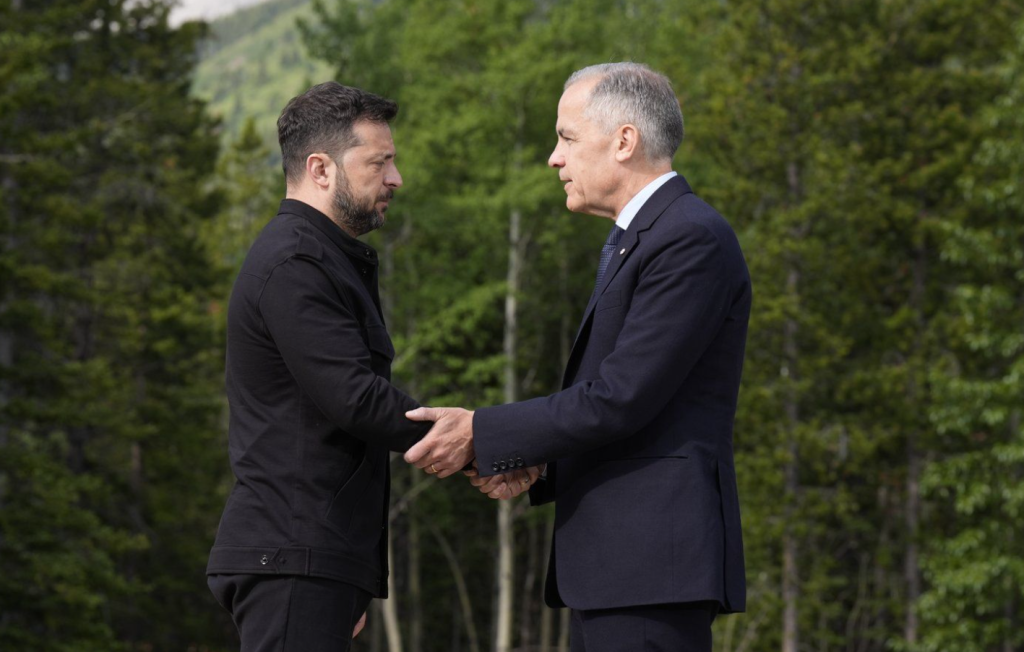
Prime Minister Mark Carney has pledged $4.3 billion in new support to Ukraine as he hosted Ukrainian President Volodymyr Zelenskyy during a pivotal meeting at the G7 summit in Alberta on Tuesday. The comprehensive package includes $2 billion in military donations for drones, ammunition, and armored vehicles—investments that Canada will count toward its NATO defence spending target—and an additional $2.3 billion in loans to help rebuild Ukraine’s shattered infrastructure.
Carney’s office clarified that the loans will be repaid using interest accrued on Russian assets frozen in Europe. In parallel, Canada also unveiled a new sanctions package aimed at weakening Russia’s wartime economy, specifically targeting its so-called “shadow fleet” and energy revenues. The sanctions name 77 individuals, 39 entities, and 201 vessels suspected of helping Russia circumvent international restrictions by moving oil, gas, and weapons.
Meeting with Zelenskyy on Tuesday morning, Carney issued a strong condemnation of the latest Russian assault on Kyiv, which killed 12 and injured more than 130 in what Zelenskyy described as the deadliest attack on the capital this year. The strikes targeted civilian infrastructure, including residential areas.
“This underscores the importance of standing in total solidarity with Ukraine and maintaining maximum pressure on Russia, which continues to avoid peace negotiations,” Carney said. Zelenskyy emphasized Ukraine’s openness to peace talks and an unconditional ceasefire, but insisted that more international pressure is needed to bring Russia to the table.
The United Kingdom joined Canada in tightening the financial noose on Russia, announcing sanctions on vessels involved in transporting Russian oil. The broader G7 discussion is increasingly focused on leveraging economic measures to counter Moscow’s military aggression.
Carney also met with NATO Secretary-General Mark Rutte, reaffirming Canada’s intention to reach the long-delayed two per cent GDP target for defence spending. The Trudeau-era shortfall in military investment has drawn criticism for years, but Carney said Canada is now “stepping up to meet our commitments,” citing new defence budget plans announced earlier this month.
The G7’s final day proceeded without U.S. President Donald Trump, who abruptly left the summit on Monday, citing escalating violence in the Middle East. His absence came as Carney prepared to lead sessions focused heavily on foreign policy. U.S. Treasury Secretary Scott Bessent remained in Canada to head the American delegation.
Trump, speaking from Air Force One, reignited controversy with his comments about making Canada a U.S. state, saying it would be “a much better deal” for Canada, but ultimately “up to them.” He warned that without joining the U.S., Canada would face tariffs and a $71 billion price tag to be part of his proposed “Golden Dome” missile defence system, a remark loosely referencing the Iron Dome.
Meanwhile, Indian Prime Minister Narendra Modi is expected to meet Carney later today following multilateral discussions on energy sovereignty. Modi’s visit has drawn loud protests from Sikh separatist groups, fueled by unresolved tensions stemming from the 2023 killing of Hardeep Singh Nijjar in B.C. and ongoing RCMP investigations that allege Indian government involvement in serious crimes on Canadian soil.
As host of this year’s G7 summit, Carney is using the global platform to sharpen Canada’s role in shaping the international response to authoritarian aggression, economic instability, and evolving geopolitical alliances.