

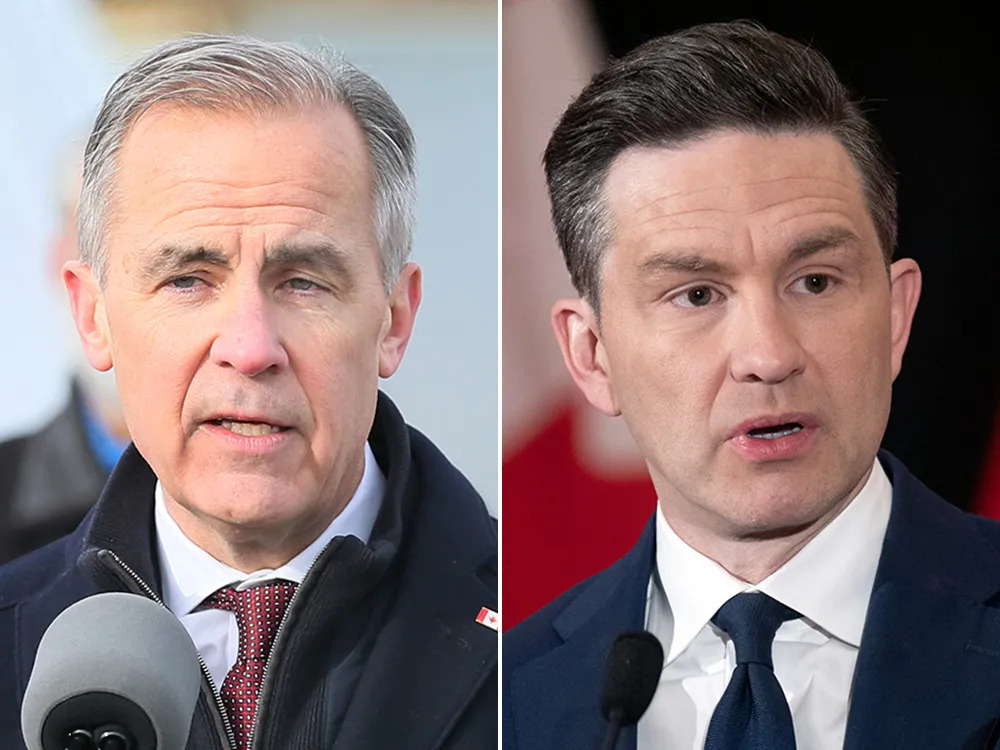
Polls Favor Carney Over Poilievre as Best Negotiator Against Trump Tariffs
The United States, under President Donald Trump, recently imposed sweeping tariffs on Canadian imports, escalating economic tensions between the two nations. The move, which includes a 25% tariff on all goods from Canada and a 10% tariff on Canadian energy exports, has been met with strong reactions from Canadian leaders. While Prime Minister Justin Trudeau has implemented retaliatory measures, the responses from Mark Carney and Pierre Poilievre—two key political figures in Canada—have sparked debate over who is best suited to handle negotiations with Trump.
Trump justified the tariffs under the International Emergency Economic Powers Act, citing concerns over border security, immigration, and illegal drug trafficking. The Canadian government, led by Prime Minister Justin Trudeau, responded swiftly with $85 billion CAD worth of retaliatory tariffs on U.S. goods, targeting industries that would have the most economic impact on the U.S.
he Bank of Canada also reacted by cutting its key policy rate by 25 basis points to 3% due to concerns about long-term economic harm from a protracted trade war.
Amid public discontent, particularly visible in Canadian sports arenas where fans booed the U.S. national anthem, Trudeau initiated diplomatic negotiations with Trump. A temporary 30-day pause was agreed upon in exchange for enhanced Canadian border security measures to address fentanyl smuggling .
Mark Carney, former Governor of the Bank of Canada and Bank of England, has positioned himself as a strong defender of Canada’s economic interests. Carney labeled Trump’s tariffs “a violation of trade agreements” and emphasized Canada’s need to retaliate decisively.
Carney’s key strategies include:
- Targeted countermeasures: Implementing retaliatory tariffs that minimize harm to Canada while severely impacting U.S. industries.
- Trade diversification: Reducing dependence on the U.S. by strengthening trade relationships with other global partners.
- Economic resilience: Advocating for long-term strategies that prioritize Canadian manufacturing, innovation, and green energy industries.
Carney stated, “Canada will not bow down to a bully. We won’t stand by as illegal U.S. tariffs hurt our workers and their families.” He also emphasized that diplomatic negotiation, backed by economic leverage, is the best way forward .
Conservative Party leader Pierre Poilievre has taken a stance, calling the tariffs “massive, unjust, and unjustified.” He urged the Canadian government to end the prorogation of Parliament and immediately implement dollar-for-dollar retaliatory tariffs on U.S. goods.
Poilievre’s key proposals include:
- Strong countermeasures: Implementing retaliatory tariffs equivalent to U.S. tariffs.
- Economic self-sufficiency: Strengthening domestic industries through tax cuts, regulatory reforms, and infrastructure development.
- National security and economic independence: Cutting foreign aid and redirecting funds to build a military base in the Arctic to assert Canadian sovereignty.
Poilievre has accused Trudeau’s government of being weak in trade negotiations, stating that Canada should adopt a “Canada First” approach to command respect on the global stage .
A recent Nanos Research survey found that 40% of Canadians believe Mark Carney is the best leader to negotiate with Trump, compared to 26% for Poilievre. The preference for Carney spans most regions, except in the Prairies, where Poilievre holds an edge .
Carney’s international experience and diplomatic finesse have earned him public trust, while Poilievre’s more combative approach resonates with those seeking a tougher response.
Despite Poilievre’s rhetoric against tariffs, he has faced criticism for not directly confronting Trump on broader policies. Unlike Carney, who has framed the tariffs as part of a larger geopolitical issue, Poilievre’s approach has focused primarily on retaliatory measures without engaging in deeper diplomatic discussions.
Some analysts suggest that Poilievre’s cautious stance toward Trump may be politically strategic, as he seeks to avoid alienating conservative voters who admire Trump’s leadership style. Others believe that Poilievre prioritizes a domestic economic agenda over extensive trade negotiations with the U.S.
The Trump tariffs crisis has underscored two very different leadership styles in Canada:
- Mark Carney’s approach: A diplomatic and strategic response, leveraging economic resilience and international partnerships.
- Pierre Poilievre’s approach: A nationalist, hardline strategy focusing on economic independence and strong countermeasures.
As the situation evolves, Canadians will have to decide which vision aligns best with the nation’s long-term economic and geopolitical interests. Will Carney’s expertise in global finance or Poilievre’s tough stance on economic sovereignty shape Canada’s trade future?