

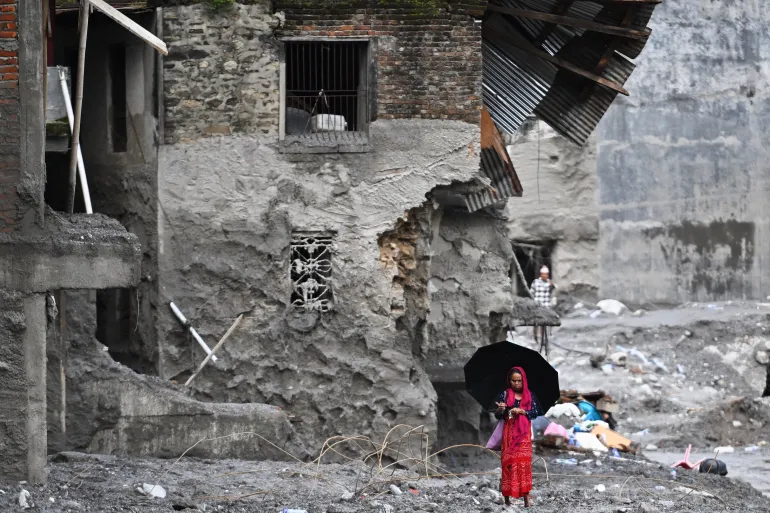
KATHMANDU — The scale of the Himalayan flood disaster continues to grow, with more than 1,000 people now confirmed dead in Nepal and China and over 4,400 still missing as rescue teams race to reach devastated communities and hundreds of workers feared trapped inside hydropower tunnels.
The combined death toll reached 1,019 on Tuesday, making the disaster one of the deadliest natural catastrophes to strike the Himalayan region in recent years.
Nepal has suffered by far the greatest losses. The country’s National Disaster Risk Reduction and Management Authority increased its confirmed death toll from 987 to 1,003, while 3,916 people remain missing.
Among those unaccounted for are 583 foreign nationals, adding an international dimension to the massive search and rescue operation.
Chinese authorities have separately reported 16 deaths and 546 people missing, including 261 foreigners.
The catastrophe began on Aug. 26 high in the Himalayas when a massive glacial collapse sent enormous quantities of rock, ice and meltwater crashing into valleys below. The collapse triggered powerful flash floods that swept downstream through communities and infrastructure along the Nepal-China border region.
Scientists examining satellite imagery believe the initial collapse may have involved the failure of bedrock beneath a glacier, creating a chain reaction that unleashed the destructive floodwaters.
Attention is now increasingly focused on Nepal’s hydropower facilities, where hundreds of workers are feared trapped inside tunnels.
Authorities initially estimated that more than 900 workers were missing from affected hydropower projects. Nepalese Prime Minister Balendra Shah said 279 workers have so far been rescued as teams continue attempting to reach others.
The tunnels present a particularly difficult challenge for rescue crews because they may be filled or blocked by mud, rocks and debris.
Images from the rescue operation have shown heavy earth-moving equipment digging through enormous quantities of mud and rock, including during nighttime operations under powerful lights.
Soldiers have also been using flashlights while digging large openings in an attempt to find possible access points into blocked tunnels.
Nepal has experienced rapid expansion of hydropower development since the beginning of this century as the mountainous country attempts to use its enormous Himalayan water resources to meet domestic electricity needs and export power to neighbouring India.
Many of those projects rely on extensive tunnel networks that carry water through steep mountain terrain to power-generating facilities.
Those same tunnels have now become some of the most difficult locations for rescuers searching for survivors.
Despite the enormous destruction, rescue teams have managed to save more than 11,000 people across affected areas.
Electricity and communications have also been restored in some communities, while damaged roads are gradually being reopened.
Prime Minister Shah said road access had been restored to Nuwakot, one of the districts hit hardest by the disaster, allowing rescuers and humanitarian supplies to reach communities that had been cut off.
But as teams gain access to previously unreachable locations, the death toll is continuing to rise.
Police official Bipin Regmi said rescuers recovered 24 bodies from a single house in Betrabati village in Nuwakot.
Authorities fear similar discoveries could follow as search teams enter more isolated communities.
The humanitarian consequences are enormous, with thousands of people having lost their homes, property and family members.
Shah acknowledged the scale of the suffering and said the government’s challenge now extends beyond rescue operations to supporting survivors and helping devastated communities eventually rebuild their lives.
International assistance is beginning to arrive in significant amounts.
More than $42 million worth of aid has already been pledged or delivered to Nepal, according to the prime minister, with additional assistance expected.
Neighbouring India and China are participating in rescue and reconstruction efforts, including helping construct temporary Bailey bridges to restore access to isolated communities where permanent bridges and roads have been destroyed.
The disaster has also become an international search operation because of the large number of foreign visitors believed to have been in the Himalayan region when the floods struck.
With hundreds of foreigners among the missing in Nepal and China, governments around the world are attempting to determine the whereabouts of their citizens.
For rescuers, however, time is becoming increasingly critical.
Nearly a week after the initial catastrophe, the possibility of finding survivors becomes more difficult with every passing day, particularly for people who may remain trapped underground or in isolated mountain communities.
Yet rescue teams continue digging through mud, clearing roads and searching tunnels in the hope that more people can still be brought out alive.
With more than 1,000 confirmed dead and thousands still unaccounted for, the full human cost of the Nepal-China flood disaster has yet to be determined — and authorities fear the numbers could rise substantially as rescuers finally reach areas that have remained cut off since the catastrophe began.