

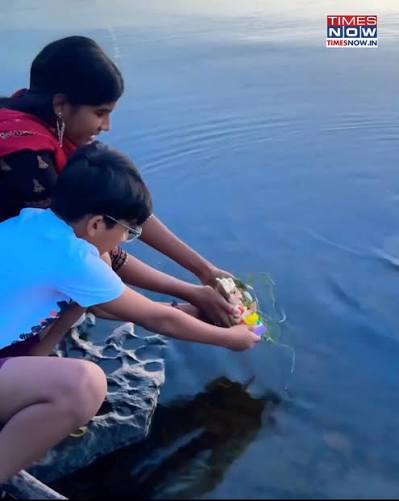
A video showing an Indian family immersing a small Lord Ganesha idol in a Canadian lake has ignited a heated online debate about balancing cultural traditions with environmental responsibility and respecting local practices.
The clip, which circulated widely on social media, shows two children placing a colourful Ganesha idol and floral offerings into the water while family members record the moment. While the idol sank beneath the surface, flowers and other offerings remained floating on the lake. The video was accompanied by a caption criticizing the act and quickly attracted thousands of comments and strong reactions.
The incident prompted divided opinions. Some social media users defended the family, arguing that traditional Ganesha idols are often made from clay and other biodegradable materials that naturally dissolve without causing significant harm to the environment. Others contended that even biodegradable offerings should not be placed in lakes and rivers, especially in countries where such practices may violate environmental regulations or public expectations.
Many commentators stressed that the issue should not be portrayed as a reflection of Hinduism itself. Several users pointed out that no Hindu scripture or religious teaching encourages the pollution of water bodies and argued that individual behaviour should not be used to judge an entire faith or community.
Others emphasized the importance of adapting customs when living abroad and respecting local environmental standards. They argued that preserving cultural traditions should go hand in hand with ensuring that natural ecosystems remain protected.
The discussion also highlighted a broader trend within India and the global Hindu community, where many temples and organizations have increasingly promoted eco-friendly celebrations, encouraging devotees to use natural clay idols and designated immersion tanks rather than rivers and lakes.
The location of the incident and whether any local bylaws were violated have not been officially confirmed. No authorities have publicly commented on the matter.
As the video continues to generate debate, it has raised larger questions about how immigrant communities can preserve cultural and religious traditions while adapting them to the environmental norms and regulations of their adopted countries.
Many observers noted that respect for faith and respect for nature need not be conflicting values, and that traditions can evolve in ways that honour both cultural heritage and environmental stewardship.