

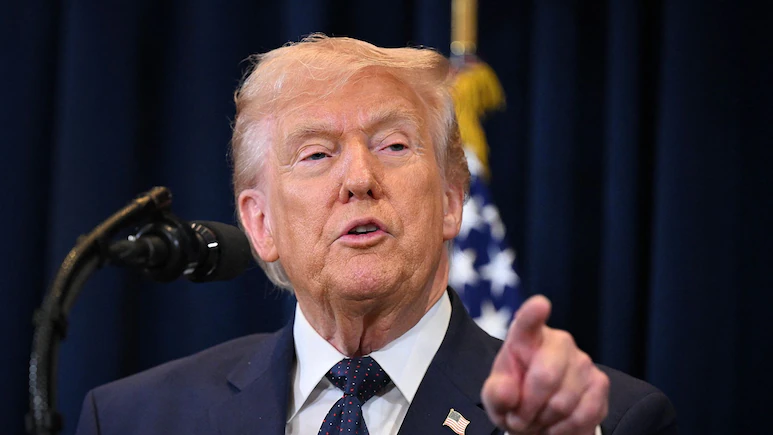
U.S. President Donald Trump says he has asked several countries to deploy naval forces to help secure the Strait of Hormuz as the ongoing war involving Iran continues to disrupt global oil shipments and push energy prices higher.
Speaking to reporters aboard Air Force One while returning to Washington, Trump said he has pressed about seven countries to contribute warships to patrol the key shipping route. However, he acknowledged that none of the nations approached so far have committed to joining the proposed coalition.
The Strait of Hormuz is one of the world’s most critical energy corridors, with roughly one-fifth of globally traded oil passing through the narrow waterway. Disruptions to shipping in the area have already triggered sharp increases in oil prices and raised concerns about global supply.
Trump argued that countries heavily dependent on Middle Eastern oil should take a larger role in protecting the route. He said the United States relies far less on oil shipments through the strait than other major economies.
The president did not specify which nations he had formally approached but has previously urged countries such as China, Britain, France, Japan and South Korea to participate in an international effort to secure the waterway.
Meanwhile, Iran’s foreign minister Abbas Araghchi said several countries have contacted Tehran seeking safe passage for commercial vessels through the region. He said Iranian authorities have allowed some ships from different nations to pass but insisted decisions about maritime access ultimately rest with Iran’s military.
Tehran has said the strait remains open to international shipping but warned that vessels linked to the United States and its allies could face restrictions amid the conflict.
Officials in several countries have responded cautiously to Trump’s request. Britain confirmed that Prime Minister Keir Starmer discussed the situation with Trump and emphasized the importance of reopening the strait to restore global shipping flows. However, British officials have not announced any plans to deploy naval forces.
China also indicated it is monitoring the situation but stopped short of committing to military involvement. South Korea said it would review the request in coordination with the United States.
France has said it is exploring the possibility of a multinational mission to escort commercial vessels through the strait but stressed that such an operation would depend on security conditions in the region.
The conflict has already spread across several parts of the Middle East. Iranian missile and drone attacks have struck targets in Gulf countries including the United Arab Emirates, Saudi Arabia, Kuwait and Bahrain. Some strikes have hit civilian infrastructure such as airports, oil facilities and commercial buildings.
In one incident, flights were temporarily suspended at Dubai’s international airport after a drone strike caused a fire at a nearby fuel tank. Authorities said the blaze was quickly contained and no injuries were reported.
The conflict began after coordinated U.S. and Israeli strikes on Iranian targets in late February. Since then, hundreds of missiles and drones have been launched across the region, causing casualties and damage in multiple countries.
Humanitarian agencies say the war has taken a growing toll on civilians. In Iran, more than 1,300 people have reportedly been killed in the fighting, including women and children. Casualties have also been reported in Israel, Gulf states and Lebanon as the conflict expands.
International energy authorities are now preparing to release emergency oil reserves to stabilize markets. The International Energy Agency said member countries plan to release more than 400 million barrels of oil to help ease supply pressures caused by the conflict.