

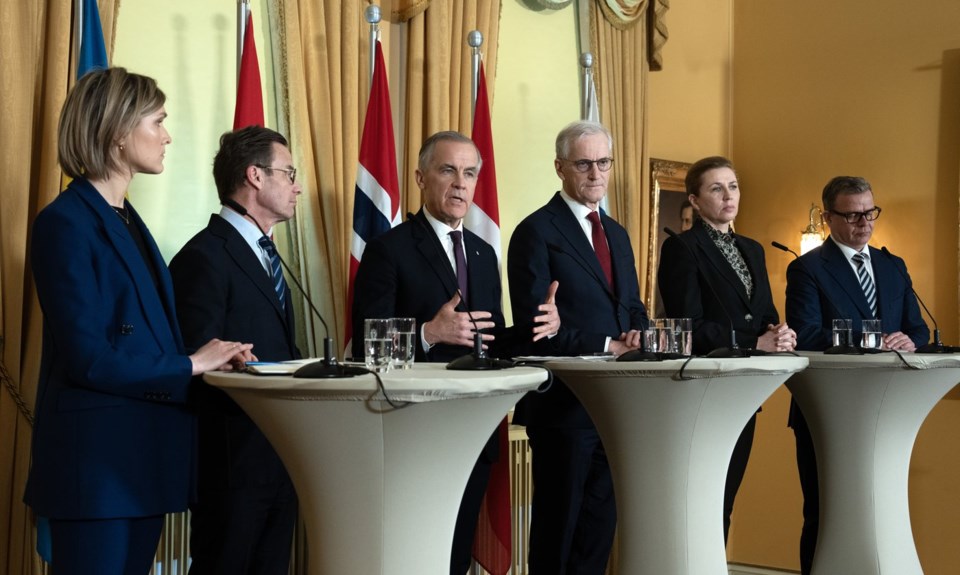
The leaders of Canada and several Nordic nations have agreed to deepen economic ties and strengthen co-operation on Arctic security as global trade and technology increasingly become tools of geopolitical pressure.
Prime Minister Mark Carney concluded a visit to Norway with a summit in Oslo alongside the prime ministers of Norway, Denmark, Iceland, Sweden and Finland. The meeting focused on protecting Arctic sovereignty, expanding economic partnerships and responding to rising international tensions.
In a joint statement following the summit, the leaders said that growing geopolitical uncertainty, conflicts and global crises make international collaboration based on shared values and international law more important than ever. They emphasized that stronger co-operation among like-minded nations is essential to protect security and prosperity.
Discussions also highlighted the need to expand trade and investment links, particularly as recent global disruptions — including tariffs and geopolitical tensions — have affected economic stability among allied nations. The leaders stressed that closer economic collaboration can help strengthen resilience in an increasingly uncertain global environment.
During a news conference after the meeting, Danish Prime Minister Mette Frederiksen said the traditional global order has changed significantly and may not return in the same form, making it necessary for democratic nations to work together to build a new framework based on shared principles.
Questions were also raised about the sovereignty of Greenland, a self-governing territory within the Kingdom of Denmark, following earlier statements by the United States about potential strategic interest in the island. Carney said the future of Greenland should be determined by its people and Denmark, and stressed that respect for territorial sovereignty remains a fundamental international principle.
He added that Canada and the Nordic countries can strengthen their sovereignty by working more closely together, particularly in the Arctic region through defence collaboration and economic partnerships. Other leaders at the summit echoed support for Denmark and Greenland.
Norwegian Prime Minister Jonas Gahr Støre said the defence of national sovereignty and territorial integrity remains a critical issue for democratic nations, particularly in the Arctic, where strategic and security challenges are increasing.
Leaders also pointed to Russia as the primary security threat in the region. Finnish Prime Minister Petteri Orpo said Nordic and Arctic countries must continue strengthening security co-operation to address growing military concerns.
At the same time, NATO is conducting its large-scale Cold Response military exercises in northern Norway and Finland, involving tens of thousands of troops from multiple allied nations.
Carney was also asked about Canada’s ongoing review of bids for new submarines, including proposals involving German, Norwegian and South Korean companies, as well as the possibility of acquiring Swedish fighter jets. He said the procurement process remains independent and under review.
The joint statement issued after the meeting reaffirmed the leaders’ commitment to continue working together on Arctic security, expand trade and investment partnerships, and promote sustainable economic growth.
Following the summit, Carney travelled to London where he is scheduled to meet with Keir Starmer. Officials said the two leaders plan to discuss bilateral relations and international developments, including ongoing conflicts in the Middle East and the impact of disruptions to global shipping routes.
Carney is also expected to meet with King Charles III during his visit before remaining in Europe for a brief vacation while maintaining contact with government officials in Canada.