

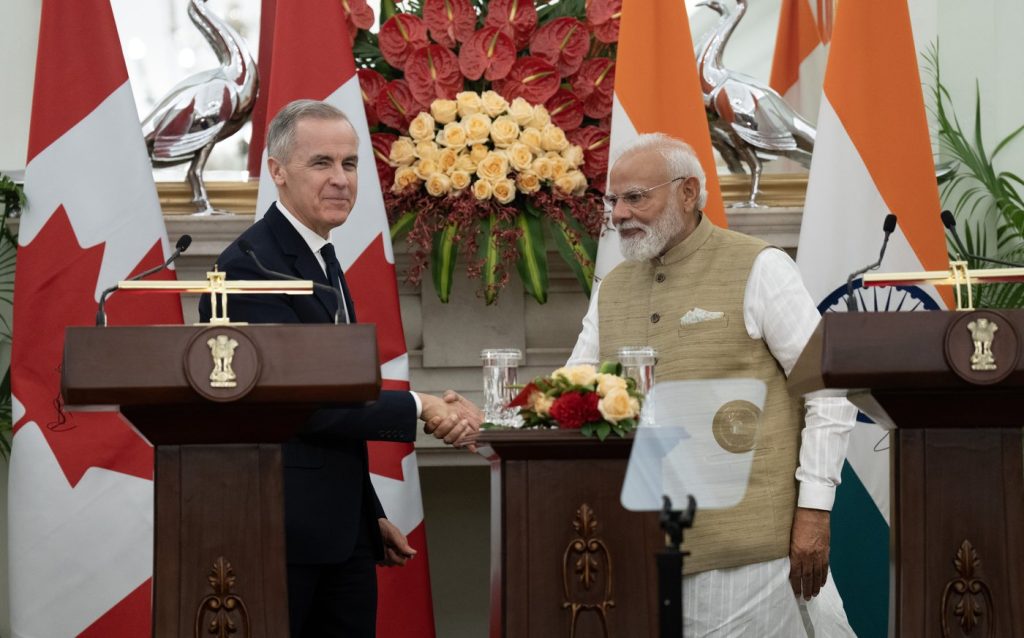
Several Canadian renewable energy organizations are praising new agreements between Canada and India aimed at expanding cooperation in solar, wind and hydrogen power development.
The announcements came during the recent visit of Prime Minister Mark Carney to India, where he spent four days in Mumbai and New Delhi before concluding the trip with a meeting with Indian Prime Minister Narendra Modi. The visit resulted in a series of agreements, including a new strategic energy partnership between the two countries.
As part of the collaboration, Canada has committed to joining the International Solar Alliance, a global initiative launched by India to accelerate solar energy development. Canada had previously been one of the few G7 countries not participating in the alliance.
In another development, Simon Fraser University signed a partnership with the Hydrogen Association of India to advance research and innovation in hydrogen technologies.
Canada also confirmed it will become a full member of the Global Biofuels Alliance, a group launched by Modi during the 2023 G20 summit to promote the global adoption of biofuels. Canada previously held observer status in the alliance.
Rachel Doran, executive director of Clean Energy Canada, said the agreements reflect Canada’s renewed focus on multilateral cooperation — an approach highlighted in Carney’s speech earlier this year at the World Economic Forum in Davos.
Doran noted that as global energy markets evolve, countries are increasingly seeking alternatives to supply chains dominated by a single country.
“We know there’s going to be a glut of things like LNG on the horizon, whereas something like solar battery supply chains are areas where many countries are trying to ensure there are multiple options,” she said.
Partnering with a rapidly expanding energy market such as India, she added, sends a strong signal about Canada’s evolving global strategy in clean energy technologies.
India has become one of the world’s fastest-growing renewable energy markets. According to the country’s Ministry of New and Renewable Energy, India currently generates more than 271 gigawatts of electricity from renewable sources, with renewables accounting for more than half of its total power capacity.
Vittoria Bellissimo, president and CEO of the Canadian Renewable Energy Association, said Canada could benefit from India’s experience in scaling up solar energy and battery storage systems.
“India is building its electricity system faster than ever before,” she said. “They’re going to depend heavily on solar and learn how to build it in ways that Canada hasn’t thought of yet.”
Alongside renewable energy cooperation, Canada and India also signed agreements on supplying India with uranium and critical minerals, potentially expanding Canada’s energy export markets.
However, the new deals also sparked political reaction in Ottawa. Conservative trade critic Adam Chambers said while his party supports expanding Canadian energy exports to India, the federal government has been slow to develop infrastructure needed to deliver those resources.
He argued that Canada lacks clear plans for pipelines or transportation routes that would allow energy exports to reach global markets, particularly through the West Coast.
Bellissimo pointed to an upcoming India–Canada Renewable Energy and Storage Summit planned for later this year. According to a joint statement from Carney and Modi, the summit will bring together industry leaders, investors and government officials to strengthen supply chains and expand trade in renewable technologies.
She said closer collaboration between the two countries could play an important role as Canada prepares to significantly expand electricity generation in the coming decades.
“We’re on a path to build more electricity than we ever have before,” Bellissimo said. “And to do that, we’re going to need strong supply chains. Any step toward deeper cooperation is a step in the right direction.”