

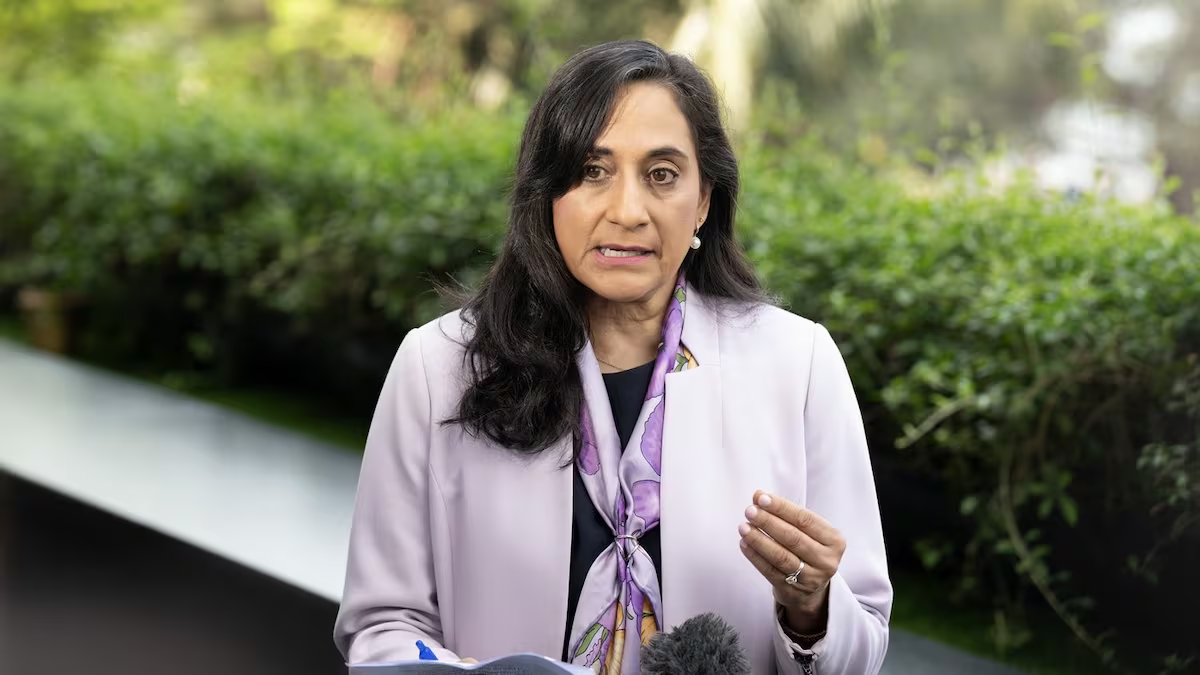
Foreign Affairs Minister backs Qatar and the UAE while Prime Minister advances trade reset with New Delhi
DELHI — Foreign Affairs Minister Anita Anand has condemned Iran’s attacks on Qatar and the United Arab Emirates, voicing Canada’s support for Gulf partners as Prime Minister Mark Carney arrived in India for high-level talks aimed at strengthening economic ties.
In online statements, Anand said she strongly denounces Iran’s targeting of Qatar and stands with the United Arab Emirates as it responds to escalating aggression. She added that Canada will continue providing support to Canadians in the region and urged Canadians in Iran to shelter in place.
Her comments come as Iran launched missiles and drones toward Israel and targeted U.S. military installations in Bahrain, Kuwait and Qatar following joint U.S.–Israeli strikes that killed Iran’s Supreme Leader, Ayatollah Ali Khamenei.
Carney landed in New Delhi on Sunday evening ahead of a scheduled meeting Monday with Indian Prime Minister Narendra Modi. The prime minister was greeted with a red-carpet reception and an honour guard, as well as a cultural performance by Bihu dancers. Large posters featuring Carney and Modi were visible near the airport as part of the formal welcome.
The visit is part of what Ottawa has described as a reset in trade and diplomatic relations with India. Carney said Saturday that Canada is seeking to conclude a comprehensive trade agreement with India that could double bilateral trade by 2030. Over the weekend, he met with senior Indian business leaders, including the heads of Indian Oil, Coal India and the National Payments Corporation of India.
However, the trip has been overshadowed by the escalating conflict in the Middle East. Carney has said Canada supports U.S. action against Iran but will not participate militarily. He made those remarks before confirmation of Khamenei’s death. Neither Carney nor Anand has publicly commented on the supreme leader’s killing.
Heightened tensions also prompted unusual security measures during the prime minister’s trip. Politicians, staff and members of the travelling media were using temporary devices for communications while in India, with regular phones and laptops stored in signal-blocking bags on the government aircraft.
After the delegation flew from Mumbai to New Delhi, some journalists discovered their devices had been moved. Prime Minister’s Office spokesperson Audrey Champoux said certain government telecommunications equipment was relocated by Canadian security officials in light of developments in the Middle East, in case it was needed urgently. She said press devices were inadvertently moved but remained secured, unopened and were returned once the error was identified.
The broader conflict has raised concerns about potential security implications for Canada. At an event Saturday, Carney described Iran as the “principal source of instability and terror throughout the Middle East” and reiterated that Iran must never develop a nuclear weapon. U.S. President Donald Trump has defended the military action by alleging Iran continued advancing its nuclear program and missile capabilities.
Carney said he and his finance and foreign affairs ministers had discussed the possibility of such an escalation with U.S. officials in recent weeks if diplomatic efforts failed.
Experts caution that Canada’s public alignment with U.S. strikes could carry risks. Thomas Juneau of the University of Ottawa pointed to a history of what he described as transnational repression targeting Iranian-Canadian dissidents and activists. Sajjan Gohel of the Asia Pacific Foundation has warned that a regime under existential pressure may intensify cyber or other retaliatory actions abroad.
In 2024, the House of Commons condemned what it described as an alleged Iranian plot to assassinate former justice minister Irwin Cotler, underscoring concerns about foreign interference and threats on Canadian soil.
As Carney continues his India visit focused on economic diplomacy, the unfolding crisis in the Middle East remains a dominant backdrop, shaping Canada’s foreign policy posture and raising fresh questions about regional security and its implications at home.