

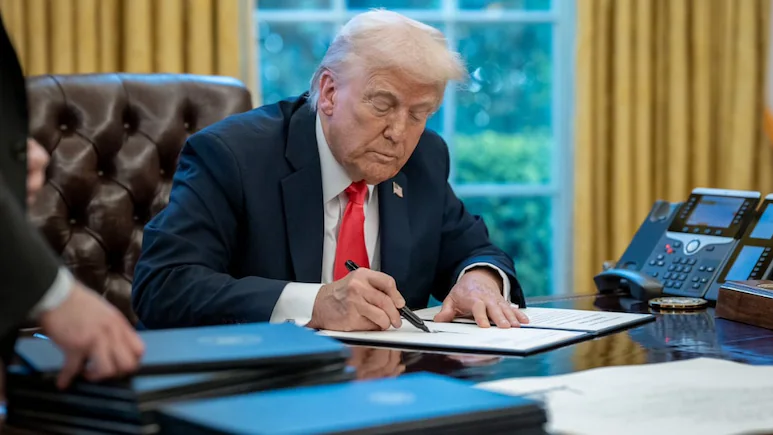
U.S. President Donald Trump has unveiled a new international initiative—the so-called “Board of Peace”—as part of the second phase of the Israel-Hamas ceasefire agreement signed in October 2025. The body is intended to oversee post-war governance and reconstruction in Gaza and, potentially, expand to address other global conflicts.
Trump has invited dozens of countries to join the initiative, including India. In a letter to Prime Minister Narendra Modi, Trump described the board as a “historic effort” to secure peace in the Middle East and pursue a new model for resolving global conflicts. The invitation was shared publicly by U.S. Ambassador to India Sergio Gor. New Delhi has not yet said whether it will participate.
What is the Board of Peace?
According to Trump’s proposal, the Board of Peace would function as a transitional governing and peace-building authority for Gaza. The initiative was endorsed by the United Nations Security Council in November 2025, but its mandate is currently limited to Gaza and authorised only through 2027.
Trump has suggested the board would be chaired by him and funded by participating countries. Member states would serve three-year terms, with the option of permanent membership through significant financial contributions.
Who would run it?
Trump has named a high-profile group of proposed board members, including U.S. Secretary of State Marco Rubio, special envoy Steve Witkoff, Jared Kushner, former U.K. prime minister Tony Blair, World Bank president Ajay Banga, and other business and security figures.
U.S. officials have said the board’s initial focus would be rebuilding Gaza, with most funds directed toward reconstruction rather than administration.
Why is it controversial?
Diplomats and analysts have raised concerns that the Board of Peace could undermine the United Nations by creating a parallel peace-building structure. Several European diplomats, speaking to Reuters, described it as a potential “Trump United Nations,” warning it could weaken established multilateral institutions.
The initiative’s expansion clause—suggesting a future role beyond Gaza—has drawn particular scrutiny. Critics argue it bypasses the UN Charter and concentrates authority in a small group of states, while supporters say it offers a more “nimble” alternative to traditional diplomacy.
A senior UN official responded cautiously, reiterating that the United Nations remains the only institution with the legal and moral authority to convene all nations on equal footing.
What happens next?
Trump has extended invitations to roughly 60 countries, including Pakistan, which has said it will engage in international peace efforts for Gaza. Whether major powers—including India—join the Board of Peace could determine whether the initiative becomes a limited post-conflict mechanism or a broader challenge to the existing global order.