

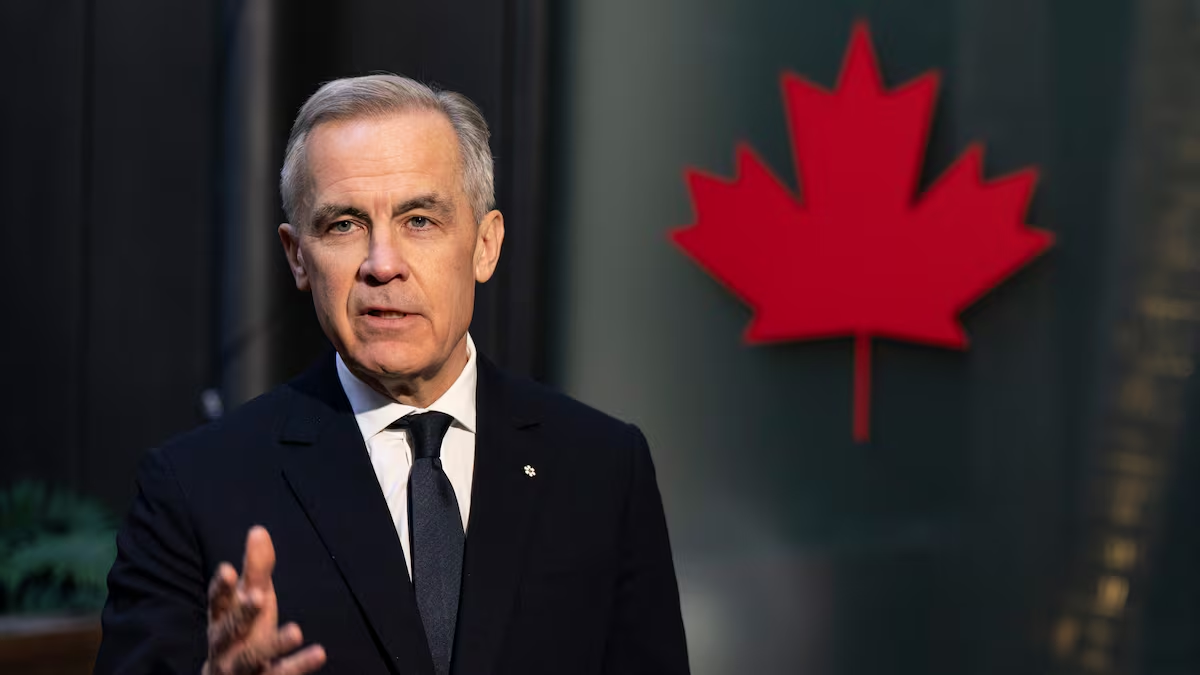
OTTAWA — Prime Minister Mark Carney says Canada is moving to expand oil exports to Asian markets as uncertainty grows over whether Venezuelan crude could displace Canadian oil in the United States following the removal of Venezuelan President Nicolás Maduro.
Speaking in Paris, where he is attending talks with allies on Ukraine, Carney was asked whether U.S. President Donald Trump’s stated intention to take control of Venezuela’s oil industry increases the urgency of building a pipeline to British Columbia’s northwest coast.
Carney said Canadian oil remains a “low-risk” option for global buyers, particularly compared with Venezuelan crude, and said that reliability will help Canada stay competitive even as geopolitical conditions shift.
He added that the federal government is focused on diversifying export markets, particularly in Asia, to reduce Canada’s reliance on the U.S. market.
The comments come amid growing political pressure at home following a weekend U.S. military operation in Venezuela that resulted in Maduro being captured and brought to New York to face criminal charges. Trump has said the United States intends to oversee Venezuela’s oil sector and encourage American companies to revive production.
Conservative Leader Pierre Poilievre has warned that a resurgence of Venezuelan oil could squeeze Canadian exports out of U.S. refineries that are designed to process heavy crude.
In a letter to Carney posted on social media Tuesday, Poilievre said the U.S. action has “altered the global energy landscape” and called on the Liberal government to “immediately approve a pipeline to the Pacific Coast.”
Poilievre said Venezuela’s heavy crude output could “rapidly rebound to historic levels,” putting it in direct competition with Canadian oil. “Every barrel the United States sources from Venezuela could mean one less barrel these refineries would buy from Canada,” he wrote, adding that Canada needs new markets “quickly.”
According to the U.S. Energy Information Administration, Venezuela holds the world’s largest proven crude oil reserves at roughly 303 billion barrels, about 17 per cent of global reserves. While its oil sector has deteriorated after years of sanctions and underinvestment, some analysts believe production could rise sharply from current levels of about 1.1 million barrels per day if restrictions are lifted and investment returns.
Poilievre has also criticized Carney for not explicitly endorsing a West Coast pipeline, noting that several Liberal MPs oppose such projects.
In November, however, the federal Liberals signed a memorandum of understanding with the Alberta government committing to work toward the construction of at least one coastal pipeline to move Alberta bitumen to Asian markets. The agreement states that any pipeline would be privately built and financed, with Indigenous communities receiving benefits and opportunities for co-ownership.
The memorandum also says a project application will be ready for submission to the federal major projects office by July 1. That office was created early in Carney’s mandate to accelerate approvals for major infrastructure.
Poilievre has called on the government to approve the proposal within 60 days of submission.
Alberta Premier Danielle Smith echoed that position Monday, saying developments in Venezuela underscore the need to speed up pipeline development to diversify Canada’s oil export markets.
Smith said Alberta is preparing to submit an application to the major projects office and expects the federal government to act “with urgency.”