

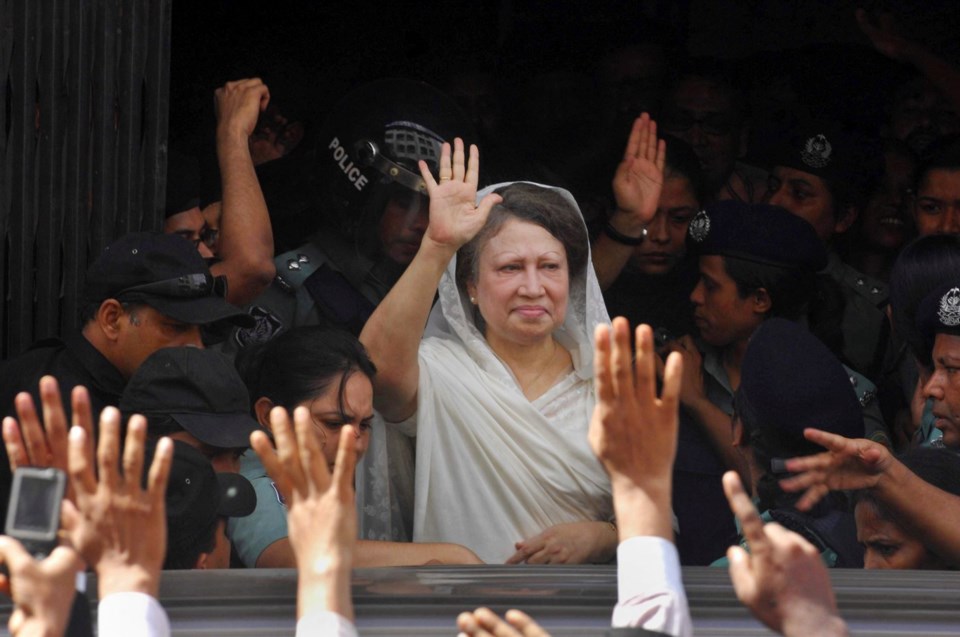
DHAKA, Bangladesh — Khaleda Zia, Bangladesh’s first elected female prime minister and a central figure in the country’s politics for more than three decades, has died at the age of 80, her party said Tuesday.
Zia’s Bangladesh Nationalist Party (BNP) confirmed her death in a statement. Bangladesh’s interim government declared a three-day national mourning period and announced a general holiday for Wednesday, when funeral prayers are scheduled to be held in front of the national Parliament building in Dhaka.
Interim leader Muhammad Yunus praised Zia’s legacy, saying her contributions to democracy and multiparty politics in Bangladesh “will be remembered forever.”
Condolences also came from regional and political leaders. Indian Prime Minister Narendra Modi said Zia’s role as Bangladesh’s first woman prime minister and her contributions to development and India-Bangladesh relations would be long remembered. Sajeeb Wazed, son of former prime minister Sheikh Hasina, said Zia’s death would have a profound impact on Bangladesh’s democratic transition. Hasina, speaking from exile in India, described Zia’s passing as “an irreparable loss” to the nation’s political life.
A defining rivalry
Zia and Hasina dominated Bangladeshi politics for a generation, their rivalry shaping elections, governance, and public debate. Zia first came to power in 1991 after the fall of military rule, defeating Hasina, the daughter of independence leader Sheikh Mujibur Rahman.
Her first term was followed by a brief and controversial second term in early 1996, after an election boycotted by major opposition parties. That government lasted just 12 days before a caretaker administration oversaw fresh polls later that year.
Zia returned to office in 2001, leading a coalition that included the Islamist Jamaat-e-Islami party. Her government pursued pro-investment, market-oriented policies and maintained strong support among business leaders, but it was also marred by allegations of corruption and claims that her elder son, Tarique Rahman, wielded significant behind-the-scenes influence.
Relations with neighboring India were strained during her tenure, with New Delhi accusing her government of allowing insurgents to operate from Bangladeshi territory—allegations her party denied.
Legal battles and later years
Zia’s political career was overshadowed in later years by corruption cases that she and her party said were politically motivated. She was sentenced to 17 years in prison in two cases related to the alleged misuse of charitable funds named after her late husband, former president Ziaur Rahman.
In January 2025, Bangladesh’s Supreme Court acquitted Zia in the final remaining case, clearing the way for a potential return to electoral politics. However, prolonged illness kept her largely out of public life.
After being released from prison in 2020 on medical grounds, Zia remained in Bangladesh despite repeated requests to seek treatment abroad, which her family said were denied by Hasina’s government. Following Hasina’s ouster in 2024, the interim administration allowed Zia to travel to London for treatment. She returned to Bangladesh in May.
Zia remained BNP chairperson until her death, though she had not attended rallies in recent years. Her son Tarique Rahman has served as acting party chair since 2018.
From resistance to legacy
Zia rose to prominence after the assassination of her husband, President Ziaur Rahman, in a 1981 military coup. Her opposition to military rule helped galvanize a mass movement that culminated in the removal of dictator H.M. Ershad in 1990, paving the way for democratic elections.
She was last seen publicly on Nov. 21 at a Bangladesh military event in Dhaka, appearing frail and using a wheelchair. Zia is survived by Tarique Rahman; her younger son, Arafat Rahman, died in 2015.
Her death marks the end of an era in Bangladesh’s politics, closing a chapter defined by intense rivalry, repeated elections, and a lasting struggle over the country’s democratic path.