

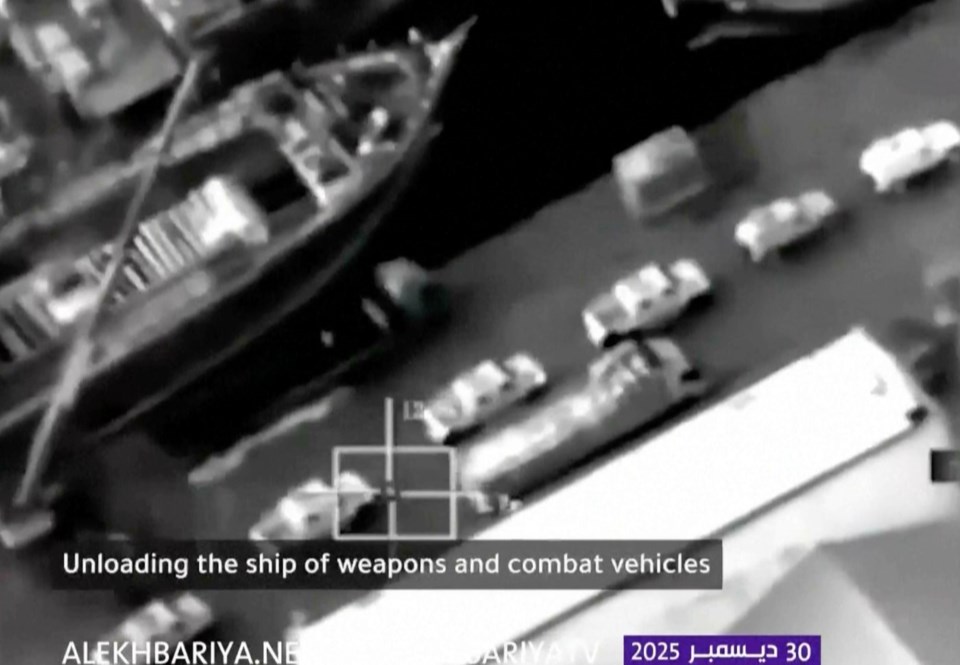
DUBAI, United Arab Emirates — Saudi Arabia carried out airstrikes Tuesday on the Yemeni port city of Mukalla, saying the attack followed the arrival of a weapons shipment from the United Arab Emirates intended for separatist forces. Riyadh warned that the Emirati actions were “extremely dangerous,” escalating tensions between the two regional allies.
The strike comes amid mounting friction over advances by the Southern Transitional Council (STC), a UAE-backed faction seeking autonomy for southern Yemen. While the STC and allied groups voiced support for the UAE’s role, other anti-Houthi forces aligned with Saudi Arabia demanded that Emirati forces withdraw from Yemen within 24 hours.
The UAE rejected Saudi allegations, calling for “restraint and wisdom,” and said it did not ship weapons as claimed. Abu Dhabi did not indicate whether it would withdraw.
Analysts warned the confrontation risks opening a new front in Yemen’s decade-long conflict, pitting forces that have opposed the Iranian-backed Houthi movement against one another. The dispute also underscores growing rivalry between Saudi Arabia and the UAE over regional influence, particularly around the Red Sea—marking what observers say is their most serious clash in decades.
“I expect a calibrated escalation from both sides,” said Mohammed al-Basha, founder of the Basha Report, a Yemen-focused risk advisory firm. He added that any further flow of weapons to the STC could be curtailed following the port strike, noting Saudi Arabia’s control of Yemeni airspace.
Details of the strike
In a statement carried by the Saudi Press Agency, the Saudi-led coalition said ships arriving in Mukalla from Fujairah in the UAE had disabled tracking devices and offloaded weapons and armored vehicles to support STC forces.
Citing an “imminent threat” to stability, the coalition said it conducted a “limited airstrike” targeting the unloaded weapons and vehicles. There was no immediate information on casualties.
Hours later, the UAE’s Foreign Ministry denied shipping weapons, saying the vehicles were sent “for use by UAE forces operating in Yemen,” and asserted Saudi Arabia had prior knowledge of the shipment. The ministry urged coordination and restraint, pointing to ongoing security challenges.
Reactions on the ground
Yemen’s anti-Houthi forces declared a state of emergency, ended cooperation with the UAE, and imposed a 72-hour ban on border crossings and access to airports and seaports in areas they control—except where authorized by Saudi Arabia.
The STC’s satellite channel aired footage of the aftermath without showing damage to armored vehicles and criticized the strike as an attack on civilian infrastructure, saying it would strengthen calls for an independent South Yemen.
The Associated Press identified a vessel believed to be involved—the Greenland, flagged to St. Kitts—using tracking data showing it was in Fujairah on Dec. 22 and arrived in Mukalla on Sunday. A second vessel could not be immediately identified.
Broader context
Mukalla, in Yemen’s Hadramout governorate, lies about 480 kilometres (300 miles) northeast of Aden, which has served as the seat of anti-Houthi authorities since the Houthis seized the capital, Sanaa, in 2014. Yemen’s war has killed more than 150,000 people and produced one of the world’s worst humanitarian crises.
The latest strike follows Saudi airstrikes last Friday that analysts described as a warning to the STC to halt its advance in Hadramout and Mahra, where it displaced forces aligned with Saudi-backed National Shield units. Pro-STC supporters have increasingly flown the flag of South Yemen, which existed as a separate state from 1967 to 1990.
In a statement Tuesday, Saudi Arabia’s Foreign Ministry explicitly linked the STC’s advance to the UAE for the first time, calling Abu Dhabi’s actions “extremely dangerous.” Allies of the council later signaled they would not back down.