

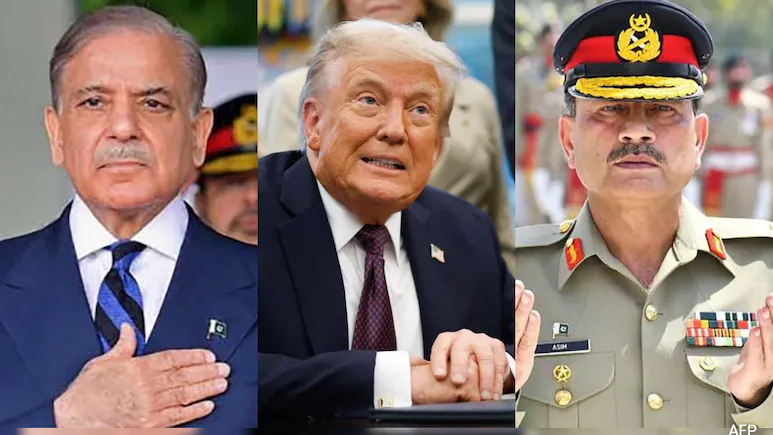
In a controversial statement stirring global debate, U.S. President Donald Trump has claimed that several countries — including Pakistan, Russia, China, and North Korea — are actively conducting nuclear weapons tests, insisting that the United States must resume its own testing to preserve military superiority and deterrence.
Speaking to CBS News, Trump defended his stance, saying that while the U.S. remains transparent about its defense programs, other nations carry out tests covertly. “Russia’s testing, China’s testing, but they don’t talk about it. We’re an open society. We talk about it. We have to talk about it because otherwise you people are going to report,” he said.
Trump asserted that many of these tests take place “deep underground,” often unnoticed by the international community. “They test, and we don’t test. We have to test,” he emphasized, adding that the U.S. cannot afford to be “the only country that doesn’t test.”
The remarks come as reports circulate about Washington potentially reviving nuclear weapons testing after more than three decades. Trump justified the move as a necessary response to Russia’s latest trials of advanced nuclear-capable systems, including the Poseidon underwater drone.
“When Russia and North Korea are testing constantly, we cannot just sit back,” Trump said. “We have to see how our systems work. We have more nuclear weapons than any other country—enough to blow up the world 150 times.” He added that he had previously discussed denuclearization with both Russian President Vladimir Putin and Chinese President Xi Jinping.
Amid rising concern, U.S. Energy Secretary Chris Wright sought to clarify that the proposed testing will not involve actual nuclear detonations. “These are what we call non-critical explosions — system tests that ensure all components of a nuclear weapon function as intended,” Wright told Fox News.
He added that the goal is to validate and improve new systems, ensuring future nuclear weapons are “safer and more reliable than the last generation.”
Trump’s comments have sparked mixed reactions globally, with security analysts warning that any resumption of nuclear testing by the U.S. could trigger a new era of global arms competition, undermining decades of efforts toward nuclear restraint.