

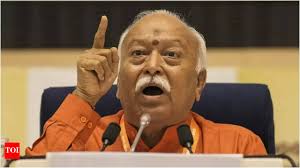
Nagpur — In his Vijayadashami address marking the centenary celebrations of the Rashtriya Swayamsevak Sangh (RSS), Mohan Bhagwat struck a tone of harmony and inclusion. But behind the soft language lay unmistakable signals aimed at Prime Minister Narendra Modi and the BJP leadership. The RSS, long seen as the ideological spine of the BJP, seems to be reminding the party — and Modi himself — that the movement is bigger than any one man.
Bhagwat’s Carefully Calibrated Message
Bhagwat opened by paying homage to Guru Teg Bahadur, Mahatma Gandhi, and Lal Bahadur Shastri, describing them as symbols of service and sacrifice. His order of mention was significant: by naming a Sikh Guru first, Bhagwat underscored the inclusive and pluralistic vision of Bharatiya culture, distancing himself from divisive narratives that often dominate political campaigns.
He reiterated:
“The Hindu society is free of and will remain free of the ‘us and them’ mentality which creates divisions.”
This line may sound benign, but within the RSS ecosystem, such statements are coded messages. They suggest discomfort with the BJP’s increasingly polarizing electoral strategies, which have helped win elections but have alienated sections of society and even some in the Sangh Parivar.
Sangh’s Unease With Personality-Centric Politics
For decades, the RSS prided itself on promoting collective leadership, ideological discipline, and low personal visibility. Modi’s rise — built on mass charisma and centralized control — was a historic exception the Sangh accepted for pragmatic reasons. But the unquestioned dominance of Modi and Amit Shah has slowly sidelined the RSS’s organizational influence.
Senior Sangh figures have privately expressed that the government has grown bigger than the organization, an inversion of the RSS’s core belief that the party must remain subordinate to the movement. One RSS pracharak bluntly put it:
“The Sangh creates leadership, it does not worship it.”
This shift in tone reflects a strategic recalibration, not open rebellion. The Sangh understands Modi remains electorally formidable, but it wants the BJP to course-correct before the ideological gap widens irreversibly.
BJP President Appointment: A Test of Modi–RSS Power Balance
The upcoming appointment of the BJP President has become the key flashpoint. J.P. Nadda’s term is nearing its end, and unlike in the past decade, the RSS is no longer willing to merely rubber-stamp Modi’s choice.
Sources close to Nagpur indicate that the Sangh wants someone with organizational roots, ideological clarity, and the capacity to reassert the party’s independence, not another extension of the PMO. This reflects a desire to re-balance power between the government and the party organization, a dynamic that Modi and Shah have tightly controlled.
If the RSS manages to influence this appointment, it would mark the first visible assertion of its will since Modi’s rise in 2014 — and a sign that Modi’s standing within the Sangh is no longer unassailable.
Is Modi Still ‘Safe’ in the Sangh’s Eyes?
For years, the RSS leadership treated Modi as a once-in-a-generation asset. But recent developments — growing internal criticism, the revival of independent RSS outreach programs, and Bhagwat’s pointed speeches — show that his position is being reassessed.
No one expects an open rupture. The RSS operates through gradual pressure and coded messaging, not public confrontation. But Modi can no longer take Nagpur’s blessings for granted. His future within the Sangh’s ideological fold may hinge on whether he’s willing to accommodate organizational autonomy and dial back the hyper-centralization that defines his governance style.
The Road Ahead
The Sangh’s message was clear: unity, inclusivity, and ideological discipline must take precedence over short-term political expediency. The BJP has ridden Modi’s popularity to historic victories, but the RSS seems to be asking a pointed question — at what cost to the movement’s foundational ethos?
As the party prepares for crucial organizational changes, including the BJP presidency, this could be the first real test of Modi’s political adaptability within his own ideological family. Bhagwat’s harmonious speech may have sounded calm, but politically, it was a quiet but sharp knock on Modi’s door.