

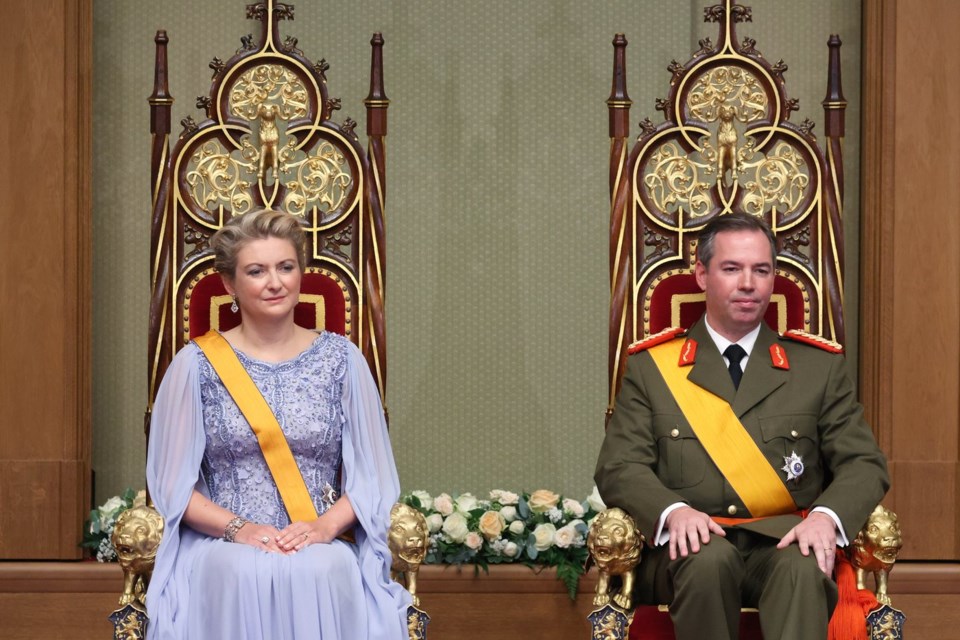
LUXEMBOURG — Grand Duke Guillaume officially ascended to the throne of Luxembourg on Friday, taking a solemn oath before parliament in a traditional ceremony attended by European royals and heads of state.
Flanked by his wife, Grand Duchess Stéphanie, the 43-year-old heir took over the largely symbolic role from his father, Grand Duke Henri, who abdicated after 25 years on the throne.
“I will live the life of my people, from whom I do not want to be separated by any barrier. I will share their joys and sufferings,” Guillaume said, echoing a 1919 speech by Grand Duchess Charlotte. He framed his accession as a moment of unity in a time of geopolitical uncertainty, calling the monarchy “a steadfast support in times of crisis.”
Outside the palace, crowds gathered to welcome the new monarch, waving Luxembourg’s red, white and light blue flag. The grand duke was set to greet the public from the palace balcony alongside his family, including his two young sons, Charles and François.
The ceremony drew royals from Belgium and the Netherlands, as well as French President Emmanuel Macron and German President Frank-Walter Steinmeier. A gala reception was planned for the evening.
A New Reign, Rooted in Traditio
Guillaume becomes Luxembourg’s seventh grand duke since 1890. Over the weekend, he will embark on a ceremonial tour of the tiny duchy — roughly the size of Rhode Island — culminating in a Sunday Mass at Notre-Dame de Luxembourg cathedral.
The new monarch is well-liked by many Luxembourgers. Lea Lister, 70, an official supplier to the royal court who once taught Guillaume to cook, brought 200 madeleines for palace staff to mark the day. “He’s very emotive, very sensitive,” she said. “I think he will be a beautiful Grand Duke for us.”
A Modern Role in a Historic Nation
Luxembourg is the world’s last remaining grand duchy and one of the EU’s smallest but richest countries per capita. Its head of state plays a ceremonial role, similar to King Charles in the U.K. or King Philippe in Belgium. Guillaume, like his father, was educated in France, Switzerland and at Britain’s Sandhurst military academy.
Historian Christoph Brüll of the University of Luxembourg said Guillaume’s powers will be symbolic. “His margin of maneuver or right to action is zero,” he noted. “The only power he has is the power of speech or words.”
Across the duchy, Guillaume’s portrait will soon replace his father’s, and his golden “G” monogram will be added to uniforms of the army, police and other services — ushering in a new chapter for Europe’s last grand duchy.