

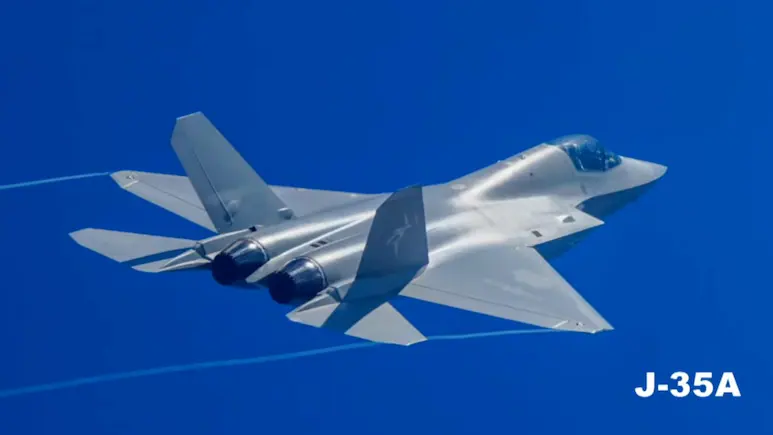
India’s long-standing edge in air superiority over Pakistan may be under serious threat with Islamabad’s expected acquisition of 40 J-35 fifth-generation stealth fighter jets from China. While technically a toned-down version of China’s own J-35—the export variant FC-31—the deal could significantly alter the balance of power in South Asia’s skies, especially as India’s indigenous fifth-generation fighter jet remains a decade away from operational service.
Developed by China’s Shenyang Aircraft Corporation, the J-35 is a twin-engine, single-seat supersonic stealth fighter equipped with cutting-edge avionics. These include an active electronically scanned array (AESA) radar for long-range detection, infrared search-and-track capabilities, and an electro-optical targeting system—technologies that dramatically enhance combat survivability and lethality. According to Chinese state media, the J-35 is engineered to operate within “stealth and counter-stealth combat frameworks” with an emphasis on neutralizing enemy air defenses and achieving air dominance.
Pakistan’s procurement of the FC-31 variant will still bring fifth-generation stealth capabilities into its air fleet—a major technological leap. This follows the recent addition of Chinese JF-17 and J-10C fighters, suggesting a deepening Sino-Pakistani defense partnership. The timing of this deal, coming shortly after Pakistan’s lackluster performance in a 100-hour military conflict with India, has only intensified concerns in New Delhi.
What makes the J-35 acquisition particularly alarming for India is its reported radar cross-section of just 0.001 square meters—comparable to the American F-35. This dramatically reduces detectability, especially during high-speed border incursions, making interception more difficult for Indian air defense systems. The aircraft is also reportedly capable of “networked warfare,” sharing targeting data with surface-to-air missile systems and coordinating strikes across multiple platforms.
Though Pakistan will not receive the full-capability J-35, even the export variant represents a significant upgrade over its current capabilities. The stealth advantage, combined with multirole flexibility, means these jets could challenge Indian forces’ ability to maintain airspace dominance in the event of hostilities on one or multiple fronts. With China also operating the J-35, India faces the very real prospect of confronting two adversaries equipped with fifth-generation stealth fighters.
India’s response is currently limited by the timeline of its Advanced Medium Combat Aircraft (AMCA) program, which has just been greenlit to move forward with an execution prototype. The Defence Research and Development Organisation (DRDO) has indicated that India’s first indigenous fifth-generation fighter will not be combat-ready before 2035.
Until then, India will rely heavily on its existing fleet of French Rafale fighters, of which over 60 will be in service by 2031. While the Rafale is a formidable fourth-plus generation aircraft, it lacks the stealth features of the J-35, creating a critical capability gap.
Experts have expressed concern. “It is worrying news,” said Group Captain Ajay Ahlawat (Retd.), a former fighter pilot. “Any version of the J-35 in Pakistani colours is going to raise concerns for our side.” India had once considered procuring the F-35 or the Russian Su-57, but both were ultimately deemed unsuitable. “The only good choice is the AMCA,” Ahlawat told NDTV, urging a national-level mission-mode effort to expedite its development.
The introduction of stealth fighters into the Pakistan Air Force marks a paradigm shift. It places new pressure on India’s air defense posture and its ability to deter or counter advanced aerial threats. Unless New Delhi accelerates its modernization programs, upgrades existing radar and missile systems, and closes the stealth gap, India may find itself strategically disadvantaged in an increasingly volatile regional security environment.