

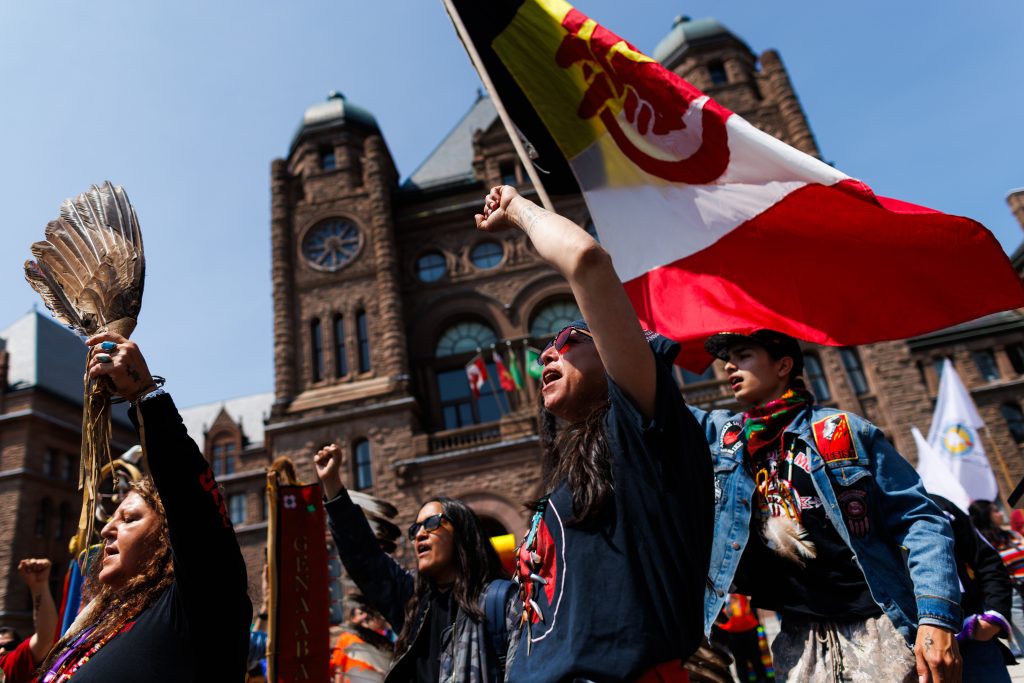
Ontario Premier Doug Ford issued an apology Thursday to members of the Anishinabek Nation for controversial remarks he made earlier in the week, in which he said First Nations should not keep coming “hat in hand” to the government while refusing mining development. The comment, widely criticized as racist by Indigenous leaders, drew swift backlash and renewed tensions between the provincial government and First Nations communities over mining rights and sovereignty.
Ford’s apology came during a meeting at Queen’s Park with several dozen chiefs from the Anishinabek Nation. Speaking directly to Grand Council Chief Linda Debassige, Ford acknowledged his misstep and said, “I get pretty passionate and I just want to sincerely apologize for my words, not only to all the chiefs in that room, but for all First Nations.” His original comments, made Wednesday, implied frustration over what he framed as a contradiction in Indigenous communities opposing mining development while expecting continued financial support from the government. “There’s going to be a point that you can’t just keep coming hat in hand all the time to the government, you’ve got to be able to take care of yourselves,” Ford said at the time. “And when you literally have gold mines, nickel mines, every type of critical mineral that the world wants, and you’re saying, ‘No, no, I don’t want to touch that, by the way, give me money’ — not going to happen.”
The controversy unfolds in the wake of the Ontario government’s passage of Bill 5, which enables the cabinet to bypass municipal and provincial laws for selected projects through the designation of special economic zones. Ford has championed the Ring of Fire in northern Ontario—an area rich in critical minerals—as the first such zone under the new law, which he claims is necessary to accelerate major infrastructure and mining initiatives. The bill was met with protests from First Nations at Queen’s Park when first introduced in April. In response to growing pressure, Ford agreed to Thursday’s meeting, accompanied by Indigenous Affairs Minister Greg Rickford.
Chief Linda Debassige said the apology was accepted as sincere by the chiefs present, and described the meeting as a positive step. “We are looking at today as a new day going forward,” she said, adding that while discussions with the premier included proposals and commitments, details would not be made public at this time. However, opposition to Bill 5 remains strong among Indigenous leaders. Debassige emphasized that the rapid passage of the legislation was a key concern and that the Anishinabek Nation’s 39 First Nations continue to oppose the law. Many First Nations have signaled that they are prepared to take direct action, including road, railway, and mine blockades, if their concerns remain unaddressed.
Despite Ford’s efforts to reset relations, not all Indigenous leaders were ready to embrace his apology. Alvin Fiddler, Grand Chief of the Nishnawbe Aski Nation, which represents 49 First Nations in northern Ontario, including those in the Ring of Fire region, said the premier’s passion does not excuse what he called a racist remark. “Being ‘passionate’ doesn’t give you an excuse to express your racism,” Fiddler said. “If and when Doug Ford is ready to personally apologize to the people of Nishnawbe Aski Nation, we will consider it. If the premier is sincere with his apology, he needs to show it, not just say it.”

Ford has framed the special economic zone legislation as part of Ontario’s strategy to respond to trade tensions with the United States under President Donald Trump, particularly in securing access to critical minerals. However, his stance has placed him at odds not only with many First Nations but also with Prime Minister Mark Carney’s federal Liberal government, which is advancing similar legislation. That move, too, has provoked resistance from Indigenous communities, many of whom gathered in Ottawa earlier this week to express collective opposition to government overreach on land and resource rights.