

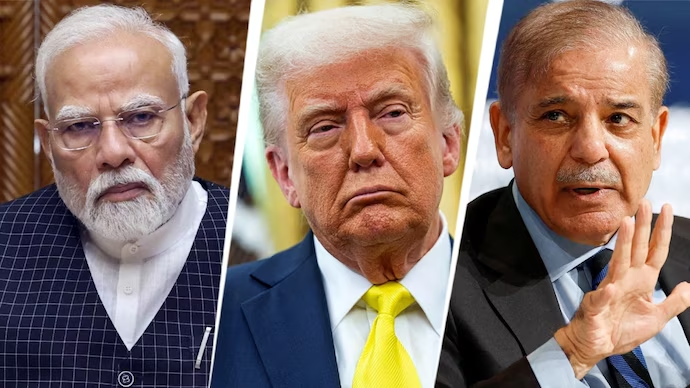
Modi’s Silence on Trump Claim Sparks Concerns of Cronyism and Compromise
U.S. President Donald Trump’s bombshell claim that he “sure as hell helped settle the problem” between India and Pakistan has ignited a storm of controversy—most notably due to the stark silence from Indian Prime Minister Narendra Modi. The statement, made by Trump while addressing American troops in Doha, suggests a behind-the-scenes role in defusing a serious conflict between the two nuclear-armed neighbors.
Trump’s boast stands in direct contradiction to India’s longstanding policy: that all matters with Pakistan are to be resolved bilaterally, without third-party mediation. Yet, while India’s Ministry of External Affairs issued a guarded denial of foreign involvement, Prime Minister Modi has personally offered no rebuttal—an omission that has deepened suspicions and opened a Pandora’s box of speculation.
Critics across political lines are asking: Why is Modi silent?
One growing theory links Modi’s restraint not to strategic diplomacy but to the protection of his close ties with two of India’s wealthiest and most powerful businessmen—Gautam Adani and Mukesh Ambani. Both have amassed extraordinary wealth and influence during Modi’s tenure, raising long-standing allegations of crony capitalism.
The Adani-Modi Connection
Adani’s fortunes have risen in tandem with Modi’s global outreach. After Modi’s official trips to countries like Bangladesh and Sri Lanka, Adani Group swiftly secured major energy and port infrastructure contracts. In one instance, following Modi’s visit to Bangladesh, Adani was awarded a power project that many in the host country criticized as being skewed in India’s favor.
At home, security restrictions near the sensitive India-Pakistan border were reportedly eased to facilitate Adani’s construction of a massive renewable energy park in Gujarat—raising red flags among India’s defense experts.
Ambani’s Ascent
Mukesh Ambani’s empire, Reliance Industries, has also flourished under Modi’s leadership. The launch of Reliance Jio disrupted the telecom sector, backed by favorable regulatory frameworks and deep state encouragement. Government-endorsed initiatives in digital infrastructure and clean energy have often coincided with Reliance expansions, reinforcing Ambani’s dominance in India’s corporate landscape.
Media and Muzzling Dissent
A further consolidation of influence came when Adani acquired NDTV, one of India’s few remaining independent media houses. Critics see this as part of a broader push to mute dissent and align media narratives more closely with the ruling establishment.
Meanwhile, legal trouble looms abroad: Adani Group is under investigation in the United States over a $265 million bribery scandal linked to renewable energy projects, prompting concerns that Modi’s hesitance to challenge Trump could be tied to lobbying efforts to soften American scrutiny.
Opposition Demands Transparency
Congress leader Jairam Ramesh has demanded a special parliamentary session, calling Modi’s silence “an insult to Indian sovereignty.” The opposition is pressing for transparency, questioning whether India’s foreign policy is being dictated by billionaire interests or even influenced by potential compromising leverage in the hands of Trump or his allies.
“Has the Prime Minister compromised India’s principled stand for the sake of private friends and foreign favor?” Ramesh asked during a media briefing.
The Bigger Picture
The controversy underscores deeper concerns about the intertwining of political authority and corporate power in India. Modi’s brand of economic nationalism has undeniably attracted investment and built global clout—but it also raises questions about who truly benefits, and at what cost to democratic accountability.
As tensions simmer in South Asia, and with India’s international image at stake, the lack of direct engagement by its top leader is not just puzzling—it’s becoming politically untenable.
India’s citizens deserve clear answers. Until then, Modi’s silence continues to speak volumes.