

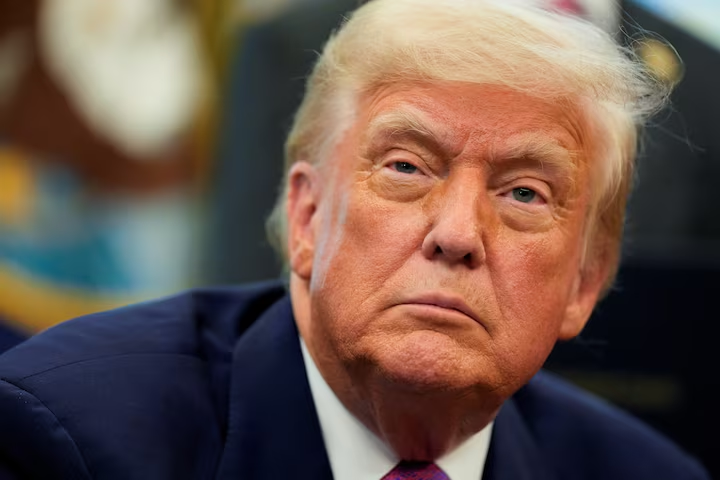
U.S. President Donald Trump claimed on Thursday that he played a pivotal role in defusing a recent flare-up between India and Pakistan, telling American troops at a base in Doha that he helped “settle” the crisis just as it was reaching a dangerous point.
“I don’t want to say I did, but I sure as hell helped settle the problem between Pakistan and India last week, which was getting more and more hostile,” Trump said. “You would have started seeing missiles of a different type… and we got it settled.”
Trump said that both India and Pakistan responded positively to a shift in focus toward trade discussions, suggesting diplomacy and economic cooperation were central to easing the standoff.
Background: Operation Sindoor and the Ceasefire
Tensions escalated earlier this month after a deadly terrorist attack in Pahalgam, Jammu & Kashmir, which left 26 civilians dead. India blamed Pakistan-based militants for the attack and responded with Operation Sindoor, a swift military operation targeting nine terror hubs in Pakistan and Pakistan-occupied Jammu & Kashmir (PoJK).
The operation triggered retaliatory shelling and drone activity from Pakistan, pushing both nations toward the brink of a larger conflict.
A ceasefire agreement was brokered on May 10, with key support from the U.S., particularly through behind-the-scenes diplomacy led by Vice President JD Vance and Secretary of State Marco Rubio.
U.S. Role: Mediation or Strategic Pressure?
While Trump has publicly credited himself for brokering peace, foreign policy expert Ambassador KP Fabian clarified that the U.S. did not formally mediate talks between India and Pakistan.
“America did not mediate,” Fabian told ANI. “They might have nudged Pakistan toward a ceasefire, which is different from direct mediation. Still, we are grateful for that pressure.”
Fabian explained that the U.S. encouraged Pakistan’s military leadership to de-escalate. Subsequently, Pakistan’s DGMO contacted his Indian counterpart, initiating the groundwork for a formal ceasefire.
India, according to Fabian, took a firm stance, refusing to acknowledge any ceasefire until Pakistan made a direct request. Only after that request came through did India agree to open military-to-military dialogue.
Trump’s Remarks Draw Mixed Response
Trump’s remarks, while self-congratulatory, reflect a longstanding pattern of publicly claiming credit in foreign affairs. He also made sweeping references to historical conflict:
“They’ve been fighting for about a thousand years. I said, let me settle it up… That’s a tough one.”
While India’s external affairs ministry has not officially responded, sources suggest New Delhi was displeased with Trump’s claim of personal credit, especially given the sensitivity of the Kashmir issue and India’s refusal to accept third-party mediation in such matters.
India Maintains Lead Role in Ceasefire
Despite Trump’s comments, experts maintain that India’s decisive military posture — not external diplomacy — was the main driver in forcing Pakistan to the table.
“India struck hard, and Pakistan didn’t know how to respond. That’s when the U.S. urged them to seek a ceasefire,” Fabian said. “We thank them for that much, but the resolution was India-led.”