

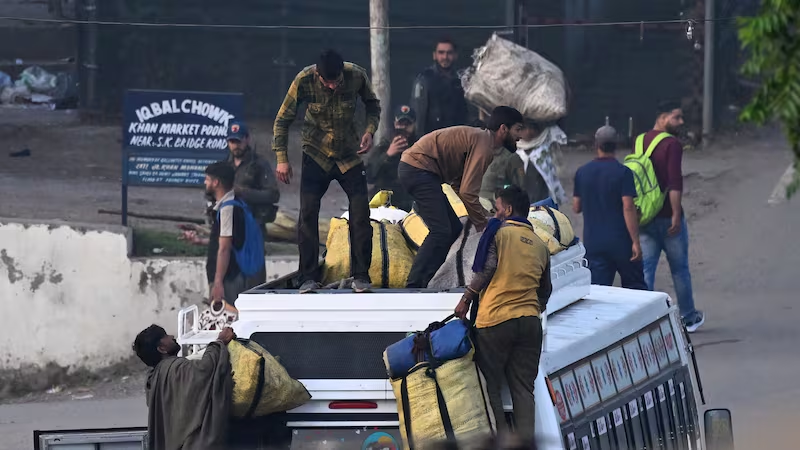
Panic spread across Indian border villages as heavy shelling from Pakistan struck the frontier town of Poonch and nearby areas in Indian-administered Kashmir early Wednesday, prompting hundreds of residents to flee their homes or take shelter in underground bunkers. The cross-border barrage, in apparent retaliation to India’s recent air strikes, has intensified fears of a wider regional conflict.
At least eight people, including two children, were killed and 38 injured in the shelling, which erupted days after India launched missile strikes targeting alleged militant sites in Pakistan-administered Kashmir. The strikes, part of what India calls “Operation Sindoor,” followed the April 22 attack in the Pahalgam resort area, where 26 Indian tourists were killed by armed militants. India has accused Pakistan-based extremists of carrying out the attack, while Islamabad denies any involvement.
Residents in Poonch described a night of terror, with loud explosions, buildings set ablaze, and no electricity or mobile service. Many fled on foot or motorcycles, carrying only essentials. Public transportation was halted, and fuel stations were overwhelmed as civilians scrambled for safety. Police used loudspeakers, mosques, and gurdwaras to urge residents to stay indoors.
“This is the first time I’ve seen Poonch town under such direct fire. We had to abandon our home,” said a local man, Mir, speaking to The National. Pankaj Sharma, another resident, added, “We didn’t want to take chances with our family’s safety. The shelling was relentless.”
In Pulwama district’s Wuyen area, panic deepened after a suspected Pakistani jet crashed near a school during the night. Residents reported a “fireball” falling from the sky. “Thank God it happened at night,” said Bashir Ahmad, whose house is adjacent to the school. “If this had happened during the day, the children could have been killed.”
Elsewhere, in Tangdhar and Rajouri, residents moved into reinforced bunkers as homes were struck and set ablaze. “This is the heaviest shelling we’ve seen in years,” one man said, watching as four houses in his neighbourhood burned.
India’s Defence Ministry stated that the strikes under Operation Sindoor were targeted at terrorist camps and emphasized that no Pakistani military installations were hit. Foreign Secretary Vikram Misri insisted the operation was necessary to “deter and prevent” further planned attacks. “We had intelligence of impending assaults,” he said. “Justice had to be served for Pahalgam.”
Meanwhile, Pakistan labeled the strikes a “blatant act of war,” claiming 26 civilians, including a child, were killed. Pakistani Information Minister Attaullah Tarar said Pakistani forces downed five Indian fighter jets, a quadcopter, and a drone—allegations India has not confirmed.
The escalation comes at a time when Iran’s Foreign Minister Abbas Araghchi is in Islamabad to support mediation efforts. Yet the violence continues to push the region toward uncertainty.
Kashmir remains a volatile flashpoint between India and Pakistan—nuclear-armed neighbours that have fought three wars since 1947, two of them over this disputed region. The latest flare-up underscores how fragile peace remains in a land long scarred by conflict and divided loyalties.