

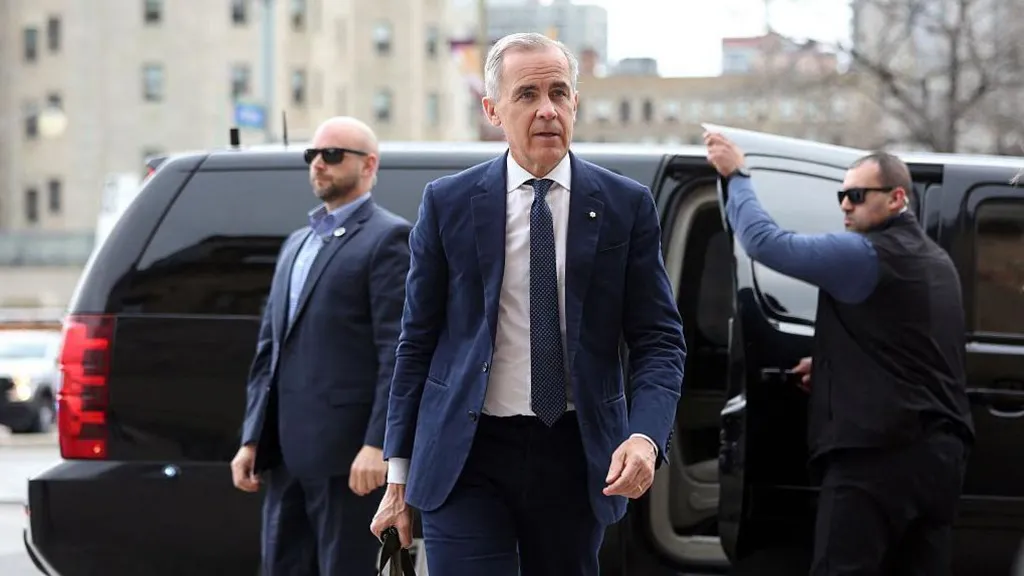
Just days after winning a near-majority in Canada’s federal election, Prime Minister Mark Carney is preparing for his first high-stakes meeting with U.S. President Donald Trump—a leader who, while offering backhanded praise, remains a volatile force in Canada-U.S. relations.
Trump’s initial reaction to Carney’s win was characteristically blunt, calling him “the one that hated Trump the least.” But the president softened his tone shortly after, describing their first post-election phone call as pleasant and noting that Carney “couldn’t have been nicer.” The two leaders are expected to meet at the White House within the week.
This upcoming encounter represents a sharp turn in the historically rocky relationship between Trump and Canada, especially after years of tension with former Prime Minister Justin Trudeau. From mocking Trudeau as “Governor Trudeau” to joking about annexing Canada, Trump’s disdain was public and persistent. Carney, by contrast, has managed to reset the tone—at least temporarily—bringing a more measured and composed persona to the Prime Minister’s Office.
Though the two leaders could not be more different—Carney, a polished economist with Harvard and Oxford credentials, and Trump, the populist billionaire and reality TV star—they share a desire to get results and little patience for political theatrics. That might form the basis of mutual respect, even if policy alignment remains distant.
According to Paul Samson, president of the Centre for International Governance Innovation and a former senior Canadian official, Carney is likely to rely on a mix of strategic diplomacy and deep economic knowledge to navigate Trump’s mercurial style. “He’s calm, calculated, and focused,” Samson said, “but not subservient.”
Carney’s post-election rhetoric has already made it clear he plans to stand firm. He has dismissed Trump’s repeated jokes about turning Canada into the “51st state” and condemned what he sees as U.S. overreach. “America wants our land, our resources, our water, our country,” Carney declared on election night. “But these are not idle threats. President Trump is trying to break us so that America can own us.”
The relationship remains fraught with issues. Trump has demanded Canada do more on migration and fentanyl trafficking—issues with relatively minimal Canadian impact. He has exaggerated trade deficits and accused Canada of “ripping off” America, all while threatening renewed tariffs on key exports.
Carney, however, insists Canada isn’t powerless. “We are the biggest client for more than 40 U.S. states,” he told the BBC, pointing to Canadian energy exports and the potential supply of critical minerals. He also signaled openness to diversifying trade away from the U.S. in favor of “like-minded” partners in Europe and the UK.
Still, such a pivot would mean abandoning decades of close cooperation with America—an alliance rooted in geography and shared democratic values. Whether Carney can preserve that legacy while managing an unpredictable U.S. president remains to be seen.
With Trump’s return to the White House shaking the foundation of the old North American order, Carney enters this new diplomatic era with both caution and conviction. Their upcoming meeting may not fix the rift, but it will set the tone for one of the most consequential bilateral relationships in the world.