

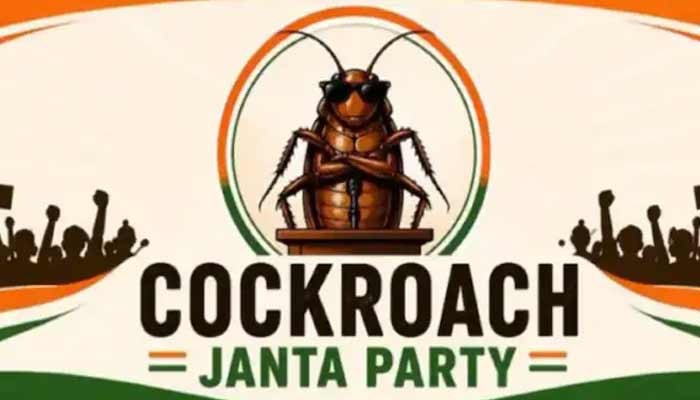
A rapidly growing social media movement driven by India’s frustrated younger generation has exploded into a national political controversy after the founder of the viral satirical account “Cockroach Janta Party” accused authorities of censorship, intimidation and targeting his family.
The Instagram-based movement, commonly known as Cockroach Janta Party or CJP, surged to more than 22 million followers within days, becoming one of the fastest-growing online political satire phenomena in India.
The account gained widespread popularity among Gen Z users by posting humorous but sharply critical commentary about unemployment, exam paper leaks, governance frustrations and growing anxiety among India’s youth population.
Its founder, Abhijeet Dipke, now alleges the movement has come under coordinated pressure following its explosive rise in popularity.
Dipke claimed the group’s website was taken down, its X account was withheld in India and its Instagram account was compromised. He also alleged that members of his family received threats following the account’s growing political influence.
Reuters reported it could not independently verify the allegations, and neither India’s Home Ministry nor IT Ministry publicly confirmed any government action against the group.
The controversy has quickly evolved into a broader debate over free speech, political dissent and digital censorship in India under Prime Minister Narendra Modi’s government.
Despite the ruling Bharatiya Janata Party continuing to secure major electoral victories in several key states, the sudden popularity of the CJP movement has highlighted growing frustrations among younger Indians facing economic uncertainty and employment challenges.
The account’s messaging appears to resonate strongly with India’s urban youth, many of whom have increasingly turned to social media platforms to express political dissatisfaction and frustration over issues such as competitive exam scandals, rising living costs and limited job opportunities.
A recent survey conducted by polling agency Cvoter reportedly found that more than 60 per cent of Indians aged 18 to 24 expressed anxiety about their future, with many specifically identifying unemployment and governance failures as major concerns.
Official government data currently places India’s urban youth unemployment rate at approximately 14 per cent — significantly higher than the country’s broader unemployment rate.
One major flashpoint fueling online anger has been repeated exam paper leak scandals, including controversies surrounding a recent national medical entrance examination that impacted roughly 2.3 million candidates.
Digital rights advocates have strongly criticized any potential action against the social media movement.
Internet Freedom Foundation condemned the alleged blocking of the account’s X presence, describing it as an arbitrary attempt to suppress free expression and political criticism online.
The controversy intensified further after senior BJP minister Kiren Rijiju appeared to question the authenticity and origins of the account’s massive online following.
Without directly naming the Cockroach Janta Party, Rijiju posted comments suggesting that some social media personalities gain popularity through audiences outside India and accused critics associated with “anti-India” narratives of attempting to undermine the country.
Dipke quickly responded by publicly sharing demographic analytics from the Instagram account, claiming that more than 94 per cent of the account’s audience is based inside India.
He also challenged Rijiju’s remarks directly, questioning why Indian youth critical of government policies were being portrayed as foreign or anti-national.
The political significance of the controversy lies not only in the size of the movement’s online following, but also in what it may reveal about shifting political attitudes among younger Indians.
While Modi and the BJP remain electorally dominant nationally, analysts say online youth-driven criticism has become increasingly visible across platforms like Instagram, YouTube and X, particularly around employment, education and economic mobility.
Prominent activist and lawyer Prashant Bhushan suggested the movement could potentially evolve into something larger if it expands beyond online activism into grassroots organization and public mobilization.
The episode is now being closely watched both within India and internationally as another major test of how the world’s largest democracy balances political criticism, online dissent and freedom of expression in the rapidly evolving digital age.