

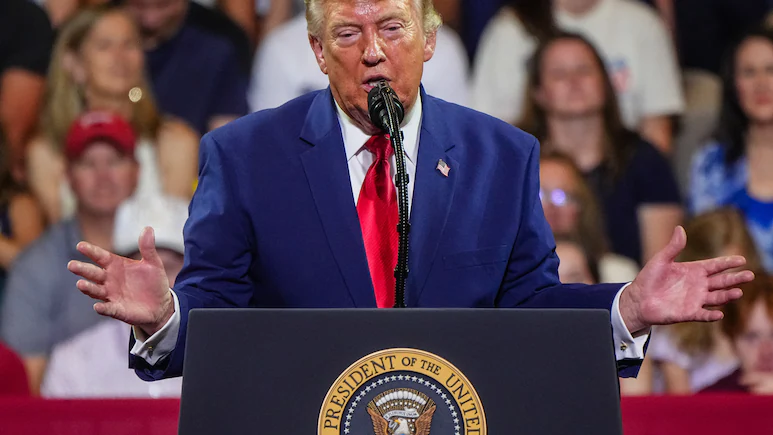
Washington, D.C., July 27: The administration of U.S. President Donald Trump has imposed new tariffs on imports from more than 60 countries, invoking a decades-old U.S. trade law that allows the government to impose trade penalties on countries deemed to have engaged in unfair trade practices.
The tariffs, which range from 10 per cent to 12.5 per cent, were introduced under Section 301 of the U.S. Trade Act of 1974. The administration argues that the affected countries have failed to adequately prohibit or enforce restrictions on goods produced through forced labour.
The new measures took effect following the expiry of temporary global tariffs that had been introduced after the U.S. Supreme Court struck down an earlier worldwide tariff policy in February.
According to the Office of the United States Trade Representative (USTR), the investigation concluded that the affected countries either lack effective bans on imports produced with forced labour or have failed to properly enforce existing laws.
The administration said it conducted a four-month review, held two rounds of public hearings, consulted with the economies involved and received more than 2,100 public submissions before announcing the new tariffs.

However, USTR has not publicly detailed the methodology used to determine why individual countries received either a 10 per cent or 12.5 per cent tariff.
Legal Basis for the Tariffs
Section 301 of the Trade Act authorizes the U.S. president to impose tariffs or other trade measures against countries whose policies are considered “unjustifiable,” “unreasonable,” or “discriminatory” and that burden U.S. commerce.
The same legal authority was used during Trump’s first presidential term to impose extensive tariffs on Chinese imports over intellectual property and technology transfer disputes.
The United States is also currently using Section 301 powers in separate actions involving China’s shipbuilding industry.
Trade law experts say Section 301 gives the executive branch broad authority to impose tariffs without requiring approval from Congress.
Countries Challenge U.S. Findings
Several governments have rejected the U.S. conclusions.
Brazil, which faces a 12.5 per cent tariff, described the decision as “arbitrary and unjustified,” arguing that Washington was using human rights concerns as a justification for broader trade restrictions.
Australia also questioned the rationale behind its inclusion, with Trade Minister Don Farrell stating that Australia has robust measures to combat modern slavery and forced labour.
Critics argue that countries with significantly different labour rights records have received identical tariff rates, raising questions about how the assessments were conducted.
Business Groups Raise Concerns
The new tariffs have also generated criticism from segments of the U.S. business community.
The National Council of Textile Organizations (NCTO) expressed concern over exemptions granted to textile and apparel imports from Bangladesh, Cambodia, Indonesia and Malaysia under certain conditions tied to purchases of U.S. cotton and textiles.
The organization argued that the exemptions could disadvantage American textile manufacturers while doing little to combat forced labour globally.
Retail industry representatives have also called for clearer standards, urging the U.S. government to establish measurable benchmarks that countries can meet to have tariffs removed.
Broader Efforts to Combat Forced Labour
The United States has strengthened its forced-labour import laws over the past decade.
The Trade Facilitation and Trade Enforcement Act of 2016 closed a longstanding loophole that had allowed imports produced with forced labour when domestic supplies were insufficient.
In 2021, Congress enacted the Uyghur Forced Labor Prevention Act, which generally prohibits imports from China’s Xinjiang region unless importers can demonstrate that products were not produced using forced labour.
Despite these measures, investigations by international media and human rights organizations have continued to identify forced labour within global supply chains, including the seafood and palm oil industries.
Uncertain Path Ahead
Trade experts caution that countries seeking relief from the new tariffs may face a lengthy process. Even if governments strengthen their forced-labour enforcement measures, they will still need to satisfy U.S. authorities that the reforms are effective before tariffs are lifted.
The latest measures significantly expand the Trump administration’s use of trade policy as both an economic and human rights tool, while also raising concerns among trading partners about transparency, consistency and the potential impact on international commerce.