

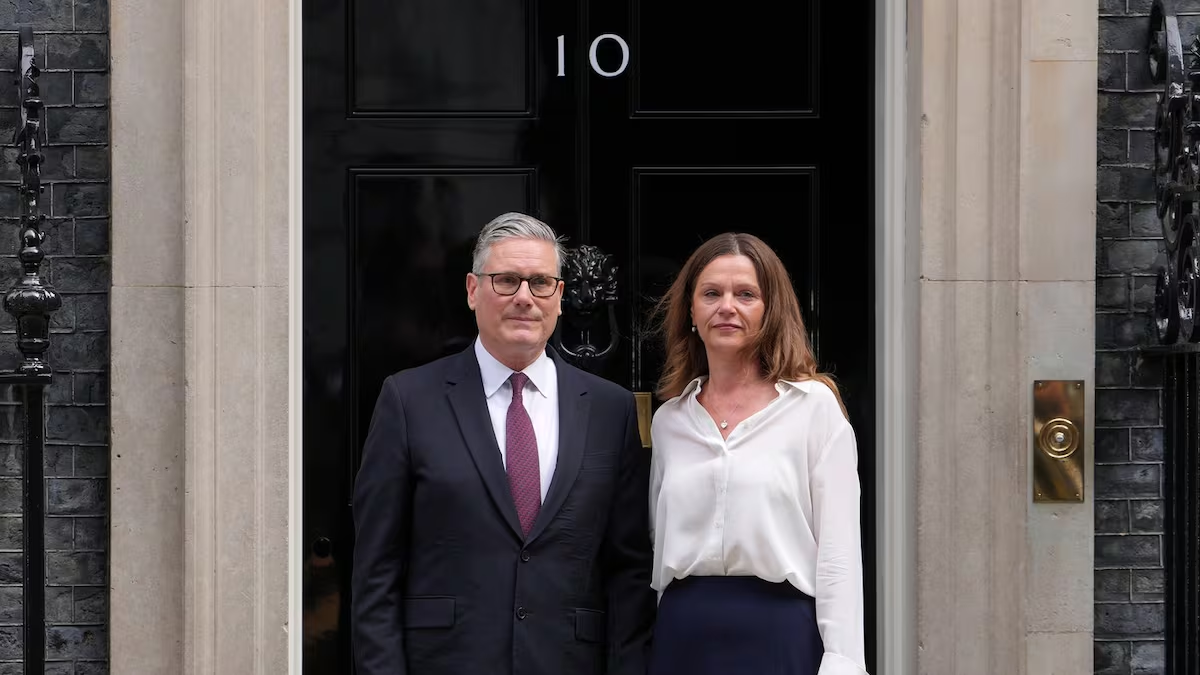
British Prime Minister Keir Starmer announced Monday that he will resign after mounting pressure from within his own Labour Party, bringing an abrupt end to a premiership that began with a landslide victory and high hopes of restoring stability and economic growth to the United Kingdom.
In an emotional statement outside 10 Downing Street, Starmer acknowledged that many members of his party no longer believed he was the right person to lead Labour into the next general election. Accepting that verdict, he said he would remain as caretaker prime minister until a new leader is chosen.
The surprise announcement has immediately propelled former Greater Manchester Mayor Andy Burnham to the forefront of the race to replace him. Burnham, who recently returned to Parliament after winning a special election, confirmed that he will seek the party leadership. His prospects received a major boost when former Health Secretary Wes Streeting, widely regarded as a potential rival, announced his support for Burnham, raising the possibility that Labour could avoid a lengthy leadership contest.
Starmer’s resignation makes him the sixth British prime minister in the past decade to leave office before completing a full term, underscoring the political turbulence that has gripped the country since the Brexit referendum. Ironically, his departure comes as Britain prepares to mark the tenth anniversary of the vote to leave the European Union, a decision that continues to shape the nation’s economy and politics.
Although Starmer led Labour to a sweeping victory in 2024, his government struggled to fulfil key promises on economic growth, public services and the rising cost of living. A series of political controversies and declining popularity weakened his standing, while Labour found itself squeezed by both the Greens on the left and Nigel Farage’s Reform UK, which has gained significant momentum in recent opinion polls.
Internationally, however, Starmer earned praise for his leadership on European security, particularly his support for Ukraine and his efforts to manage tensions arising from the conflict involving Iran. European leaders and Ukrainian President Volodymyr Zelenskyy were among those paying tribute to his role in strengthening cooperation and defending regional stability.
Across the Atlantic, U.S. President Donald Trump weighed in on the development, arguing that Starmer’s difficulties stemmed from his handling of immigration and energy policies.
Attention is now turning to Andy Burnham, who many within Labour see as a leader capable of reconnecting with voters and countering the rise of Reform UK. Supporters believe his experience and strong regional appeal could help revive the party’s fortunes, although analysts caution that a change in leadership alone may not guarantee a change in policy direction.
Labour nominations for the leadership will open in early July, with a new leader expected to be in place before Parliament returns in September. If Burnham faces no serious challenge, Britain could have a new prime minister within weeks, ushering in yet another chapter in the country’s remarkable decade of political upheaval.